Running a business involves legal decisions at nearly every stage, from choosing an ownership structure and negotiating contracts to purchasing property, bringing in new owners, resolving disputes, and planning for succession. Addressing those issues proactively can help business owners protect what they have built and make more informed decisions as their companies grow.
Winkelman Law Firm represents businesses, entrepreneurs, owners, and professionals in Hoquiam, throughout Grays Harbor County, and across surrounding Western Washington communities. Our Hoquiam business attorneys assist clients with transactional matters, contracts, business formation, ownership issues, commercial disputes, real estate concerns, and long-term succession planning.
Whether you are launching a new company, operating an established family business, considering a significant transaction, or confronting a dispute, our team provides practical legal guidance focused on the realities of operating a business.
Business law is rarely limited to one transaction or legal document. Decisions made when a company is formed can affect ownership rights years later. A contract negotiated today can determine what happens if a customer, vendor, landlord, or business partner fails to perform. An informal ownership arrangement can become a significant problem when an owner wants to leave the company.
Legal counsel can help business owners anticipate these issues rather than addressing them only after a conflict develops.
Winkelman Law Firm assists businesses with matters involving:
The appropriate legal strategy depends on the company, its owners, and the transaction or problem involved. A closely held family company may have very different priorities from a new entrepreneur, professional practice, or established company preparing for a sale.
Our Hoquiam business lawyers work to understand both the immediate legal issue and the larger business objective behind it. That perspective allows our team to provide advice designed around practical outcomes rather than treating each contract, transaction, or dispute as an isolated event.
Starting a business requires more than choosing a name and beginning operations. The legal structure selected at formation can affect ownership, management, liability, taxation, financing, and how the company may eventually be transferred or sold.
Washington businesses may operate through structures such as limited liability companies, corporations, partnerships, or sole proprietorships. The appropriate choice depends on the nature of the business and the goals of its owners.
Important formation considerations can include:
For businesses with multiple owners, internal agreements can be particularly important. Owners should understand their rights and responsibilities before a disagreement, departure, disability, or unexpected death puts those arrangements to the test.
Formation planning can also establish procedures for decision-making, ownership transfers, and other events that might otherwise create uncertainty.
Our Hoquiam business formation attorneys help entrepreneurs and owners evaluate entity structures and establish a stronger legal foundation for their companies. When tax or accounting questions influence the decision, legal planning can also be coordinated with the client's tax and financial professionals.

Contracts define many of the relationships that allow a business to operate.
Companies may rely on agreements with customers, vendors, contractors, landlords, lenders, business partners, purchasers, and other parties. When those agreements are unclear or incomplete, disputes can arise over obligations that could have been addressed before the contract was signed.
Depending on the business, commercial agreements may address:
A contract should reflect the actual transaction rather than simply contain standard legal language. Terms that make sense for one business relationship may create unnecessary risk in another.
Our Hoquiam business attorneys assist clients with drafting, reviewing, negotiating, and interpreting commercial agreements. We can help identify provisions that deserve additional attention, clarify responsibilities between the parties, and structure agreements around the client's business objectives.
Legal review can be particularly valuable before a significant agreement is signed. Addressing uncertainty during negotiations is often more practical than attempting to resolve competing interpretations after a dispute has developed.
Buying or selling a business can be one of the most significant transactions an owner undertakes. The transaction may involve far more than agreeing on a purchase price. Assets, liabilities, contracts, real estate, financing, ownership interests, and transition responsibilities can all affect how the deal should be structured.
Business transactions may involve the purchase or sale of company assets, ownership interests, or an entire operating business. Each structure can raise different legal and financial considerations.
Issues that may need to be addressed include:
Due diligence is also an important part of many transactions. Buyers should understand what they are acquiring, while sellers should know what representations and continuing obligations they are accepting as part of the sale.
Our Hoquiam business attorneys assist buyers and sellers with structuring, reviewing, and negotiating business transactions. Winkelman Law Firm can help clients identify legal issues before closing and develop agreements that clearly document the terms of the transaction.
A business with multiple owners needs clear rules for how important decisions will be made.
Those rules may be established through operating agreements, shareholder agreements, partnership agreements, bylaws, or other governing documents. The appropriate structure depends on the entity and ownership arrangement.
Governance documents may address:
These issues may seem remote when owners are working toward the same goals. Their importance becomes much clearer when circumstances change.
An owner may want to retire. Business partners may disagree about expansion, spending, or management. A family member may inherit an ownership interest. One owner may want to sell while another wants to continue operating the company.
Clear governance arrangements can provide a framework for handling these events.
Our Hoquiam corporate and business lawyers help owners establish and review agreements governing their relationships with one another. We also assist when existing documents need to be interpreted or revised as the company and its ownership structure evolve.
Businesses frequently need capital to acquire property, purchase equipment, expand operations, complete acquisitions, or manage other significant investments.
Financing arrangements can create substantial long-term obligations, making it important for owners to understand the legal terms before committing the company or themselves to a transaction.
Depending on the financing, documents may address:
Owners should pay particular attention when they are asked to personally guarantee a business obligation. An entity may ordinarily separate certain business liabilities from personal assets, but a personal guarantee can create direct obligations for the individual signing it.
Commercial transactions can also involve financing between buyers and sellers, installment arrangements, equipment purchases, or other negotiated payment structures.
Winkelman Law Firm assists Hoquiam and Grays Harbor County businesses with reviewing and documenting commercial transactions. Our attorneys help clients understand the legal obligations created by transaction documents and identify provisions that may affect future business decisions.
When a transaction also involves tax, accounting, or specialized financial considerations, our team can work alongside the client's other professional advisors so the legal structure supports the broader transaction.
Real estate can be central to a company's operations and long-term value.
A business may lease storefront, office, industrial, or professional space. Other companies purchase the property where they operate, acquire investment real estate, or hold land as an important business asset.
Commercial real estate issues can arise through:
Before entering a significant real estate transaction, business owners should understand both the property arrangement and how it affects the company.
For example, owners of closely held businesses may hold real estate separately from the operating company and lease it back to the business. That arrangement can create estate-planning and succession questions in addition to ordinary real estate concerns.
Commercial leases also deserve careful review. Rent is only one component of the relationship. Maintenance obligations, operating expenses, insurance, improvements, renewal rights, assignment provisions, and default terms can have significant consequences during a long-term tenancy.
Winkelman Law Firm's experience in both business law and real estate allows our Hoquiam attorneys to evaluate these issues together. We help business owners consider how real estate transactions and property arrangements fit into the company's operations, ownership structure, and long-term plans.
Business owners often spend years building a company without giving the same attention to how ownership or leadership will eventually change.
Succession planning addresses what happens when an owner retires, sells the company, transfers ownership to family members, becomes unable to participate in the business, or dies unexpectedly. Planning before a transition occurs gives owners more control over the outcome.
A business succession strategy may consider:
Closely held and family-owned companies can present additional challenges. The person best suited to manage the company may not be the only person the owner wants to benefit financially. Treating ownership, management, and inheritance as separate questions can provide greater flexibility.
Succession arrangements should also be coordinated with governing documents and the owner's personal estate plan. An intended transfer can become more complicated when an operating agreement, shareholder agreement, trust, or other legal arrangement points in a different direction.
Our Hoquiam business attorneys help owners consider succession before a transition becomes urgent. Winkelman Law Firm's experience in business law, estate planning, probate, and real estate allows our team to address the overlapping legal issues that frequently arise when ownership of a closely held business changes.
Even carefully managed businesses can encounter disputes.
Conflicts may develop between owners, customers, vendors, contractors, landlords, purchasers, sellers, or other parties. When a disagreement begins affecting operations, finances, property, or important business relationships, owners need to understand both their legal position and their practical options.
Business disputes may involve:
Litigation is one method of resolving a commercial dispute, but it is not the only one. Negotiation, mediation, and other forms of dispute resolution may provide a more efficient path in appropriate circumstances.
The right approach depends on what is at stake, the strength of the parties' legal positions, whether the business relationship needs to continue, and how quickly the matter needs to be resolved.
Our Hoquiam business litigation attorneys help clients evaluate disputes from both legal and commercial perspectives. When resolution outside court is possible, we can work toward negotiated solutions. When litigation becomes necessary, our team can advocate for the client's interests through the dispute-resolution process.
Not every business relationship lasts indefinitely.
Owners retire, pursue different opportunities, experience personal or financial changes, or develop disagreements about the future of the company. Sometimes one owner leaves while the business continues. In other circumstances, the company itself may need to wind down.
Ownership changes can raise questions about valuation, payment, company property, existing debts, contracts, management authority, and continuing obligations.
Depending on the circumstances, the process may involve:
Existing operating agreements, shareholder agreements, partnership agreements, or other governing documents can play an important role in determining how a departure or dissolution proceeds.
When owners disagree, the legal issues can become intertwined with financial and operational concerns. A dispute about ownership may affect employees, customers, property, and the ongoing value of the business.
Winkelman Law Firm helps Hoquiam business owners navigate ownership transitions and dissolution matters with attention to both immediate legal rights and the practical consequences for the company. Addressing these issues carefully can help create a clearer path forward for the owners and the business.
Legal needs do not end after a company is formed.
Established businesses regularly encounter contracts, ownership questions, real estate transactions, financing arrangements, potential disputes, and decisions that can have legal consequences long after a particular transaction is complete.
Having an attorney familiar with the business can make it easier to address those issues as they arise.
Ongoing legal counsel may help business owners:
Not every business decision requires extensive legal involvement. The value of ongoing counsel is having a resource available when a decision carries meaningful legal or financial consequences.
For businesses in Hoquiam and throughout Grays Harbor County, local counsel can also bring familiarity with the industries, property issues, closely held companies, and family-owned businesses that are important to the region.
Our Hoquiam business lawyers work with entrepreneurs and established companies at different stages of the business life cycle. Whether the issue involves a single transaction or an ongoing legal relationship, our team focuses on practical guidance that supports the client's business objectives.
Business owners need legal counsel that understands how contracts, ownership arrangements, real estate, disputes, and long-term planning can affect one another.
Winkelman Law Firm'sattorneys bring decades of combined legal experience to businesses, entrepreneurs, and owners in Hoquiam, throughout Grays Harbor County, and across surrounding Western Washington communities.
Founding shareholder Ben Winkelman's practice includes business law, general civil law, trial practice, real estate, estate planning, probate, and mediation. His more than 20 years of legal experience allows him to assist clients with both day-to-day business matters and larger transactions, disputes, and succession concerns.
Ryan M. Pesicka brings additional experience in business law, contracts, entity formation, corporate counsel, civil litigation, contract disputes, and real property matters. His background provides valuable perspective when business transactions develop into disputes or when legal decisions involve several areas of a company's operations.
Our Hoquiam business attorneys work to understand what the client is trying to accomplish before recommending a legal approach. Whether the matter involves starting a company, negotiating an agreement, completing a transaction, resolving an ownership dispute, or preparing for succession, our team provides practical counsel focused on protecting the business and supporting its long-term objectives.
Legal decisions made today can influence a business for years to come. Clear agreements, thoughtful planning, and timely legal guidance can help owners address risk while keeping their attention on operating and growing the company.
Winkelman Law Firm represents entrepreneurs, business owners, and established companies in Hoquiam and throughout Grays Harbor County.
Contact our Hoquiam business and corporate law attorneys to discuss your company's legal needs and how our team can help with business formation, contracts, transactions, ownership matters, disputes, real estate, or succession planning.
Reviewed for legal accuracy by Benjamin R Winkelman on October 18, 2026
For Hoquiam business law, we suggest keeping formation papers, ownership agreements and important contracts together. Include amendments and a current list of authorized decision-makers. We can use the complete records to evaluate a transaction rather than relying on an outdated summary of the company.
In Hoquiam business law, we check the legal name of the contracting party and the signer's intended capacity. A trade name may differ from the entity that owns the business. We review the proposed signature block alongside any personal guarantee instead of assuming a business heading answers the liability question.
Our Hoquiam business law review considers payment, termination, insurance and dispute provisions as well as the price. Identify any promises your operations may not be able to meet. We can assess the entire agreement before a signature turns a routine order into broader obligations.
For Hoquiam business law, we review which decisions require consent under the governing documents. A dated record can identify the decision, participants and authority relied upon. We help assess the appropriate process rather than assuming a casual conversation satisfies every approval requirement.
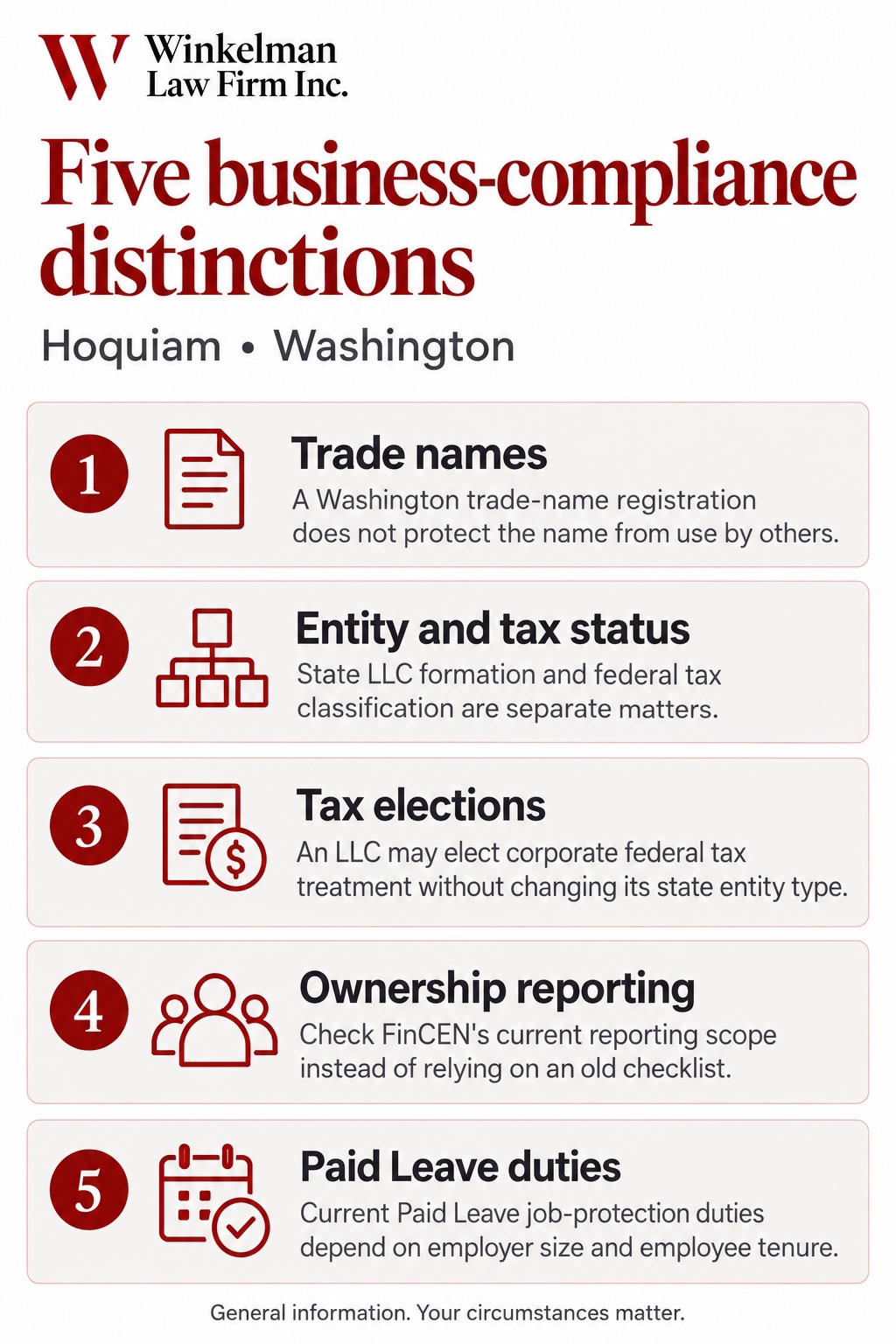
No. Washington's Department of Revenue explains that registering a trade name does not protect that name from use by others. Review trademark issues separately from the state business filing before committing to a name or brand. See Washington trade names and name protection.
An LLC is formed under state law but can have a different classification for federal tax purposes. IRS guidance explains the default classifications and the option to elect corporate treatment, so review the tax election separately from the Washington entity filing. See IRS LLC tax classification.
Check FinCEN's current reporting guidance rather than relying on an old checklist. Its current fact sheet exempts entities created in the United States and their beneficial owners, while certain foreign-formed entities registered to do business here remain subject to reporting requirements or exemptions. See FinCEN current BOI reporting scope.
Starting January 1, 2026, most Washington employers with at least 25 employees must provide job protection to eligible employees taking Paid Leave. The employee tenure requirement is generally 180 calendar days. Review the program's sizing, eligibility, notice and health-coverage rules rather than carrying forward the former 50-employee job-protection assumption. See Washington Paid Leave: 2026 job protection.
We assist clients with Hoquiam business law from our office in Hoquiam, Washington. You can contact us and mention your main concerns, any existing documents and upcoming dates. We can then discuss your circumstances and the next steps for a consultation.