Irrevocable trusts can serve important purposes in estate, wealth, tax, and asset protection planning, but they also require clients to accept greater restrictions than they would with a typical revocable trust. Understanding those consequences before transferring property is essential.
At Winkelman Law Firm, our Hoquiam irrevocable trust attorneys help individuals and families evaluate whether an irrevocable trust is appropriate for their objectives. We serve clients in Hoquiam, throughout Grays Harbor County, and across surrounding Western Washington communities.
Our lawyers approach irrevocable trust planning carefully. Rather than treating these trusts as universal solutions for protecting property or reducing taxes, we consider the client's assets, beneficiaries, long-term goals, and willingness to give up certain rights or control. When an irrevocable trust is appropriate, it should have a clearly defined purpose and fit within the client's broader estate plan.
An irrevocable trust is a trust arrangement that generally cannot be freely amended or revoked by the person who created it in the same manner as a revocable living trust. The specific rights retained by the person creating the trust depend on the trust terms and applicable law, but the greater limitations on control and modification are central features of irrevocable planning.
The person creating and transferring property to the trust is commonly called the settlor, grantor, or trustor. A trustee is responsible for managing trust property according to the trust document, and beneficiaries receive the benefits provided under its terms.
Depending on how the trust is structured, establishing an irrevocable trust can involve giving up significant rights over transferred property. That distinction can be necessary to accomplish certain planning objectives, but it also means the decision should not be made casually.
Irrevocable trusts may be considered in connection with goals involving:
The appropriate structure depends on the purpose the trust is intended to serve. Two irrevocable trusts can operate very differently because their terms, assets, trustees, beneficiaries, and planning objectives differ.
For Hoquiam residents considering an irrevocable trust, the starting question should therefore be what specific objective requires this type of arrangement?
Our Hoquiam irrevocable trust lawyers help clients answer that question before property is transferred or significant control is surrendered.
The most significant distinction between revocable and irrevocable trusts concerns the amount of control and flexibility retained by the person creating the trust.
With a typical revocable living trust, the settlor generally retains broad authority to amend or revoke the trust while legally able to do so. The settlor may also serve as trustee and continue exercising substantial control over trust property.
An irrevocable trust operates differently. Depending on its terms, the settlor may surrender rights to modify the arrangement, reclaim property, control trust assets, or determine how those assets are managed after the transfer. A separate trustee may have authority over property placed in the trust.
These differences can affect:
Neither structure is inherently better. They are designed to accomplish different objectives.
A Hoquiam family primarily interested in maintaining control, planning for incapacity, and establishing instructions for administration after death may find that a revocable living trust better fits its objectives. A client pursuing a specialized wealth-transfer, tax, or asset protection strategy may have reasons to consider an irrevocable arrangement.
The important point is that potential benefits associated with an irrevocable trust often arise precisely because the settlor has accepted restrictions that would not exist with a revocable trust.
Our attorneys help clients in Hoquiam and throughout Grays Harbor County understand that tradeoff before deciding which type of trust fits their estate planning goals.
An irrevocable trust should generally be created to accomplish a defined planning objective rather than simply because a client wants a more sophisticated estate plan.
For some individuals and families, irrevocable planning may provide options that are not available through a standard will or revocable living trust. The appropriate strategy depends on the property involved, the client's goals, applicable law, and the degree of control the client is prepared to relinquish.
Potential reasons for considering an irrevocable trust may include:
These objectives can overlap, but they should not be treated as guaranteed consequences of creating an irrevocable trust. For example, labeling a trust “irrevocable” does not automatically protect its assets from every creditor or remove those assets from consideration for every tax purpose.
The details of the arrangement matter.
Our Hoquiam irrevocable trust attorneys work with clients to identify the intended result first and then consider whether an irrevocable trust is an appropriate tool for pursuing it. For some clients, the potential planning advantages may justify accepting greater restrictions. For others, maintaining flexibility and control may be more important.
That analysis helps ensure that irrevocable trust planning serves a genuine purpose rather than adding unnecessary complexity to an estate plan.
Asset protection is one reason some clients begin exploring irrevocable trusts, but the relationship between the two requires careful analysis. An irrevocable trust does not automatically place property beyond the reach of every creditor or legal claim.
Certain irrevocable trust structures may be used as part of an asset protection strategy because the person transferring property gives up rights or control that would ordinarily exist with individually owned assets or a revocable trust. Whether a particular arrangement provides meaningful protection depends on factors such as the trust terms, the settlor's retained rights, the nature of the property, applicable law, and when the transfer occurs.
Timing can be particularly important. Asset protection planning is generally intended to address potential future risks before a specific creditor problem or claim arises. Transferring property after an obligation or dispute already exists can raise significant legal issues and should not be viewed as a way to place assets improperly beyond the reach of legitimate creditors.
Effective planning also requires considering what the client is giving up in exchange for potential protection. If an asset is transferred to an irrevocable trust, the settlor may no longer have the same ability to use, sell, reclaim, or control that property.
For some Hoquiam clients, an irrevocable trust may be one component of a broader strategy involving business interests, real estate, family wealth, or other significant assets. For others, a different planning approach may be more appropriate.
Our Hoquiam irrevocable trust attorneys help clients evaluate asset protection objectives before recommending a trust structure. The goal is to identify lawful planning strategies that fit the client's circumstances without overstating the protection any particular trust can provide.

Certain irrevocable trusts can also play a role in estate tax planning. Depending on how a trust is structured and funded, transferring property may affect how particular assets are treated for estate tax purposes.
This area is especially important for Washington residents because estate tax planning can involve both federal law and Washington law. The relevance of a particular strategy depends on factors such as the value and type of property involved, ownership arrangements, beneficiaries, lifetime transfers, and the client's broader estate plan.
An irrevocable trust may be considered when a client wants to pursue objectives involving:
However, creating an irrevocable trust does not automatically remove property from a taxable estate or generate tax savings. The settlor's retained rights, the trust provisions, the timing and nature of transfers, and applicable tax rules can all affect the result.
Tax considerations can also extend beyond estate taxes. Depending on the trust, transfers and ongoing administration may create income, gift, reporting, or other tax issues that should be evaluated as part of the planning process.
Our Hoquiam irrevocable trust lawyers help clients consider whether specialized trust planning fits their larger estate and wealth-transfer objectives. When tax planning is one of the goals, the trust should be evaluated as part of a coordinated strategy rather than treated as a stand-alone tax solution.
Selecting a trustee is an important decision in any trust plan, but it can take on additional significance when a trust is irrevocable.
Because the settlor may surrender substantial authority over transferred property, the trustee may have meaningful responsibility for managing assets, interpreting distribution provisions, communicating with beneficiaries, maintaining records, and carrying out the trust's terms.
When considering a trustee, Hoquiam residents should evaluate factors such as:
The appropriate trustee depends on the structure and purpose of the arrangement. A trusted family member may be appropriate in some circumstances, while other trusts may call for a different approach.
The decision should also account for successor trustees. An irrevocable trust may continue for many years, making it important to consider how administration will continue if the original trustee dies, resigns, or becomes unable to serve.
Our Hoquiam trust attorneys help clients consider trustee selection as part of the trust's overall design rather than treating it as an afterthought.
The term “irrevocable” can create the impression that a trust can never be changed under any circumstances. The reality is more nuanced.
Unlike a revocable living trust, an irrevocable trust generally does not give the settlor unrestricted authority to amend or cancel the arrangement. That loss of flexibility is one of the reasons clients should understand the consequences before creating and funding the trust.
However, the absence of a unilateral right to revoke does not necessarily mean modification or termination is impossible in every situation.
Depending on the trust terms, the people involved, and Washington law, there may be circumstances in which changes can be made through beneficiary and trustee action, court involvement, or other legally available procedures. The options can vary considerably from one trust to another.
Reasons someone might seek a modification can include:
Whether a particular change is permitted—and how it can be accomplished—requires review of the actual trust document and the circumstances surrounding the request.
This is an important distinction for Hoquiam residents considering irrevocable planning. A client should not create an irrevocable trust on the assumption that unwanted provisions can simply be rewritten later. At the same time, someone dealing with an existing irrevocable trust should not automatically assume there are no options when circumstances have materially changed.
Our Hoquiam irrevocable trust attorneys can review an existing trust, explain the restrictions established by its terms, and evaluate potential options under Washington law. Careful drafting at the outset remains important precisely because future flexibility can be more limited than it is with a revocable trust.
Transferring property to an irrevocable trust can have consequences that extend well beyond signing the trust document. Because the settlor may surrender important rights over the property, clients should understand both the intended benefits and the restrictions before completing a transfer.
One of the first questions is how much control the settlor is prepared to give up. Depending on the trust, the settlor may no longer have the unrestricted ability to reclaim, sell, transfer, or otherwise manage property after it has been placed in the trust.
Before establishing and funding an irrevocable trust, Hoquiam residents should consider:
The nature of the property itself can also influence the decision. Transferring real estate may present different considerations from transferring financial assets or an ownership interest in a closely held business. Business agreements, ownership restrictions, financing arrangements, and other obligations may need to be considered before certain property is transferred.
Long-term flexibility is equally important. A planning strategy that makes sense today should be evaluated in light of reasonably foreseeable changes involving family, finances, businesses, or property.
An irrevocable trust can be a powerful planning tool when its restrictions serve a deliberate purpose. It can also create unnecessary complications when established without a clear objective.
Our Hoquiam irrevocable trust lawyers help clients evaluate those tradeoffs before property is transferred. Careful planning at the beginning can help ensure that the trust's structure reflects the client's long-term goals and that the consequences of relinquishing control are understood.
Irrevocable trust planning requires careful consideration of property, control, beneficiaries, and long-term estate planning objectives. At Winkelman Law Firm, ourattorneys bring decades of combined legal experience to clients in Hoquiam, throughout Grays Harbor County, and beyond.
Founding shareholder Ben Winkelman has more than 20 years of legal experience, including work involving trusts, wills, estate planning, and probate. Associate attorney Ryan M. Pesicka also brings estate planning experience along with a broader background involving business and civil matters.
Our Hoquiam irrevocable trust attorneys focus on the purpose behind the proposed arrangement before recommending a particular strategy. We help clients understand the potential advantages, restrictions, and long-term consequences so they can make informed decisions about their property and estate plans.
When an irrevocable trust is appropriate, our team works to develop a structure aligned with the client's specific planning objectives rather than applying a one-size-fits-all solution.
If you are considering an irrevocable trust, understanding the consequences before transferring property is essential.
Winkelman Law Firm helps individuals and families in Hoquiam, throughout Grays Harbor County, and across surrounding Western Washington communities evaluate irrevocable trusts as part of their broader estate plans.
To discuss creating an irrevocable trust or reviewing an existing arrangement,contact our Hoquiam irrevocable trust attorneys to schedule an appointment. Our lawyers can help you evaluate your objectives, understand your options, and determine whether an irrevocable trust is appropriate for your circumstances.
Reviewed for legal accuracy by Benjamin R Winkelman on October 18, 2026
We suggest keeping ownership documents, value information and any loan restrictions when planning Hoquiam irrevocable trusts. Those records help identify what is being transferred and which approvals may matter. We review the proposed transfer before treating a signed trust as authority to move every asset.
For Hoquiam irrevocable trusts, we begin with the trust's distribution terms and the beneficiary's actual circumstances. A written request can identify the purpose, amount and supporting expenses without assuming payment is automatic. We can help clarify what the trustee needs to evaluate while preserving a useful record of the request.
Our review of Hoquiam irrevocable trusts includes how expenses and reimbursements are recorded. Receipts, payment records and a note of the trust-related purpose help separate administration costs from personal spending. We can evaluate questions about a particular expense against the trust and the trustee's responsibilities.
We recommend assembling the complete document history before making decisions about Hoquiam irrevocable trusts. An older copy may omit a later change or related court order. We can help identify missing records and assess which documents need review before anyone relies on an incomplete set.
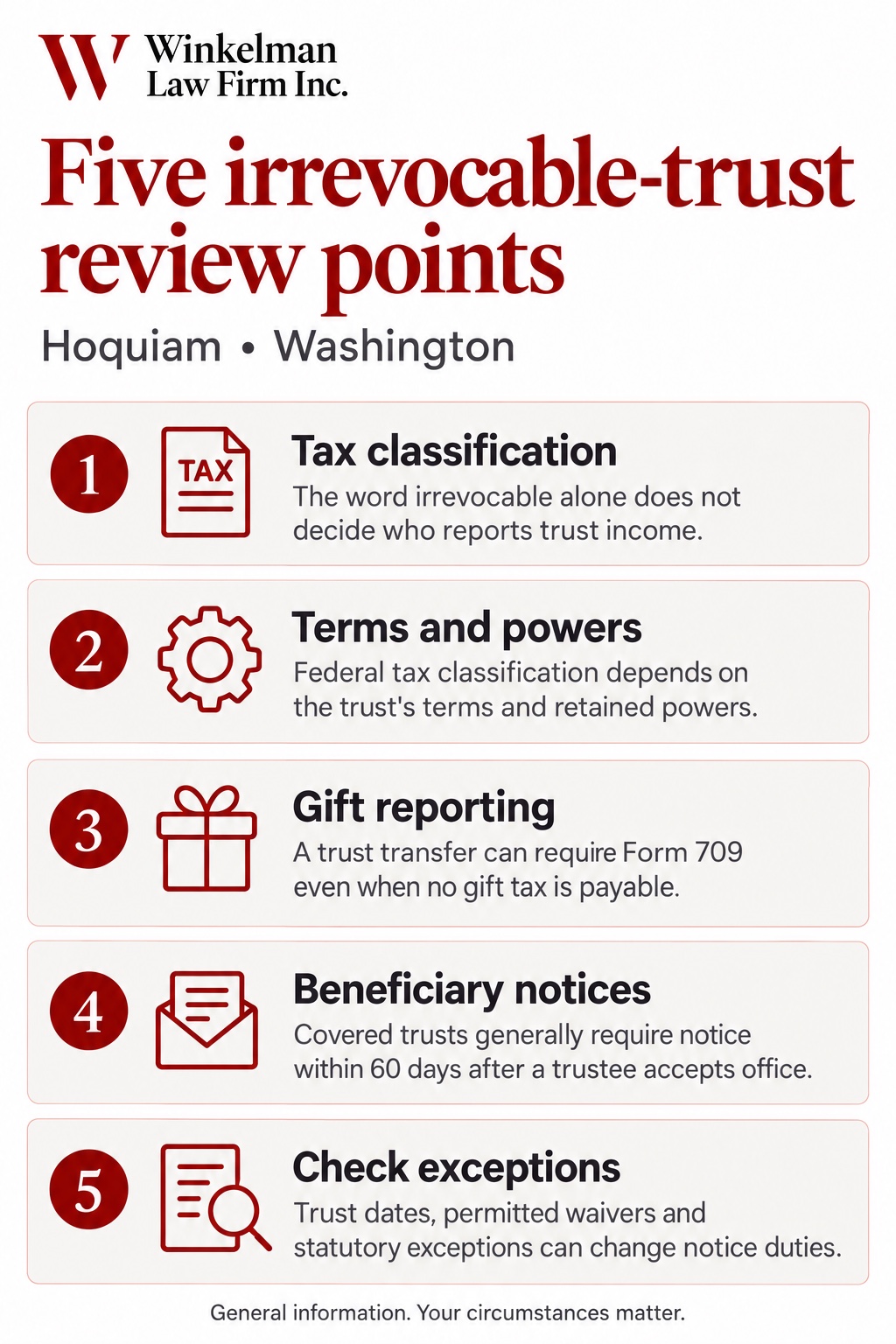
No. An irrevocable trust can be classified as a grantor trust, simple trust or complex trust for federal income-tax purposes, depending on its terms and retained powers. Have the reporting obligations reviewed separately from the document's revocability label. See IRS trust tax classifications.
Yes. Federal gift-tax reporting and an immediate tax payment are separate questions, and a transfer to a trust can require Form 709 even when available exclusions or credit eliminate tax due. Review the transferred interest and applicable filing rules before assuming that no payment means no return. See IRS Form 709 instructions.
Washington law generally requires notice to qualified beneficiaries within sixty days after a trustee accepts office for covered irrevocable trusts. The trust's date, permitted waivers and statutory exceptions matter, so review the document and the particular beneficiaries before preparing notices. See RCW 11.98.072: Trustee notification.
No. The 2026 estate-and-trust schedule reaches its 37% ordinary-income bracket above $16,000 of taxable income. Whether a trust uses that schedule or reports income to another taxpayer requires review of its actual tax classification. See IRS Revenue Procedure 2025-32: 2026 estate-and-trust brackets.
We assist clients with Hoquiam irrevocable trusts from our office in Hoquiam, Washington. You can contact us and mention your main concerns, any existing documents and upcoming dates. We can then discuss your circumstances and the next steps for a consultation.