Divorce can require decisions about children, property, finances, support, and the future of a household at a time when personal circumstances may already feel uncertain. Understanding the legal process and identifying the issues that need to be resolved can make those decisions more manageable.
Winkelman Law Firm represents individuals facing divorce in Hoquiam, throughout Grays Harbor County, and across surrounding Western Washington communities. Our Hoquiam divorce attorneys help clients understand their rights and responsibilities, evaluate potential agreements, and address contested issues when spouses cannot reach a resolution on their own.
Whether a divorce involves relatively straightforward finances or complex questions about parenting, real estate, retirement assets, or a closely held business, our lawyers focus on practical strategies designed around the client's circumstances and priorities.
Washington refers to divorce legally as a dissolution of marriage. The process formally begins when a petition for dissolution is filed with the court. From there, the steps required to reach a final divorce depend substantially on whether the spouses agree on the major issues and whether temporary disputes need to be addressed while the case is pending.
A Washington divorce may involve several stages, including:
Washington is a no-fault divorce state. A spouse generally does not need to prove misconduct or wrongdoing by the other spouse to obtain a divorce. Instead, the marriage must be considered irretrievably broken.
That does not mean every Washington divorce is simple. Even when both spouses agree that the marriage should end, they may disagree about what happens next.
Parents may have different views about residential schedules or decision-making. Spouses may disagree about whether property is separate or community property, how assets should be valued, who should remain in the family home, how debts should be allocated, or whether maintenance should be paid.
Our Hoquiam divorce lawyers help clients identify these issues early and understand how each one fits into the larger dissolution process. Establishing a clear picture of the property, finances, parenting concerns, and disputed questions can help determine whether the case is positioned for settlement or requires more formal court involvement.
The difference between a contested and uncontested divorce generally comes down to whether the spouses can reach agreement on the issues that must be resolved before the marriage can be dissolved.
In an uncontested divorce, the spouses are able to agree on the necessary terms. Depending on the circumstances, those terms may address property and debts, parenting arrangements, child support, spousal maintenance, and other financial responsibilities.
An uncontested divorce can reduce the number of issues requiring court intervention, but agreement should still be approached carefully. Final divorce orders can have significant and lasting consequences, and terms that appear workable today may create problems later if important details have been overlooked.
A contested divorce occurs when the spouses cannot agree on one or more significant issues. Common disagreements involve:
A contested divorce does not necessarily mean the case will proceed all the way to trial. Spouses may resolve some issues through direct negotiation between their attorneys, mediation, or settlement discussions while asking the court to decide only the matters that remain disputed.
Likewise, a divorce that begins cooperatively can become contested if disagreements emerge as financial information is exchanged or specific terms are discussed.
Our Hoquiam divorce attorneys evaluate each case based on the actual issues rather than assuming that one approach fits every family. When a reasonable agreement can be reached, our team can help clients document that resolution appropriately. When significant disagreements remain, we are prepared to advocate for the client's interests through the contested divorce process.
A divorce legally ends a marriage, but the final orders may need to resolve several separate issues before the spouses can fully move forward.
The specific questions depend on the family. A couple without children and with limited shared property may have fewer issues to address than spouses who have been married for decades, are raising children, own real estate, or have accumulated significant retirement or business assets.
Common divorce issues include:
These issues should not always be evaluated independently. A proposed property division, for example, can affect each spouse's post-divorce financial circumstances. Parenting arrangements may affect transportation, housing, work schedules, and expenses. Business ownership can raise both property-division and valuation concerns.
Complete financial information is particularly important. Before agreeing to a division of property or responsibility for debts, spouses should have a reasonable understanding of what assets and obligations exist and how proposed terms may affect them after divorce.
Our Hoquiam divorce lawyers help clients evaluate the individual issues as well as how those decisions work together. The objective is to reach final orders that resolve the legal case while accounting for the practical circumstances clients will face after the divorce is complete.
When parents divorce, ending the marriage is only one part of the legal process. They must also establish arrangements addressing where their children will live, how parenting time will be structured, how significant decisions will be made, and how the children's financial needs will be supported.
Washington parenting plans provide the framework for many of these arrangements. Depending on the family's circumstances, a parenting plan may address residential schedules, holidays and school breaks, transportation between households, decision-making responsibilities, and methods for resolving future disagreements.
Parents may agree on many of these terms, or significant disputes may arise about what arrangements are appropriate.
Divorce involving children can require consideration of:
Parenting arrangements should also be practical. Work schedules, school locations, transportation, children's activities, and the distance between households can all affect whether a proposed schedule will function in everyday life.
Our Hoquiam divorce attorneys help parents evaluate parenting arrangements within the broader divorce process. When parents can reach appropriate agreements, our lawyers can help ensure those terms are properly incorporated into the final orders. When parenting issues remain contested, we advocate for our clients while maintaining focus on the legal standards and circumstances affecting the children.

Property division can shape each spouse's financial position for years after a divorce. Washington courts make a just and equitable distribution of property and liabilities after considering the circumstances required by state law. This does not necessarily mean every asset and debt will simply be divided equally.
Before property can be divided appropriately, the spouses need to understand what they own, what they owe, and which assets may require additional analysis.
A marital estate may include:
Questions can become more complicated when separate and community finances have been mixed or when an asset has changed substantially during the marriage. Businesses, real estate, retirement benefits, and other significant assets may also raise valuation or characterization issues.
Property negotiations should consider more than the stated value of individual assets. The practical consequences of keeping a home, assuming particular debts, receiving retirement assets, or retaining an interest in a business can differ considerably.
Our Hoquiam divorce lawyers help clients identify property and debt issues, evaluate proposed divisions, and address disputes over ownership, characterization, or value. Winkelman Law Firm's broader experience with business and real estate matters can also be useful when a divorce involves assets that require analysis beyond routine household property.
Spousal maintenance, also commonly called alimony or spousal support, may be an issue when spouses have different financial resources or earning circumstances.
Washington does not automatically award maintenance in every divorce. Courts consider legally relevant circumstances when determining whether maintenance should be awarded and, when appropriate, its amount and duration.
A maintenance dispute may involve the spouses' financial resources, earning abilities, age and circumstances, the length of the marriage, the standard of living established during the marriage, and whether a spouse needs time for education or training.
The financial picture should be considered as a whole. Property division, housing expenses, income, debt obligations, and other financial responsibilities can all affect each spouse's circumstances following divorce.
Maintenance may also become an issue while the divorce is still pending. Temporary financial arrangements can differ from the terms ultimately included in final divorce orders.
Our Hoquiam divorce attorneys represent clients requesting maintenance as well as those responding to maintenance requests. We evaluate the financial information involved, the circumstances of the marriage, and how a proposed support arrangement fits with the other financial issues being resolved in the divorce.
A divorce may take time to complete, but families often need workable arrangements before final orders can be entered. Temporary orders can address certain immediate issues while the divorce remains pending.
The matters requiring temporary resolution depend on the family. Parents may need a schedule establishing where children will reside during the case. One spouse may need temporary financial support. Questions may arise about who remains in the family home, who pays particular expenses, or how property should be handled while longer-term issues are being resolved.
Temporary orders may address matters such as:
Temporary arrangements are important because the parties still need to manage daily responsibilities while the divorce proceeds. A clear interim structure can reduce uncertainty about parenting, finances, and household obligations.
At the same time, temporary orders are not a substitute for carefully addressing the final terms of the divorce. The issues ultimately resolved in final orders may require additional information, negotiation, mediation, or court proceedings.
For clients in Hoquiam and throughout Grays Harbor County, our divorce lawyers can evaluate whether temporary relief is appropriate and help identify which issues need immediate attention. We also consider temporary requests in the context of the client's broader divorce strategy so that short-term decisions do not unnecessarily complicate the issues that still need to be resolved.
Divorce and legal separation can address many of the same issues, but they do not have the same legal result.
A divorce ends the marriage. A legal separation allows spouses to remain legally married while obtaining court orders addressing issues that may include property, debts, parenting arrangements, child support, and spousal maintenance.
Couples may consider legal separation for different personal, financial, or practical reasons. In other situations, divorce is the more appropriate path because the spouses intend to permanently end the marriage and establish separate legal and financial lives.
The decision deserves careful consideration because choosing legal separation does not eliminate the need to address significant issues between the spouses. Depending on the circumstances, many of the same questions that arise during divorce may still need to be resolved.
For spouses with children, that can include parenting plans and child support. Couples may also need to address real estate, retirement assets, debts, business interests, and maintenance.
Our Hoquiam divorce attorneys help clients understand the practical and legal differences between dissolution and legal separation. We can evaluate the client's objectives, explain the issues that may need to be resolved under either approach, and help determine how to proceed based on the circumstances.
Many divorces are resolved without requiring a judge to decide every disputed issue at trial. Negotiation, mediation, and other settlement efforts can allow spouses to reach agreements concerning some or all of the terms of their divorce.
Settlement can be particularly valuable when spouses want greater involvement in developing parenting, property, or financial arrangements that will affect their lives after the case ends.
Reaching an agreement does not require spouses to agree initially on every issue. Attorneys may help narrow disagreements, exchange proposals, identify potential compromises, and determine whether mediation could help resolve remaining disputes.
Some cases, however, involve issues that cannot be settled on acceptable terms. Significant disagreements over children, property, support, finances, or other matters may require court intervention.
Our Hoquiam divorce lawyers approach settlement and litigation as tools rather than predetermined outcomes. Ben Winkelman's experience includes family law, mediation, and trial practice, allowing our team to pursue negotiated resolutions when appropriate while remaining prepared to advocate in court when contested issues require judicial resolution.
Divorce can involve family law, financial issues, real estate, business interests, and courtroom advocacy within the same case. Experienced legal counsel can help clients understand how those issues interact and make informed decisions throughout the process.
Winkelman Law Firm'sattorneys bring decades of combined legal experience to clients in Hoquiam and throughout Grays Harbor County.
Founding shareholder Ben Winkelman has more than 20 years of legal experience, including work involving family law, trial practice, and mediation. His background includes service on the Washington State Bar Family Law Section Executive Committee from 2007 through 2013, including serving as chair. He also received a CALI Excellence for the Future Award in Family Law.
Associate attorney Ryan M. Pesicka brings additional family law and litigation experience, including handling family law matters in Grays Harbor County before joining Winkelman Law Firm.
Our Hoquiam divorce attorneys combine that experience with a practical approach tailored to each client's circumstances. Whether a divorce can be resolved through agreement or involves substantial contested issues, our team focuses on protecting the client's interests and working toward clear, durable final orders.
Divorce can affect your children, home, property, finances, and plans for the future. Understanding your legal options early can help you approach those decisions with greater clarity.
Winkelman Law Firm represents clients in Hoquiam, throughout Grays Harbor County, and across surrounding Western Washington communities in contested and uncontested divorces.
If you are considering divorce, have been served with divorce papers, or need representation in an ongoing case,contact our Hoquiam divorce attorneys to schedule an appointment. Our team can evaluate your circumstances, explain the issues ahead, and help you determine the appropriate path forward.
Reviewed for legal accuracy by Benjamin R Winkelman on October 18, 2026
For a Hoquiam divorce, we suggest preserving statements and records you are legally entitled to access. Keep the account names and dates organized rather than relying on a balance shown on one screen. We can discuss appropriate ways to obtain missing information without accessing someone else's private account.
In a Hoquiam divorce, we review the proposed division alongside income, housing costs and continuing debts. A list of assets alone may not show how a household will meet ordinary expenses. We can identify questions about cash flow, timing and taxes before you decide whether proposed terms are workable.
We ask clients in a Hoquiam divorce to keep the complete packet, including notices and attachments. The date and method of service can matter to the procedural review. We can evaluate the required response from the actual papers rather than a summary of what another person says they mean.
For a Hoquiam divorce, we review the plan type and the documents needed to implement the proposed division. Certain employer retirement plans require a qualified domestic relations order that meets federal and plan requirements. We can coordinate that issue with the settlement instead of assuming a general award automatically moves the funds.
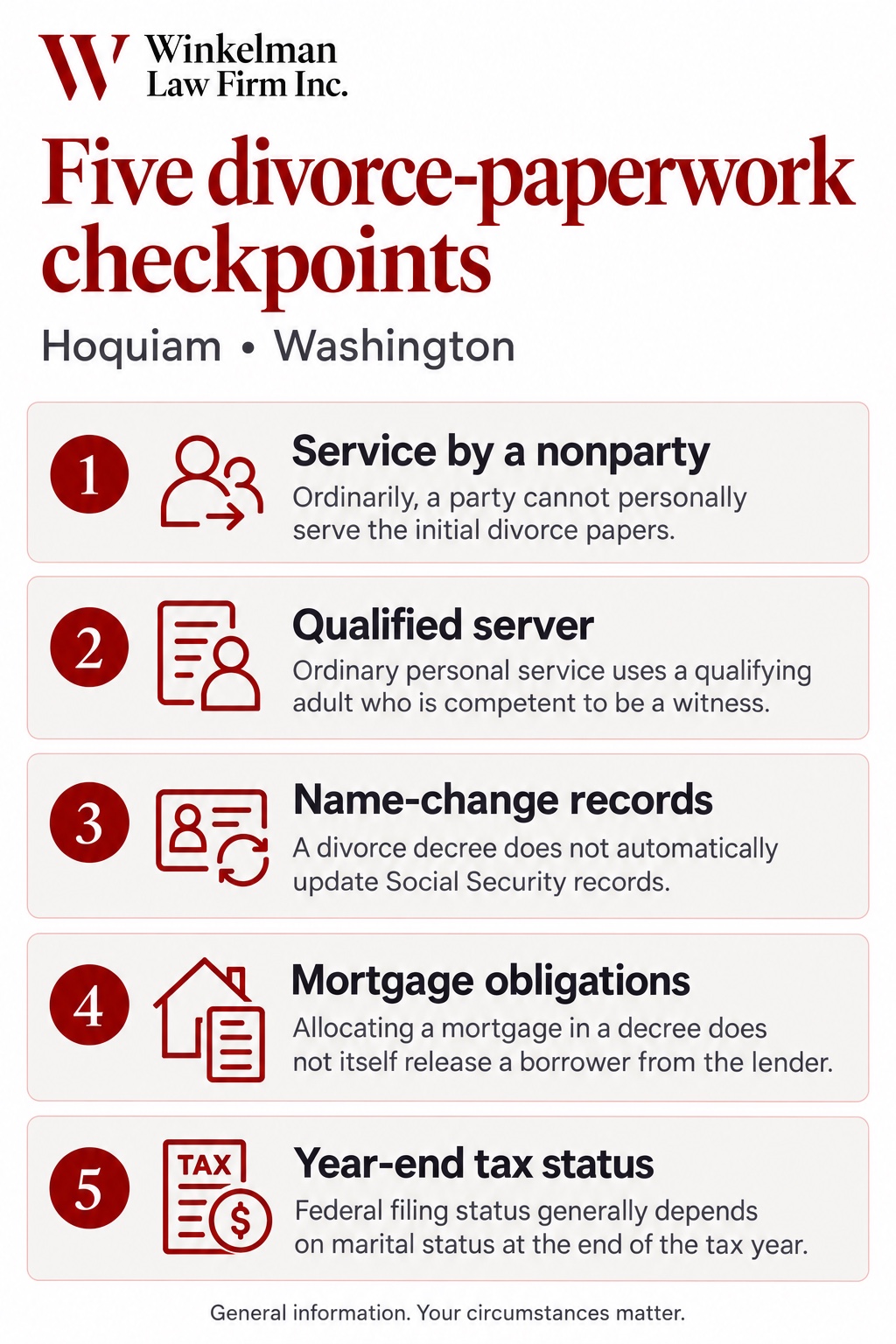
Ordinarily, a party cannot personally serve the summons and initial papers. Washington Civil Rule 4 permits service by a sheriff or another qualifying person over eighteen who is competent to be a witness and is not a party, with separate rules for alternative service. See Washington Civil Rule 4: Service.
No. Social Security requires you to report a legal name change and provide the required evidence for its records. Keep an appropriate copy of the divorce order and follow the agency's current application process. See Social Security name changes.
Generally, a divorce decree allocating the mortgage does not itself release a borrower from the lender's contract. A creditor release, qualifying refinancing or another lender-approved arrangement may still be necessary, so coordinate the decree with the loan documents. See CFPB: Debt obligations after divorce.
Federal filing status generally depends on marital status at the end of the tax year, with additional rules for particular filing categories. A divorce or qualifying legal separation by December 31, 2026, can affect the 2026 return filed afterward. Coordinate the court timeline and tax review instead of assuming the filing date controls. See IRS: Divorce & Taxes Checklist.
We assist clients with Hoquiam divorce from our office in Hoquiam, Washington. You can contact us and mention your main concerns, any existing documents and upcoming dates. We can then discuss your circumstances and the next steps for a consultation.