Building wealth often takes decades. Transferring it successfully to the next generation requires more than deciding who receives particular assets. Families may need to consider how property will be managed, when beneficiaries should receive control, how a business will continue, and how different parts of an estate plan work together.
Winkelman Law Firm helps individuals, families, and business owners in Hoquiam, throughout Grays Harbor County, and across surrounding Western Washington communities develop thoughtful strategies for family wealth, legacy, and succession planning.
Our Hoquiam estate planning attorneys help clients look beyond individual documents and consider the larger purpose of their planning. Whether the goal is preserving family property, transferring a business, providing for children and grandchildren, or creating a lasting inheritance strategy, we work to develop plans that reflect both current circumstances and long-term objectives.
Family wealth planning takes a broader view of what a person wants to accomplish with the assets accumulated during a lifetime.
A traditional estate plan may establish who receives property and who is responsible for administering the estate. Legacy planning builds on those decisions by considering how wealth should move between generations, whether assets require continued management, and what structures can help carry out the family's long-term objectives.
Depending on the family, planning may involve:
The appropriate strategy depends on the assets involved and what the client wants those assets to accomplish.
Some people want their children to receive property outright. Others want assets managed in trust for a period of time. A business owner may be concerned with preserving an operating company rather than simply dividing its value among beneficiaries. A blended family may need to balance providing for a surviving spouse with preserving an inheritance for children.
Our Hoquiam family wealth planning attorneys help clients identify these objectives before deciding which legal tools should be used. Starting with the family's goals rather than a predetermined set of documents can produce a more cohesive plan.
Deciding who should inherit is only one part of planning for the next generation. Families should also consider when beneficiaries will receive property, how assets will be managed, and whether different beneficiaries require different approaches.
An outright inheritance may be appropriate in some circumstances. In others, continued management through a trust may better reflect the family's objectives.
Questions worth considering include:
Equal treatment also does not always require identical assets. One child may be involved in a family business while another is not. Certain property may have sentimental or practical importance that makes an equal physical division difficult.
These decisions should be made intentionally rather than left to beneficiaries to resolve after death.
Our Hoquiam legacy planning attorneys help families consider both the transfer of wealth and the responsibilities that accompany it. A well-designed succession strategy can provide clearer direction for beneficiaries and future decision-makers while keeping the plan centered on the client's priorities.
Trusts can provide flexibility when a family wants more control over how wealth is managed and transferred.
Rather than requiring every asset to pass directly to a beneficiary, a trust can establish terms for continued management and distribution. The appropriate structure depends on the purpose of the trust, the property involved, and the needs of the beneficiaries.
Trust planning may be useful when families want to:
Selecting a trustee is an important part of the process. The trustee may be responsible for managing property, administering distributions, maintaining records, and carrying out the terms established by the person creating the trust.
Trusts should also be coordinated with the assets they are intended to hold or receive. Creating a trust without considering ownership, beneficiary designations, and other transfer arrangements can leave important parts of the plan disconnected.
Our Hoquiam trust and legacy planning attorneys help clients determine when trust-based planning fits their family wealth objectives. The goal is not to create complexity unnecessarily, but to use the appropriate structure when continued management, controlled distributions, or multigenerational planning calls for more than an outright transfer.
Real estate often represents both substantial financial value and personal significance. A family home, vacation property, timberland, rental property, or other real estate may have been held for decades and may be an important part of the legacy a client wants to leave.
Passing that property to the next generation requires careful planning.
Leaving a property equally to several beneficiaries may appear straightforward, but shared ownership can create practical questions. One beneficiary may want to keep the property while another wants to sell. Family members may disagree about maintenance, expenses, improvements, or future use.
Planning ahead allows clients to consider issues such as:
Similar considerations can apply to valuable personal property and other assets that cannot easily be divided.
Our Hoquiam legacy planning attorneys help families consider how significant assets fit within the larger estate and succession plan. Thoughtful planning can provide clearer direction and reduce the number of important ownership decisions beneficiaries must make during estate administration.
For many business owners, the company is one of the family's largest assets and an important part of the owner's legacy.
Transferring a business requires planning for both ownership and operation. The person who should inherit an economic interest in a company is not necessarily the person who should manage it.
A succession strategy may need to address:
These questions become especially important when some children participate in the company and others do not. Simply dividing ownership equally may not produce the outcome the owner intended.
Succession planning also should not wait until retirement is imminent. Unexpected illness, incapacity, or death can force a transition before a family or company is prepared.
Winkelman Law Firm helps business owners in Hoquiam and throughout Grays Harbor County coordinate business succession with their personal estate and legacy planning. By considering ownership, family objectives, and estate planning together, our attorneys can help clients establish clearer plans for what happens to the business when leadership or ownership eventually changes.
Family wealth planning can extend beyond the people who are immediate beneficiaries today.
Parents and grandparents may want to create a structure that benefits children, grandchildren, or later generations while preserving flexibility for circumstances that cannot be predicted decades in advance.
Planning for younger beneficiaries may involve deciding who will manage inherited assets and when a beneficiary should receive control. An inheritance appropriate for a financially established adult may require a different structure when the beneficiary is a minor or young adult.
Families may also have different goals for different assets. Some property may be intended to provide immediate support, while other assets may be preserved for education, housing, long-term financial security, or future generations.
Effective planning considers questions such as:
There is no single structure that works for every family.
Our Hoquiam family wealth planning attorneys help clients determine how much control and flexibility their plans should provide. The objective is to create a strategy that reflects the family's values and circumstances while providing practical instructions for the people who will eventually administer the plan.
Blended families can present particularly important legacy-planning decisions.
A person may want to provide financial security for a current spouse while also preserving an inheritance for children from a previous relationship. Without deliberate planning, those goals may conflict.
For example, leaving everything outright to a surviving spouse gives that spouse control over the inherited property. The surviving spouse's later estate plan may not necessarily distribute those assets to the first spouse's children.
On the other hand, a plan focused entirely on children may fail to provide the level of support the client intended for a surviving spouse.
Planning strategies can be designed to balance these interests. Depending on the circumstances, that may involve trusts, carefully structured distributions, beneficiary designations, property arrangements, or other estate-planning tools.
Blended-family planning should also account for assets owned separately before the marriage, jointly acquired property, real estate, retirement accounts, business interests, and existing obligations or agreements.
Clear planning can be especially valuable when family relationships are complex or when significant assets were accumulated before a later marriage.
Our Hoquiam legacy planning attorneys help clients examine these competing objectives directly. Rather than leaving important questions unresolved, Winkelman Law Firm works with clients to establish a plan that clearly reflects how they want to provide for a spouse, children, stepchildren, and other beneficiaries.
A legacy plan depends on people as well as documents.
Personal representatives, trustees, agents under powers of attorney, and business successors may eventually be responsible for significant financial and legal decisions. Choosing the right people for these roles can be just as important as determining who receives the property.
Clients should consider whether a proposed decision-maker has the time, judgment, organizational ability, and willingness to serve. Geographic location, family relationships, financial experience, and potential conflicts may also influence the decision.
Appropriate communication can help prepare family members for future responsibilities. This does not necessarily mean disclosing every financial detail or providing beneficiaries with complete control over planning decisions. It can mean making sure important people know that a plan exists, understand the role they may be asked to perform, and know where essential information can be found.
Selections should also be reviewed over time. A person who was an appropriate trustee or personal representative 15 years ago may no longer be the best choice.
Our Hoquiam succession planning attorneys help clients think carefully about who will carry out their plans and how those responsibilities fit together. Clear roles and thoughtful selections can make an eventual transition easier for both beneficiaries and the people responsible for administering family wealth.
Family wealth rarely exists in a single form. A client may own a residence, retirement accounts, investments, business interests, insurance policies, and other property, each of which may be transferred or managed differently.
Effective legacy planning considers how those pieces interact.
Estate documents should be coordinated with asset ownership and beneficiary designations. Business succession arrangements should support the owner's broader inheritance objectives. Trust planning should account for the assets intended to fund the trust. When tax considerations are significant, the legal strategy should also be developed with those potential consequences in mind and coordinated with appropriate tax and financial professionals.
This becomes increasingly important as estates become more complex.
A strategy that works for a family with relatively straightforward assets may no longer be appropriate after business growth, significant investment gains, an inheritance, or the acquisition of substantial real estate.
Winkelman Law Firm helps Hoquiam families take a coordinated view of these issues. Our attorneys can address the legal components of estate and succession planning while helping clients identify areas where coordination with accountants, financial professionals, insurance advisors, or other professionals may be appropriate.
The goal is a strategy in which the different components of the family's planning support one another rather than operate independently.
A legacy plan should be capable of changing as the family changes.
Over time, children become adults, grandchildren are born, businesses grow or are sold, real estate is acquired, relationships change, and the people originally selected for important responsibilities may no longer be appropriate.
Changes in wealth can also alter planning priorities. A family that once needed a relatively simple estate plan may later own substantial investments, multiple properties, or business interests that require a more coordinated succession strategy.
Reviewing a plan after major life or financial events provides an opportunity to determine whether the existing structure still reflects the client's intentions.
That review may involve beneficiary provisions, fiduciary selections, trusts, business succession arrangements, asset ownership, or other elements of the overall strategy.
Our Hoquiam attorneys help families evaluate whether their existing plans remain aligned with current circumstances and long-term goals. This ongoing approach to wealth stewardship can help preserve the usefulness of a carefully designed legacy plan as life continues to change.
Family wealth and succession planning can involve much more than drafting a will. Real estate, businesses, trusts, probate considerations, family relationships, and long-term ownership questions can all become part of the same strategy.
Winkelman Law Firm'sattorneys bring decades of combined legal experience to clients in Hoquiam, throughout Grays Harbor County, and across surrounding Western Washington communities.
Founding shareholder Ben Winkelman's practice includes wills, trusts and estate planning, probate, business law, real estate, family law, and mediation. His more than 20 years of legal experience provides a broad perspective for families whose planning involves several types of property or overlapping legal considerations.
Ryan M. Pesicka adds experience in estate planning, business law, contracts, entity formation, real property, and civil litigation.
Our team works with clients to understand what they have built, who they want to benefit, and how they want important assets and responsibilities handled in the future. From family property and trusts to closely held businesses and multigenerational planning, we help clients develop legal strategies around their individual priorities.
The wealth, property, and businesses accumulated during a lifetime deserve a plan that reflects what you want them to accomplish for the people who come after you.
Winkelman Law Firm helps individuals, families, and business owners create thoughtful strategies for transferring assets, preserving family property, preparing for succession, and establishing a lasting legacy.
Contact our Hoquiam family wealth and succession planning attorneys to schedule an appointment with our team. We serve clients in Hoquiam, throughout Grays Harbor County, and across surrounding Western Washington communities.
Reviewed for legal accuracy by Benjamin R Winkelman on October 18, 2026
For Hoquiam family wealth planning, a separate letter can explain the personal meaning of a business, property or keepsake. It should be clear which statements express hopes and which legal documents govern the transfer. We can review that distinction so an explanatory letter does not create uncertainty about your formal instructions.
In Hoquiam family wealth planning, we suggest separating ownership, management, employment and inheritance questions. A written agenda can help identify which expectations are shared and which remain unresolved. We can evaluate the legal documents after those issues are identified rather than assuming a family conversation changes existing agreements.
Our Hoquiam family wealth planning includes reviewing prior transfers and your current intentions about future inheritances. Keep dates, values and any written explanation of whether a transfer was a gift or loan. We can assess how those records fit the plan before treating earlier assistance as an automatic adjustment to a later inheritance.
For Hoquiam family wealth planning, we ask about title, expenses, maintenance and the family's expectations for use. Different relatives may envision different arrangements for the same property. We can explore how the legal plan should address decision-making and future exits before a transfer is completed.
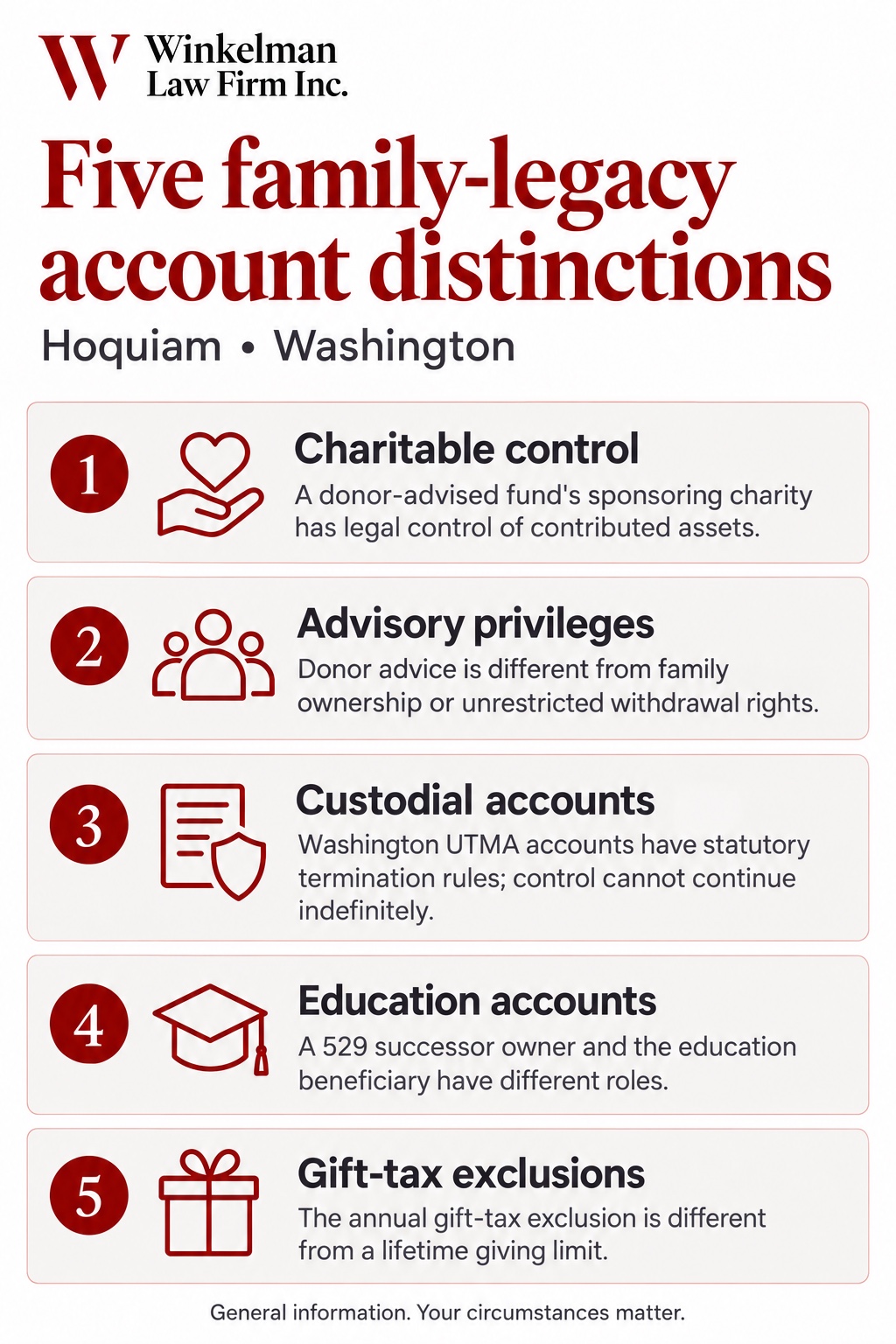
No. Once a contribution is made to a donor-advised fund, the sponsoring charitable organization has legal control of the contributed assets. The donor or adviser retains advisory privileges, which should not be confused with family ownership or unrestricted withdrawal rights. See IRS donor-advised fund control.
No. Washington custodianships have statutory termination rules, with different ages depending on how the transfer was made and whether a permitted extension was properly established. Review the original transfer rather than assuming a parent can keep control for as long as desired. See RCW 11.114.200: Termination of custodianship and extensions.
They are separate roles. WA529 Invest's guidance separately addresses the education beneficiary and the successor account owner designated for the current owner's death, so review both designations and follow the particular plan's current update process. See WA529 Invest: Successor owners and beneficiaries.
The federal annual gift-tax exclusion is $19,000 per recipient for 2026. It is not a total lifetime giving limit, and gifts involving future interests or other special rules need separate review. Keep the date, recipient and value of each gift so tax advice and family legacy records use the same facts. See IRS: frequently asked questions on gift taxes.
We assist clients with Hoquiam family wealth planning from our office in Hoquiam, Washington. You can contact us and mention your main concerns, any existing documents and upcoming dates. We can then discuss your circumstances and the next steps for a consultation.