Family court orders are based on circumstances at a particular point in time, but families continue to change. Children grow older, work schedules change, parents move, income rises or falls, and parenting arrangements that once worked may become difficult to maintain.
Winkelman Law Firm represents parents in Hoquiam, throughout Grays Harbor County, and across surrounding Western Washington communities who need to modify or respond to proposed changes to existing family law orders.
Our Hoquiam family law modification attorneys help clients evaluate changes involving parenting plans, residential schedules, child support, and related orders. We work with parents seeking modifications as well as those opposing requested changes.
A significant life change does not automatically change a court order. Until an order is properly modified, its existing terms generally remain important. Understanding the legal requirements for the particular modification being requested is therefore an essential first step.
Washington law establishes different standards for modifying different types of family law orders. The requirements for changing child support, for example, are not identical to the requirements for substantially changing a child's residential schedule.
That makes the reason for the requested change important.
Potential modification cases may arise after changes involving:
Not every change will justify modifying an existing order. The court may need to consider how substantial the change is, when it occurred, what type of order is involved, and whether the legal requirements for the requested modification have been satisfied.
Timing can also matter in support cases because Washington law provides multiple avenues for modifying or adjusting child support depending on the circumstances.
Parents should not assume that an informal change in their lives has automatically changed their legal responsibilities. An existing order may remain enforceable even when the family's day-to-day practices have evolved.
Our Hoquiam family law modification lawyers help clients identify which legal standard applies before pursuing or responding to a requested change. That initial analysis can help determine whether formal modification is appropriate and what information may be needed to support the client's position.
Washington generally places meaningful limits on changing an established parenting plan, particularly when a parent is seeking a substantial change to the existing residential arrangement.
For major modifications, the law generally requires more than showing that another schedule would now be preferable. Depending on the circumstances, the court may consider whether relevant facts have arisen since the prior order or were unknown when it was entered, whether the required change in circumstances has occurred, and whether the requested modification satisfies the statutory standards concerning the child's best interests.
Washington law also identifies specific circumstances in which an existing residential schedule may be changed. These can include situations in which the parents agree to the modification and certain other circumstances specifically recognized by statute.
Because these standards are fact-dependent, modification cases can turn on the history of the existing order and what has happened since it was entered.
Evidence may include:
Our Hoquiam child custody modification attorneys help clients evaluate the requested change against the applicable Washington standards rather than assuming that any change in circumstances is sufficient.
The scope of the requested change matters.
A major modification can substantially alter the residential arrangements established by the existing parenting plan. Washington law generally sets a higher threshold for these changes because courts do not simply reconsider an established residential schedule whenever one parent would prefer a different arrangement.
Washington law also provides a pathway for certain minor adjustments to residential schedules when statutory requirements are met. These adjustments may address more limited scheduling problems without changing the residence where the child is scheduled to live the majority of the time.
For example, the statute recognizes certain circumstances involving limited changes in residential time, a qualifying change of residence, or an involuntary work-schedule change that makes the existing schedule impractical.
Whether a proposed change is legally considered minor or requires a more substantial modification depends on the actual terms being requested. Our Hoquiam parenting plan modification lawyers help clients evaluate that distinction before moving forward.
Parents often seek legal advice about modification after realizing that the parenting plan no longer reflects what is happening in their family's daily life.
The reason for that mismatch matters. Washington law does not provide a general right to rewrite a parenting plan merely because circumstances have evolved or one parent believes another schedule would be better.
Depending on the type of modification requested, potentially relevant circumstances can include:
The legal significance of these circumstances varies. A fact that may support a limited residential adjustment does not necessarily justify a major change in where a child primarily resides.
That distinction is one reason modification cases require careful analysis before filing. The existing order, the specific change requested, and the evidence supporting that request all need to be considered together.
Our Hoquiam parenting plan modification attorneys help parents determine whether changed circumstances may fit Washington's modification framework. We also represent parents who have been asked to accept a substantial change and believe the legal requirements have not been met.
Child support orders are based on financial and family circumstances that can change over time. A parent's income may increase or decrease, employment may change, or other circumstances affecting the support calculation may become substantially different from those that existed when the order was entered.
Washington law provides more than one pathway for changing an existing child support order. Depending on the circumstances and timing, a parent may seek a modification based on substantially changed circumstances or may qualify for an adjustment under other provisions of Washington law.
Potential reasons for reviewing an existing support order may include:
A change in circumstances does not automatically change the amount due under an existing order. Parents should not assume that losing a job, earning more money, or reaching an informal agreement immediately creates a new legally enforceable support obligation.
Timing can be especially important. Washington law generally limits modification of support to obligations accruing after the modification petition or adjustment motion rather than automatically rewriting previously accrued obligations.
Our Hoquiam child support modification attorneys help parents review existing orders, current financial information, and the circumstances that have changed. We represent both parents seeking a different support amount and parents responding to requests for an increase or decrease.

Employment and income changes are common reasons parents begin questioning whether an existing child support order remains appropriate.
A parent may lose a job, change employers, receive a substantial raise, experience a reduction in earnings, or move into self-employment. Other cases involve commissions, bonuses, overtime, business income, or fluctuating earnings that make the parent's current financial circumstances more difficult to evaluate.
Relevant documentation may include:
The reason for an income reduction can also matter. Washington law specifically provides that voluntary unemployment or voluntary underemployment by the parent required to pay support, standing alone, does not constitute a substantial change of circumstances for modification purposes.
Parents therefore should not treat every employment change as automatically supporting a lower or higher obligation.
Our Hoquiam family law modification lawyers help clients evaluate the financial facts behind a requested child support change. Careful documentation can be particularly important when income fluctuates, a parent owns a business, or the parties disagree about the income that should be considered.
Parents sometimes reach their own agreement after deciding that an existing parenting schedule or support arrangement no longer fits their circumstances.
Cooperation can make modification considerably easier, but an informal agreement and a modified court order are not necessarily the same thing.
For example, parents may begin following a different residential schedule because their work arrangements have changed. They may agree to different exchange times or adjust parenting days to accommodate school and activities. In another case, parents may agree that financial circumstances have changed enough to justify revisiting child support.
Even when both parents agree, formally documenting an appropriate modification can provide clarity about what is legally required going forward.
A written court order can help prevent future disputes about:
An informal arrangement can become particularly problematic if the parents later disagree about what they originally intended or one parent decides to return to the terms of the existing order.
Our Hoquiam modification attorneys help parents determine when an agreed change should be incorporated into a formal order. When agreement is possible, our team works to translate the parents' understanding into clear terms that address the issues requiring modification.
Not every parent involved in a modification case is seeking the change.
A parent may receive paperwork asking the court to substantially alter a residential schedule, increase or decrease child support, or change other provisions of an existing order. The receiving parent may agree with some proposed changes while strongly opposing others.
A request for modification should be evaluated based on what is actually being requested and the legal standard that applies.
Important questions can include:
Responding promptly is important because modification proceedings involve court procedures and deadlines. Washington Courts maintains separate forms for responses to petitions involving child support and parenting-plan modifications, reflecting that a responding parent has an opportunity to present a position on the requested change.
Our Hoquiam family law modification attorneys represent parents who need to challenge, negotiate, or otherwise respond to requested changes. We review the existing order, the proposed modification, and the evidence supporting each position so the client can make informed decisions about whether to negotiate an appropriate resolution or contest the request.
Families sometimes need short-term flexibility. A temporary work assignment, illness, school activity, travel schedule, or other circumstance may lead parents to adjust parenting time without intending to permanently replace the existing arrangement.
When parents cooperate, practical adjustments may help them manage temporary circumstances. However, following a different schedule does not necessarily modify the underlying court order.
That distinction becomes important if disagreements develop later.
A parent who believes a temporary arrangement has become permanent may have a very different understanding from a parent who expected the original schedule to resume. Long-running deviations from an existing parenting plan can also become relevant in later modification proceedings under certain circumstances.
Similar concerns arise with child support. Parents should not assume that privately changing payment arrangements necessarily modifies the amount required by an existing support order.
Our Hoquiam family law modification attorneys help clients distinguish between temporary flexibility and situations that may warrant a formal modification. When a lasting change is appropriate, obtaining clear legal terms can reduce uncertainty about which obligations govern moving forward.
Modification cases can be resolved in several ways depending on what is being changed and whether the parents agree.
Some cases begin with substantial disagreement but narrow after the parties exchange financial information, parenting records, or other relevant evidence. Others may be appropriate for negotiation or mediation.
The process may involve:
Parenting-plan cases may require evidence concerning the existing residential arrangement, the circumstances that have changed, and the effect of the proposed modification. Child support disputes frequently require updated income information and other financial documentation.
The scope of the dispute also matters. Parents may agree that some changes are necessary while disagreeing about others. Resolving the issues that are not genuinely contested can allow the parties to concentrate on the matters requiring further negotiation or court involvement.
Our Hoquiam modification lawyers represent clients throughout this process. Whether seeking a change or opposing one, we focus on identifying the applicable legal standard, developing the relevant evidence, and pursuing an appropriate resolution through negotiation, mediation, or contested proceedings.
Modification cases require an understanding of both the original family law order and the legal standards governing changes after that order has been entered.
Winkelman Law Firm'sattorneys bring decades of combined legal experience to families in Hoquiam and throughout Grays Harbor County.
Founding shareholder Ben Winkelman has more than 20 years of legal experience involving family law, trial practice, and mediation. His background includes service on the Washington State Bar Family Law Section Executive Committee from 2007 through 2013, including serving as chair.
Associate attorney Ryan M. Pesicka brings additional family law and litigation experience, including substantial family-law work after relocating to Grays Harbor County.
Our Hoquiam family law modification attorneys represent clients on both sides of modification proceedings. We help parents seeking changes to outdated orders as well as parents who believe a requested modification does not satisfy Washington's legal requirements.
That balanced experience is particularly useful in cases involving disputed parenting schedules, changing financial circumstances, or significant disagreements about what has occurred since the original order was entered.
An existing family law order may no longer reflect your family's circumstances, but changing day-to-day circumstances does not necessarily change the legal obligations established by the court.
If you need to modify a parenting plan or child support order—or have received a request seeking changes you oppose—Winkelman Law Firm can help you understand the applicable requirements and your available options.
Our team represents parents in Hoquiam, throughout Grays Harbor County, and across surrounding Western Washington communities.Contact our Hoquiam family law modification attorneys to schedule an appointment and discuss the changes affecting your family.
Reviewed for legal accuracy by Benjamin R Winkelman on October 18, 2026
For Hoquiam family law modifications, we start with the signed order and a dated account of what has changed. Keep supporting records that distinguish current circumstances from conditions already considered. We can evaluate which changes may matter under the standards governing the particular request.
In Hoquiam family law modifications, we suggest keeping employer schedules and a practical calendar showing the effect on the current arrangement. Identify whether the change is temporary, ongoing or still uncertain. We assess that information before recommending a specific request to the court.
For Hoquiam family law modifications, records of an agreed arrangement can help explain what the family has actually been doing. Keep the dates and complete communications as well as the existing order. We review the legal significance without assuming informal practice automatically rewrites a court order.
We ask clients considering Hoquiam family law modifications to keep the complete papers and note when they were received. Include hearing notices and supporting declarations, not just the first page. We can review the procedural steps and disputed facts from the actual filing.
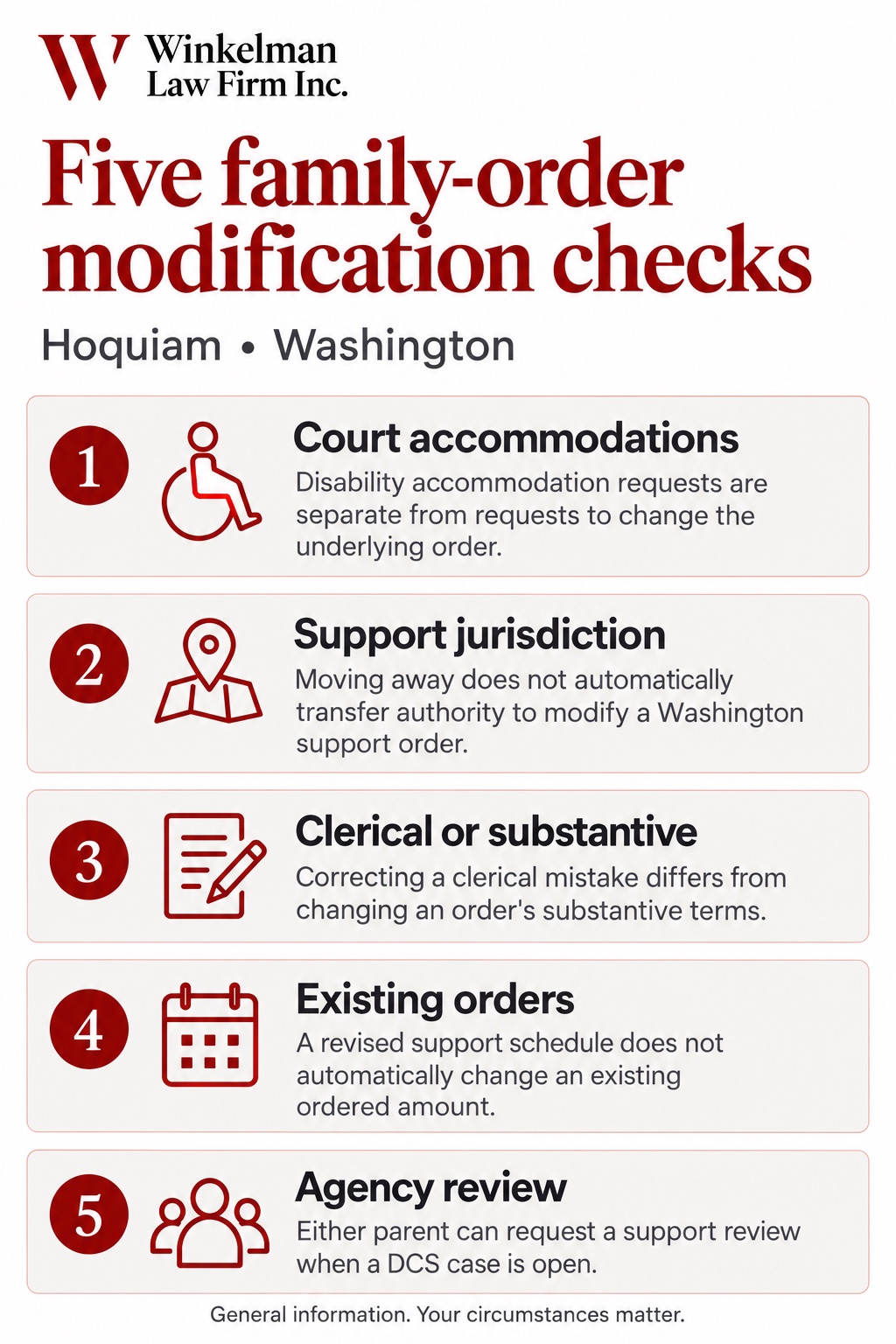
Washington courts provide a process for requesting disability accommodations that help a qualified person participate in a hearing. Contact the court handling the modification and explain the accommodation needed through its current procedure; that request is separate from asking to change the underlying family-law order. See Washington court disability accommodations.
Not necessarily. For a controlling Washington support order, continuing authority to modify can depend on where the child and parents live and on legally effective consent. Review the order and all parties' residences before assuming that one person's move transfers jurisdiction. See RCW 26.21A.120: Continuing jurisdiction over child support.
No. Civil Rule 60 distinguishes clerical mistakes arising from oversight or omission from requests for substantive relief from a judgment. Identify the actual error and applicable procedure instead of using a clerical correction to seek a different legal result. See Washington Civil Rule 60.
Do not assume the revised schedule changes the amount in an existing order by itself. If a Division of Child Support case is open, either parent can request a review through DCS. The agency or court process and the grounds for a change still need review for the particular order. See DSHS: child support modification.
We assist clients with Hoquiam family law modifications from our office in Hoquiam, Washington. You can contact us and mention your main concerns, any existing documents and upcoming dates. We can then discuss your circumstances and the next steps for a consultation.