Legal disputes do not always need to end in a courtroom. Mediation, arbitration, and other forms of alternative dispute resolution can provide parties with structured ways to address disagreements while potentially reducing the time, expense, and uncertainty associated with litigation.
Winkelman Law Firm assists individuals, families, business owners, and companies in Hoquiam, throughout Grays Harbor County, and across surrounding Western Washington communities with mediation, arbitration, negotiation, and dispute resolution.
Our Hoquiam mediation and arbitration attorneys help clients understand their legal positions, prepare for dispute-resolution proceedings, evaluate settlement options, and protect their interests throughout the process. Our broader experience in family law, business law, real estate, and civil litigation also allows us to approach mediation and arbitration with an understanding of the underlying legal issues driving the dispute.
Whether the disagreement involves family relationships, a business, a contract, property, or another civil matter, alternative dispute resolution may provide a path toward resolving the conflict without a full trial.
Alternative dispute resolution refers to processes used to resolve legal conflicts outside a traditional courtroom trial.
Two of the most familiar forms are mediation and arbitration, although negotiation between the parties and their attorneys can also play an important role in resolving disputes.
Alternative dispute resolution may be considered in matters involving:
The appropriate process depends on the dispute and the objectives of the people involved.
Some parties want to preserve an ongoing relationship. Others primarily want greater control over the timing and terms of a potential resolution. In certain situations, an existing contract may contain provisions addressing mediation or arbitration if a dispute develops.
Alternative dispute resolution does not mean a client should approach the matter casually. The outcome can affect property, finances, business rights, parenting arrangements, contractual obligations, and other important interests.
Our Hoquiam dispute resolution attorneys help clients prepare carefully for these proceedings. That includes identifying the issues that matter most, evaluating the strengths and risks of the legal position, organizing relevant information, and determining what terms may or may not provide an acceptable resolution.
Mediation is a structured negotiation process in which a neutral mediator helps the parties work toward a voluntary agreement.
The mediator does not ordinarily decide who wins the dispute. Instead, the mediator helps the parties identify disputed issues, communicate positions, evaluate possible compromises, and explore whether an agreement can be reached.
Depending on the matter, participants may meet together, separately with the mediator, or through a combination of approaches.
Mediation can provide several practical advantages. The parties generally retain greater control over the outcome because a settlement requires agreement rather than a decision imposed by a judge or arbitrator. Mediation may also allow parties to consider practical solutions that address their particular circumstances.
The process can be useful when:
Reaching an agreement still requires careful consideration. A proposed settlement may create lasting legal and financial consequences, and parties should understand the terms before accepting them.
Our Hoquiam mediation attorneys help clients prepare for mediation, evaluate proposals, negotiate settlement terms, and understand how a potential agreement affects their legal interests. Ben Winkelman's experience in mediation, family law, business law, and civil matters provides additional perspective when disputes involve overlapping legal and practical concerns.
Arbitration differs from mediation because an arbitrator generally acts as a decision-maker rather than simply helping the parties negotiate.
The parties present their positions to an arbitrator or arbitration panel, which considers the dispute and issues a decision according to the rules and agreements governing the proceeding. Depending on the circumstances, arbitration may be binding or nonbinding.
Arbitration procedures can vary considerably. The parties may have agreed to arbitration in an existing contract, or they may decide to use arbitration after a dispute develops.
Issues that should be understood before arbitration include:
Although arbitration occurs outside the traditional courtroom process, it can still involve significant legal and financial consequences. Preparation may include reviewing contracts, gathering records, identifying evidence, developing legal arguments, and presenting the client's position during the proceeding.
Our Hoquiam arbitration attorneys help clients understand the process and prepare for arbitration when a dispute is subject to that form of resolution. Winkelman Law Firm approaches arbitration with the same attention to the underlying facts, agreements, and legal issues that would be necessary in a litigated dispute.
Mediation and arbitration are both alternatives to a traditional trial, but they serve different purposes.
The central distinction is who controls the outcome.
In mediation, the parties generally decide whether to settle and what terms they are willing to accept. The mediator facilitates negotiations but does not ordinarily impose a resolution.
In arbitration, the arbitrator acts more like a private decision-maker. The parties present their positions, and the arbitrator issues a decision according to the agreement and rules governing the proceeding.
Important differences can include:
The appropriate process depends on the dispute. Mediation may be particularly useful when the parties want to retain control over settlement terms or preserve an ongoing relationship. Arbitration may be used when an existing agreement requires it or when the parties want a third party to decide the dispute outside a traditional court trial.
Our Hoquiam mediation and arbitration attorneys help clients understand the process they are entering and prepare accordingly. Knowing whether the objective is negotiating an agreement or persuading a decision-maker is fundamental to developing an effective strategy.
Family law disputes are often well suited for mediation because the parties may need to continue interacting long after the immediate case is resolved.
Parents may need to communicate about their children for years. Divorcing spouses may need to resolve several interconnected financial and parenting issues at the same time. Mediation can provide a structured setting for working through those disagreements.
Family law mediation may address issues involving:
Mediation does not require the parties to agree on every issue before the process begins. Its purpose is often to determine whether areas of disagreement can be narrowed or resolved through negotiation.
Reaching an agreement can give families more involvement in shaping the outcome than leaving every disputed issue for a court to decide. However, proposed terms should still be evaluated carefully, particularly when they affect children, property, support obligations, or long-term financial interests.
Winkelman Law Firm brings substantial family-law experience to these matters. Ben Winkelman's background includes more than 20 years of legal practice involving family law, trial practice, and mediation, including prior leadership within the Washington State Bar Family Law Section.
Our Hoquiam family law attorneys help clients prepare for mediation, evaluate proposals, and negotiate from an informed position while keeping the client's long-term objectives in focus.
Commercial disputes can consume resources and distract owners from operating their businesses. Mediation may offer a way to address the conflict while allowing the parties to explore practical solutions outside a full trial.
Business mediation can be particularly valuable when the parties have an ongoing commercial relationship or when a dispute involves several issues that could potentially be resolved as part of one negotiated agreement.
Matters may involve:
A negotiated business settlement can sometimes address issues that extend beyond determining whether one party legally prevailed. The parties may be able to establish payment terms, restructure obligations, transfer an ownership interest, end a contract, or establish a path for continuing the business relationship.
Mediation is not appropriate for every commercial dispute, and productive negotiation requires an understanding of the underlying legal position.
Our Hoquiam business attorneys help clients evaluate their agreements, financial interests, potential exposure, and settlement options before and during mediation. Winkelman Law Firm's experience in business law, contracts, civil litigation, and mediation allows our team to consider both the legal merits of the dispute and the practical business consequences of different outcomes.
Property and other civil disputes can also benefit from negotiated resolution when the parties have room to develop a practical agreement.
Real estate conflicts may involve people who will remain connected even after the immediate dispute ends. Neighbors may continue living beside one another. Business owners may continue using nearby property. Family members may share interests in inherited real estate.
Disputes may involve:
A court can determine legal rights, but litigation may not always provide the flexibility the parties want. Mediation can allow participants to consider specific arrangements concerning payment, access, property use, transfers, deadlines, or other terms relevant to resolving the conflict.
Successful mediation still depends on preparation. Clients should understand the documents, facts, and legal issues affecting their position before evaluating a proposed compromise.
Winkelman Law Firm's experience in real estate, contracts, business law, and general civil matters allows our Hoquiam attorneys to approach these disputes from several perspectives. We help clients identify the issues that require resolution, evaluate potential settlement terms, and determine whether a negotiated agreement adequately addresses their interests.
Preparation can significantly affect how effectively a client participates in mediation or arbitration.
Although both processes take place outside a traditional courtroom trial, the parties still need to understand the facts, legal issues, documents, and financial interests involved in the dispute.
Preparation may include:
Preparation for mediation also requires thinking carefully about settlement priorities. Clients should know which issues are most important, where compromise may be possible, and what alternatives exist if an agreement is not reached.
Arbitration preparation is different because the objective is generally to persuade the arbitrator. Documents, testimony, contractual language, and other evidence may therefore play a more formal role.
Our Hoquiam mediation and arbitration attorneys help clients prepare with the specific process in mind. Winkelman Law Firm works to ensure clients understand both the legal issues and the practical choices they may face before negotiations or hearings begin.
Reaching a proposed settlement is not the same as determining that the settlement should be accepted.
Clients should understand what they are receiving, what obligations they are assuming, what rights may be released, and how the agreement will affect them after the dispute ends.
Depending on the matter, settlement terms may address:
The value of a settlement cannot always be measured by comparing one dollar amount with another. Timing, certainty, future obligations, litigation costs, business disruption, and the ability to preserve an important relationship can also matter.
At the same time, avoiding litigation should not become the sole reason to accept terms that fail to address the client's important interests.
Our Hoquiam dispute resolution attorneys help clients evaluate proposed agreements in the context of both their legal position and their broader objectives. When settlement is appropriate, our team can help negotiate and document terms intended to provide a clear resolution rather than create additional uncertainty.
Mediation does not guarantee an agreement.
The parties may remain too far apart, disagree about essential facts, or have fundamentally different objectives. In other situations, mediation resolves some issues while leaving others for further negotiation or litigation.
An unsuccessful mediation is not necessarily wasted effort. The process may clarify the disputed issues, reveal areas where the parties agree, or provide a better understanding of the positions that will need to be addressed if the case continues.
The next step may involve:
The appropriate course depends on the type of case and what occurred during the negotiations.
Clients should also approach mediation with an understanding of their alternatives if no agreement is reached. Knowing what continued litigation may require can provide important context when evaluating settlement proposals.
Winkelman Law Firm helps Hoquiam clients prepare for both possibilities. Our attorneys can pursue a negotiated resolution when appropriate while remaining prepared to continue advocating for the client's interests if mediation does not resolve the dispute.
Effective dispute resolution requires an understanding of both the legal issues and the practical consequences of settlement.
Winkelman Law Firm'sattorneys bring decades of combined legal experience to individuals, families, businesses, and property owners in Hoquiam and throughout Grays Harbor County.
Founding shareholder Ben Winkelman's practice includes mediation, trial practice, family law, business law, real estate, probate, and general civil matters. His more than 20 years of legal experience gives him perspective on disputes that may be resolved through negotiation as well as those that require continued litigation.
Ben has also served in leadership positions within the Washington State Bar Family Law Section, including as chair of its Executive Committee, providing additional depth in family-law matters where mediation frequently plays an important role.
Ryan M. Pesicka brings experience in civil litigation, family law, business law, contract disputes, real property matters, and employment disputes.
Because our team works across both transactional and litigation matters, our Hoquiam attorneys can evaluate a dispute with an understanding of the underlying legal relationship as well as the potential consequences if the conflict continues.
Mediation and arbitration can provide effective alternatives to a courtroom trial, but the decisions made during these proceedings can have lasting legal, financial, business, and family consequences.
Winkelman Law Firm helps clients prepare for dispute resolution, understand their legal positions, evaluate proposed settlements, and protect their interests throughout mediation and arbitration proceedings.
Contact our Hoquiam mediation and arbitration attorneys to discuss your dispute and potential options for resolution. Our team serves clients in Hoquiam, throughout Grays Harbor County, and across surrounding Western Washington communities.
Reviewed for legal accuracy by Benjamin R Winkelman on October 18, 2026
For Hoquiam mediation, we discuss who has authority to make decisions for each participating person or entity. Insurance, ownership or representative roles may require additional coordination. We can review attendance and approval needs before the session instead of assuming every attendee can bind everyone affected.
In Hoquiam mediation, we identify which missing records could prevent an informed evaluation of settlement terms. Organize the requests and explain why the information matters to the disputed issues. We can assess preparation and scheduling options without assuming a settlement should be accepted before key facts are understood.
Our Hoquiam mediation preparation considers installment dates, security, required documents and the consequences of nonpayment. A larger stated amount may involve different practical risks from an immediate payment. We review the proposed terms as a whole rather than evaluating the headline number alone.
When comparing mediation vs arbitration for a Hoquiam, Washington agreement, we review the actual clause and any incorporated rules. Costs, selection of the decision-maker and procedural requirements may affect the choice. We can explain those provisions without assuming all arbitration agreements operate the same way.
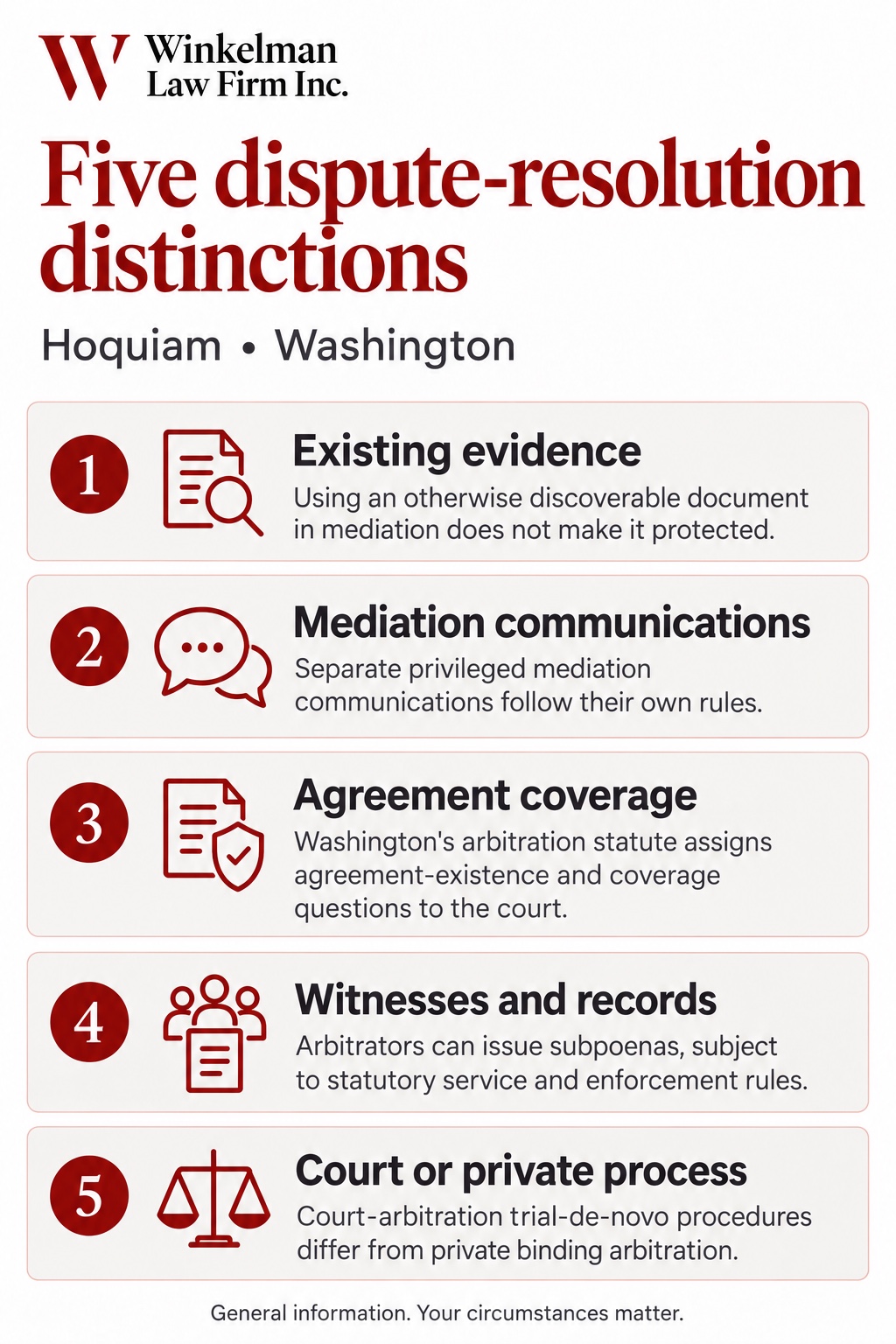
No. Washington's mediation statute says otherwise admissible or discoverable evidence does not become protected solely because it is disclosed or used in mediation. Distinguish the original business record from a separate privileged mediation communication. See RCW 7.07.030: Mediation and otherwise discoverable evidence.
Washington's arbitration statute assigns the court the question whether an agreement exists or a controversy falls within it, while assigning certain preliminary and contract questions to the arbitrator. Review the governing agreement and applicable law before assuming every threshold issue belongs to the same decision-maker. See RCW 7.04A.060: Arbitration agreement validity.
Yes. Washington law authorizes an arbitrator to issue subpoenas for hearing testimony and production of records, with rules for service, enforcement and permitted discovery. Review the arbitration order and statute before assuming ordinary court discovery procedures apply without limits. See RCW 7.04A.170: Arbitrator subpoenas.
No. Washington's court-arbitration process provides a route to request a trial de novo, subject to strict filing, service and other requirements. A private binding arbitration agreement follows a different framework. Have the applicable award, agreement and rules reviewed promptly instead of assuming the same challenge process applies to both. See Washington SCCAR 7.1: request for trial de novo.
We assist clients with Hoquiam mediation from our office in Hoquiam, Washington. You can contact us and mention your main concerns, any existing documents and upcoming dates. We can then discuss your circumstances and the next steps for a consultation.