Family law matters can affect where you live, how you spend time with your children, your financial stability, and important relationships within your family. Whether you are considering divorce, facing a parenting dispute, seeking support, or dealing with a significant change after final orders were entered, clear legal guidance can help you understand your options and make informed decisions.
At Winkelman Law Firm, our Hoquiam family law attorneys represent individuals and families facing a wide range of domestic relations matters. We serve clients in Hoquiam, throughout Grays Harbor County, and across surrounding Western Washington communities.
Our lawyers help clients address immediate legal concerns while keeping long-term consequences in view. When issues involving children, property, support, and finances overlap, we work to develop practical strategies tailored to the client's family, priorities, and circumstances.
Family law covers many legal issues involving spouses, parents, children, property, and financial obligations. Some cases begin with the end of a marriage or relationship, while others arise years later when an existing parenting or support arrangement no longer reflects the family's circumstances.
Winkelman Law Firm represents Hoquiam clients in matters involving:
These issues frequently overlap. A divorce involving children, for example, may require decisions about a parenting plan, child support, property division, debts, and potentially spousal maintenance. A later relocation may require reviewing an existing parenting arrangement and determining how a proposed move affects the children and the other parent.
Family law cases can also change direction. A matter that initially appears capable of negotiated resolution may develop contested issues, while a highly disputed case may ultimately be resolved through mediation or settlement.
Our Hoquiam family lawyers evaluate each matter based on the legal issues involved and the client's objectives. We help clients understand Washington family law, identify the decisions that need to be made, and determine an appropriate strategy for pursuing resolution.
The goal is not to create unnecessary conflict. It is to protect the client's interests while working toward durable legal arrangements that reflect the realities of the family.
Ending a marriage involves more than obtaining a court order changing marital status. Divorce can require spouses to resolve financial obligations, divide property and debts, determine whether maintenance is appropriate, and establish parenting arrangements when children are involved.
Some spouses agree on most or all of these issues. Others disagree about significant property, finances, parenting responsibilities, or support. The appropriate legal strategy depends on the issues that remain contested and whether the parties can reach acceptable agreements outside court.
A Washington divorce may involve questions concerning:
Legal separation can address many of the same issues without immediately terminating the marriage. Whether divorce or legal separation is more appropriate depends on the client's circumstances and objectives.
Property and parenting issues deserve particular attention because decisions made during divorce can have lasting consequences. A settlement that resolves the immediate case should also be evaluated for how it will function after the parties begin living under the final orders.
Our Hoquiam divorce attorneys help clients identify the issues that must be resolved and evaluate options for reaching an agreement. When negotiation or mediation can produce an appropriate result, those approaches may reduce unnecessary conflict. When significant issues remain contested, our lawyers are prepared to advocate for clients through the court process.
Washington family law uses parenting plans to establish important arrangements for children when parents live separately. Although parents and searchers commonly use the terms “custody” and “visitation,” a parenting plan can address where children reside, how parenting time is allocated, who makes significant decisions, and how certain disputes will be handled.
Parenting arrangements should reflect the circumstances of the children and family rather than being approached as a competition between parents.
Depending on the case, a parenting plan may address:
Parenting disputes can arise during divorce, between parents who were never married, or after an existing parenting plan has been in place for years.
Some parents are able to develop an agreed schedule. Others may disagree about where a child should primarily reside, how time should be divided, whether particular restrictions are necessary, or who should make important decisions.
The focus of the legal process is not simply what arrangement is most convenient for either parent. Washington law requires consideration of the children and the circumstances relevant to establishing an appropriate parenting plan.
Our Hoquiam child custody lawyers help parents understand how Washington parenting plans work and advocate for arrangements that address their children's needs while protecting the parent's legal interests. When disputes cannot be resolved through negotiation or mediation, our attorneys can present contested parenting issues to the court.
Child support is intended to address the financial needs of children when parents live separately. In Washington, support is generally determined under statewide guidelines that consider parental income and other legally relevant circumstances.
Although support calculations provide an important starting point, determining the appropriate obligation can involve more than entering numbers into a formula. Questions may arise concerning income, employment, health care expenses, child care costs, other children a parent supports, and additional expenses associated with the child's needs.
Child support issues can arise during divorce, in cases involving unmarried parents, and when an existing support order needs to be reviewed or modified.
Disputes may involve:
Child support and parenting time are related to the same family, but they involve distinct legal obligations. A disagreement about parenting arrangements does not automatically eliminate a support obligation, and support disputes should be addressed through the appropriate legal process.
Our Hoquiam child support attorneys help parents understand how Washington support rules apply to their circumstances. We assist with establishing support, addressing disputed financial information, and evaluating whether changes in circumstances may justify reviewing an existing order.
Spousal support, commonly called alimony and generally referred to as maintenance under Washington law, may become an issue when spouses have significantly different financial circumstances during or after divorce.
Maintenance is not automatically awarded in every divorce. Whether support is appropriate depends on the circumstances of the marriage and the factors the court is permitted to consider.
Relevant issues may include the financial resources available to each spouse, the length of the marriage, the standard of living established during the marriage, the age and circumstances of the spouses, and the time one spouse may need to pursue education or training.
Maintenance can become particularly important when one spouse has spent substantial time outside the workforce, has significantly lower earning capacity, or needs time to become more financially independent.
Disputes can concern both whether maintenance should be paid and, if so, the amount and duration.
For Hoquiam residents, maintenance should also be evaluated alongside property division and other financial issues in the divorce. Decisions about assets, debts, housing, and income can affect the parties' overall financial positions after the marriage ends.
Our Hoquiam family law attorneys represent clients seeking maintenance as well as clients responding to support requests. We evaluate the financial circumstances involved and help clients pursue support arrangements that are consistent with Washington law and the facts of the case.

Dividing property and debts can be one of the most significant financial parts of a divorce. Washington courts are required to make a just and equitable division based on the circumstances rather than simply applying an automatic equal split to every asset and obligation.
An important part of the process is identifying what the spouses own and owe.
Property division may involve:
Characterizing property can become complicated when finances have been combined over many years. An asset that began as separate property may have changed in value, been transferred, or become connected with other marital finances. Real estate and businesses can create additional valuation and ownership questions.
Debt also requires careful attention. Determining how obligations should be allocated can affect each spouse's financial position long after the divorce is completed.
A negotiated property settlement may allow spouses greater control over the outcome. When agreement is not possible, the court can determine how property and debts should be divided.
Our Hoquiam divorce lawyers help clients identify significant assets and liabilities, evaluate property issues, and consider how proposed divisions may affect their future financial circumstances. When a marital estate includes real estate, businesses, or other complex assets, our broader experience in those areas can also help us evaluate the issues involved.
Family circumstances do not remain fixed simply because a court entered final orders. Children grow older, parents change jobs, income changes, residential arrangements evolve, and families sometimes need existing orders to reflect significantly different circumstances.
Washington law provides procedures for seeking modification of certain family law orders, but the requirements depend on what the person wants to change.
A parent may need to consider modification after:
Not every change in circumstances is sufficient to modify every type of order. The legal requirements for changing child support are not necessarily the same as those for substantially modifying a parenting plan.
That distinction makes it important to identify exactly what needs to change before deciding how to proceed.
Modification cases can also involve disagreements about whether circumstances have changed enough to justify revisiting an existing order. One parent may believe a new arrangement is necessary, while the other believes the current order should remain in place.
Our Hoquiam family law attorneys represent parents seeking modifications and those responding to requested changes. We review the existing orders, the circumstances that have developed since they were entered, and the legal requirements that apply to the particular modification being requested.
When family circumstances have genuinely changed, addressing the issue through the appropriate legal process can help create orders that better reflect the family's current reality.
A parent's decision to move can create significant family law issues when an existing parenting plan determines where a child lives and how the child spends time with each parent.
Relocation may be prompted by employment, housing, a new relationship, family support, education, or other changes in a parent's circumstances. Even when the reason for moving is understandable, a proposed relocation can affect school schedules, transportation, parenting time, and the other parent's ability to maintain an ongoing relationship with the child.
Washington law establishes procedures that may apply when a parent intends to relocate with a child whose residential arrangements are governed by a court order. Depending on the circumstances, notice requirements and opportunities to object may become important.
Relocation disputes can involve questions about:
Parents considering relocation should evaluate these issues before making assumptions about how an existing parenting plan will operate after the move. Likewise, a parent who receives notice of a proposed relocation should understand what legal options and deadlines may apply.
Our Hoquiam family law attorneys represent parents seeking to relocate as well as parents responding to proposed moves. We help clients evaluate the existing parenting plan, the proposed changes, and the Washington procedures relevant to the circumstances.
Marriage can have significant consequences for property, finances, businesses, and long-term financial planning. Prenuptial and postnuptial agreements allow couples to address certain financial expectations through a written agreement rather than leaving every issue to be determined if the marriage later ends.
A prenuptial agreement is generally created before marriage, while a postnuptial agreement is entered into after the spouses are already married.
These agreements may be considered when one or both spouses have:
A marital agreement should be approached as a significant legal document rather than simply a contingency for divorce. The terms can affect important financial rights, making careful drafting, disclosure, timing, and the circumstances surrounding the agreement important.
For Hoquiam couples, these agreements can also complement estate and business planning. A business owner, for example, may want a marital agreement to coordinate with existing ownership restrictions, succession arrangements, or estate planning documents.
Our Hoquiam family law lawyers help clients evaluate, negotiate, and prepare prenuptial and postnuptial agreements based on their individual circumstances and financial objectives.
Not every family law dispute needs to be decided at trial. Many issues involving divorce, parenting, property, and support can be resolved through negotiation or mediation when the parties are able to reach acceptable terms.
Negotiated resolutions can give families greater involvement in the outcome. Instead of asking a judge to decide every disputed issue, the parties may be able to develop arrangements that account for practical considerations involving children, schedules, property, finances, and future responsibilities.
Mediation provides another structured opportunity to work toward agreement with the assistance of a neutral mediator.
Potential benefits of resolving appropriate issues outside trial can include greater flexibility, more control over the terms of an agreement, and reduced conflict between people who may need to continue communicating as parents.
Settlement is not appropriate in every case, however. Significant disagreements about parenting arrangements, finances, property, support, or other legal rights may require court intervention. A party should not feel pressured to accept terms that fail to address important concerns simply for the sake of reaching an agreement.
Our Hoquiam family law attorneys evaluate both negotiated and contested approaches based on the circumstances of the case. Ben Winkelman's experience includes family law, trial practice, and mediation, giving our team perspective on resolving disputes through agreement when appropriate while remaining prepared to advocate in court when important issues cannot be resolved.
Family law cases require attorneys who can address both the personal nature of the dispute and the legal issues that may determine a family's future. Winkelman Law Firm'sattorneys bring decades of combined legal experience to clients facing divorce, parenting disputes, support matters, modifications, and other family law concerns in Hoquiam and throughout Grays Harbor County.
Founding shareholder Ben Winkelman has more than 20 years of legal experience, with substantial work involving family law, trial practice, and mediation. His family law background includes service on the Washington State Bar Family Law Section Executive Committee from 2007 through 2013, including serving as chair.
Associate attorney Ryan M. Pesicka also brings significant family law experience, including litigation-focused representation before joining Winkelman Law Firm.
Our Hoquiam family law attorneys understand that no two families present exactly the same circumstances. We focus on practical legal strategies tailored to the client's priorities, whether the matter can be resolved through negotiation or requires advocacy in contested proceedings.
Family law decisions involving children, finances, property, and support can have consequences that continue long after a case is completed.
Winkelman Law Firm represents individuals and families in Hoquiam, throughout Grays Harbor County, and across surrounding Western Washington communities in a broad range of family law matters.
If you are facing divorce, a parenting dispute, support issue, modification, relocation, or another family law concern,contact our Hoquiam family law attorneys to schedule an appointment. Our lawyers can help you understand your options, protect your interests, and determine an appropriate path forward.
Reviewed for legal accuracy by Benjamin R Winkelman on October 18, 2026
For Hoquiam family law matters, we suggest organizing existing orders, recent financial records and a short timeline of the main events. Identify which issues concern children, support, property or an upcoming hearing. We can then distinguish immediate procedural questions from longer-term settlement goals.
In Hoquiam family law cases, we recommend preserving the complete conversation and the date of any proposed agreement. A short message may not address all the terms needed for an enforceable court order. We review the actual language and current orders before assuming an informal exchange resolves the issue.
Our Hoquiam family law review starts with the case number, court name and complete copies of the existing orders. Your current address alone may not determine which court should handle the next step. We examine the procedural history before recommending where a request should be filed.
For Hoquiam family law, we suggest a factual timeline that distinguishes specific incidents from general disagreements. Include relevant school schedules, existing orders and complete communications. We can assess the issues without asking you to turn a child into the messenger between adults.
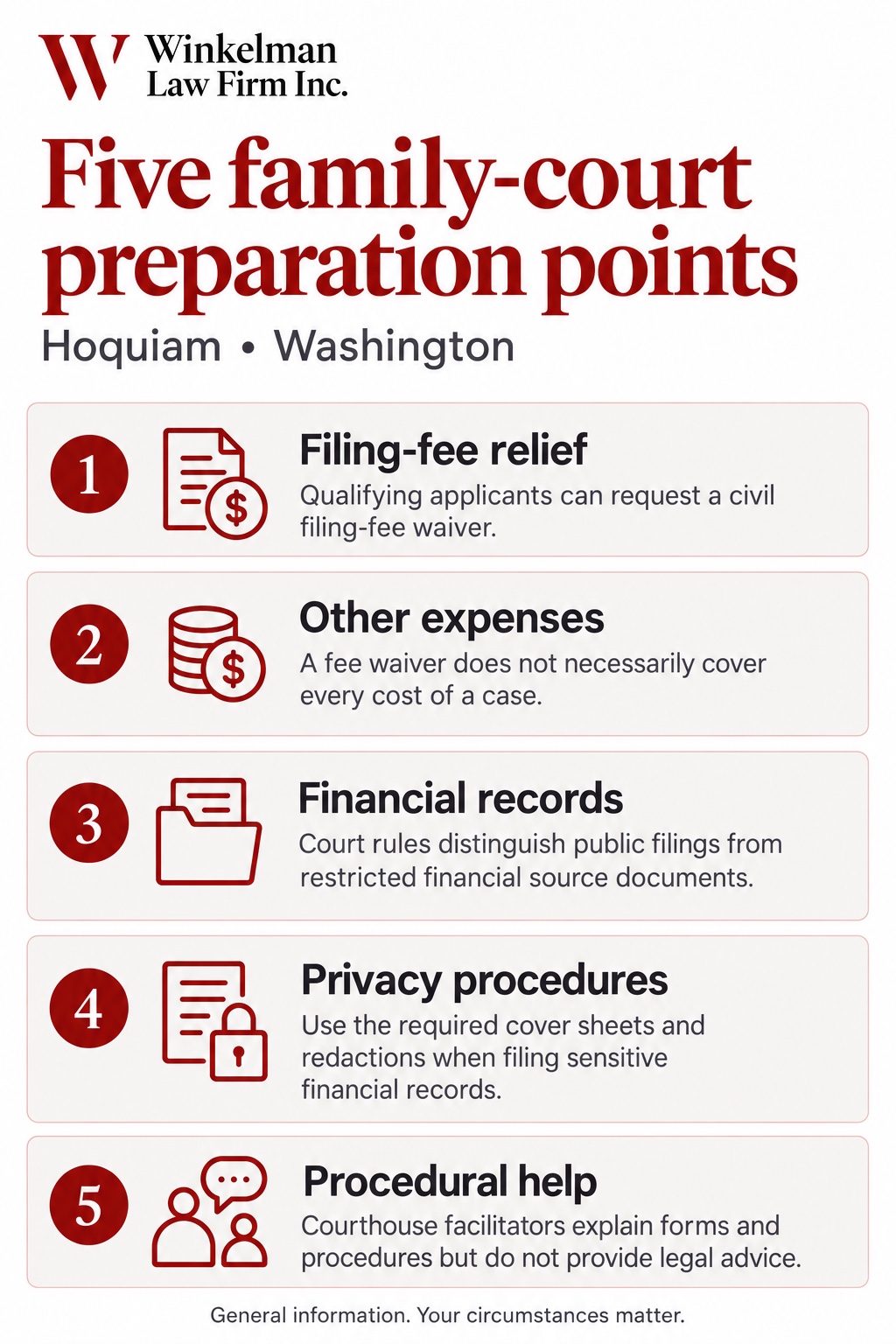
Washington has a process under General Rule 34 for requesting waiver of qualifying civil filing fees and surcharges based on financial circumstances. Use the court's current forms and required supporting information; do not assume a fee waiver covers every expense associated with the case. See Washington civil fee waiver forms.
Do not assume that every financial filing is automatically private. Washington GR 22 distinguishes generally public court records from restricted financial source documents such as tax returns and bank statements, so review the correct cover sheets and redactions before filing. See Washington GR 22: Access to family law records.
No. A courthouse facilitator may help identify forms, explain procedures and assist with scheduling, but does not give legal advice or represent a party in court. Confirm the services available in the county and obtain legal advice separately when needed. See Washington courthouse facilitators.
Use the current Washington Courts schedule and worksheets rather than an old saved packet. The official list includes June 2026 revisions. We can review the forms applicable to a Hoquiam family-law matter alongside the case's existing orders and any additional local filing requirements. See Washington Courts: child-support schedule and worksheets.
We assist clients with Hoquiam family law from our office in Hoquiam, Washington. You can contact us and mention your main concerns, any existing documents and upcoming dates. We can then discuss your circumstances and the next steps for a consultation.