Starting, operating, or expanding a business involves decisions that can affect ownership rights, financial obligations, liability, and the company's future. Clear legal structures and carefully drafted agreements can help business owners define those relationships before uncertainty develops.
Winkelman Law Firm assists entrepreneurs, business owners, and companies in Hoquiam, throughout Grays Harbor County, and across surrounding Western Washington communities with business formation, contracts, and commercial transactions.
Our Hoquiam business attorneys help clients establish new companies, evaluate entity structures, prepare ownership agreements, negotiate commercial contracts, and complete significant business transactions. We also assist established companies when ownership changes, new opportunities arise, or existing agreements need to be updated.
Whether you are forming your first business or completing a transaction involving an established company, our team provides practical legal guidance designed around the business and the objectives of its owners.
A new business often begins with an idea, a customer opportunity, or a particular skill. Turning that opportunity into a functioning company requires decisions about how the business will be owned and operated.
Addressing those questions early can establish clearer expectations and reduce the likelihood of avoidable disputes later.
Initial legal planning may involve:
Businesses with multiple owners should pay particular attention to their internal relationships. Friends, relatives, or colleagues may begin a company with a shared vision, but circumstances can change as the business grows.
Owners should understand who has authority to make decisions, what happens when additional capital is needed, whether an ownership interest can be transferred, and how the company will respond if an owner wants to leave.
Our Hoquiam business formation attorneys help clients address these questions at the beginning rather than relying on informal assumptions. When accounting or tax considerations affect the choice of structure, we can coordinate the legal planning with the client's tax and financial professionals.
A strong foundation does not eliminate every future business challenge, but it can provide clearer rules for addressing those challenges when they arise.
Entity selection affects how a company is owned, managed, and governed. It can also influence liability exposure, taxation, financing, succession, and future ownership changes.
There is no single entity structure that is best for every Washington business.
The appropriate choice depends on factors such as:
A business with one owner may have different priorities from a company formed by several partners. A family-owned business intended to pass to the next generation may require a different ownership strategy from a company the founders expect to sell.
Entity selection should therefore be considered in the context of the owner's broader plans.
The legal structure is also only part of the process. Governing documents, contracts, ownership records, and the way the business is actually operated should remain consistent with the chosen entity.
Our Hoquiam business attorneys help clients evaluate entity options based on how they intend to own, manage, and develop the company. The goal is to establish a structure that supports current operations while leaving room for foreseeable growth and change.
Washington business owners have several structures available, each with different characteristics.
Limited liability companies are commonly used because they can provide flexibility in ownership and management while separating certain company obligations from the personal obligations of owners when properly structured and operated. LLCs can be particularly useful for closely held businesses, family companies, and ventures with a relatively small number of owners.
Corporations provide a more formal ownership structure built around shares, directors, officers, and corporate governance. Depending on the company's objectives, that structure may be appropriate for businesses planning for multiple shareholders, investment, growth, or particular tax treatment.
Partnership arrangements may also be used when two or more people conduct business together. Because informal business relationships can create uncertainty about ownership, authority, and obligations, partners should understand how their relationship is legally structured rather than relying solely on verbal agreements.
Sole proprietorships are comparatively simple but generally do not create the same legal separation between the owner and business that an appropriately maintained separate entity can provide.
Choosing among these structures involves more than comparing filing requirements. Owners should consider how decisions will be made, how profits will be handled, what happens when an owner leaves, and how the company may eventually be transferred or sold.
Winkelman Law Firm helps entrepreneurs and established business owners in Hoquiam and throughout Grays Harbor County evaluate these options and create legal structures suited to their operations and long-term objectives.
When a business has multiple owners, clear governing documents can define how the company operates and what happens when circumstances change.
An LLC operating agreement, shareholder agreement, partnership agreement, or other ownership document can establish the rights and responsibilities of the people involved in the business. These agreements are particularly important when owners contribute different amounts of money, perform different roles, or have different expectations about the company's future.
Governing agreements may address:
These questions are easier to address while owners are working together than after a disagreement develops.
Business governance should also evolve with the company. An agreement created for two founders may no longer fit after additional owners join, the company grows substantially, or responsibilities shift.
Our Hoquiam business attorneys help clients create and review governing documents that reflect how the owners actually intend to operate the company. Clear agreements can provide a framework for routine decision-making while also establishing procedures for significant changes in ownership or management.
Contracts are central to business relationships. They establish expectations, allocate responsibilities, and provide a framework for what happens when circumstances do not unfold as expected.
A well-drafted agreement should clearly reflect the transaction rather than rely on generic language that may not fit the parties' actual relationship.
Important contract terms may address:
Contract review is particularly important before signing an agreement involving significant money, property, long-term obligations, or operational commitments.
The negotiation stage also provides an opportunity to identify unclear provisions and allocate risk before the parties are bound by the agreement. Once a dispute develops, changing unfavorable language may no longer be possible.
Winkelman Law Firm assists businesses in Hoquiam and throughout Grays Harbor County with drafting, reviewing, interpreting, and negotiating commercial contracts. Our attorneys focus on making the agreement consistent with the client's objectives while identifying provisions that could create unexpected obligations or uncertainty.
Businesses may use different contracts depending on their industry, operations, property, and relationships with other companies.
Some agreements govern everyday operations. Others document transactions that may occur only once or a few times during the life of a business.
Commercial agreements may include:
The name of the agreement matters less than whether its terms accurately address the underlying business relationship.
For example, a service contract should make clear what work is expected, how payment will be handled, and what happens if the relationship ends early. A commercial lease may need careful attention to maintenance, operating expenses, improvements, insurance, renewal rights, and assignment provisions in addition to the base rent.
Businesses should also be cautious about repeatedly using old agreements without considering whether operations or legal relationships have changed.
Our Hoquiam contract attorneys help clients develop agreements suited to specific transactions and review documents presented by other parties before commitments are made. Clear contracts can provide businesses with greater certainty about their rights and responsibilities and establish a stronger foundation if disagreements later arise.
A business acquisition or sale can involve years of work and substantial financial value. Careful documentation is important for both buyers and sellers.
The first major question is often what is actually being transferred. A transaction may involve purchasing company assets, acquiring ownership interests, or buying substantially all of an operating business. The structure can affect liabilities, contracts, property, financing, and other aspects of the deal.
A purchase or sale may require consideration of:
Buyers should understand the business and obligations they are acquiring. Sellers should understand the representations they are making and whether any responsibilities will continue after closing.
Negotiating the purchase agreement is therefore only one part of the process. Due diligence, supporting documents, financing arrangements, and closing requirements may also need to be coordinated.
Our Hoquiam business transaction attorneys represent buyers and sellers in business acquisitions and sales. Winkelman Law Firm helps clients structure and document transactions with attention to both the immediate deal and the legal obligations that may continue after ownership changes.
Business ownership often changes as a company grows.
A founder may bring in a new partner, an employee may earn or purchase an ownership interest, an existing owner may retire, or family members may gradually assume ownership of a closely held company. Each transition can affect management rights, financial interests, voting authority, and the relationships among existing owners.
Ownership transfers may require consideration of:
Existing operating agreements, shareholder agreements, or other governing documents should be reviewed before an ownership transfer occurs. Those documents may establish approval requirements, purchase rights, valuation procedures, or restrictions on who can become an owner.
Bringing in a new owner should also involve more than simply assigning a percentage of the company. The parties should understand what rights accompany that interest and what responsibilities the new owner is expected to assume.
Our Hoquiam business attorneys help clients document ownership changes and update governing arrangements when necessary. Careful planning can help ensure that the legal structure of the company continues to reflect how ownership and management actually operate after the transaction is complete.
Growth often requires businesses to make significant financial commitments.
A company may borrow money to purchase equipment, acquire real estate, expand operations, buy another business, or fund other investments. Business owners may also negotiate seller financing, installment payments, secured transactions, or other arrangements involving substantial future obligations.
Transaction documents may address:
Business owners should understand which obligations belong solely to the company and which may create personal exposure. Personal guarantees deserve particular attention because they can make an individual directly responsible for obligations associated with a business transaction.
Financing can also intersect with other legal matters. A business acquisition may involve seller financing. A real estate purchase may require both loan documents and property agreements. Bringing in an investor may affect ownership and governance rights.
Our Hoquiam business transaction attorneys help clients review and document commercial arrangements with attention to how each transaction affects the larger business. When tax, accounting, lending, or financial issues require additional expertise, Winkelman Law Firm can coordinate the legal aspects of the transaction with the client's other professional advisors.
Business formation and transactions require more than completing paperwork. Decisions about ownership, contracts, real estate, financing, and succession can remain important long after a transaction closes.
Winkelman Law Firm'sattorneys bring decades of combined legal experience to entrepreneurs, business owners, and companies in Hoquiam and throughout Grays Harbor County.
Founding shareholder Ben Winkelman's practice includes business law, real estate, estate planning, probate, general civil law, trial practice, and mediation. His more than 20 years of legal experience provides valuable perspective when a business transaction overlaps with property ownership, succession planning, or other long-term legal considerations.
Ryan M. Pesicka brings experience in business law, contracts, entity formation, corporate counsel, real property, and civil litigation. His background includes both advising businesses and handling disputes involving contracts and commercial relationships.
Our Hoquiam business lawyers focus on understanding the transaction and the client's larger objective. Whether forming a new company, negotiating an important contract, changing ownership, or completing a purchase or sale, our team works to establish clear legal terms and practical structures that support the business moving forward.
The decisions made when forming a business or completing a major transaction can shape the company's rights and obligations for years.
Winkelman Law Firm helps entrepreneurs and established companies create business structures, negotiate contracts, document ownership arrangements, and complete commercial transactions with greater clarity.
Contact our Hoquiam business formation and transaction attorneys to discuss your business needs. Our team serves clients in Hoquiam, throughout Grays Harbor County, and across surrounding Western Washington communities.
Reviewed for legal accuracy by Benjamin R Winkelman on October 18, 2026
For Hoquiam business formation, we distinguish entity registration from licensing, tax and operational requirements. The necessary steps depend on the structure, activities and location. We can review how the legal documents fit the applicable registrations instead of treating one filing as the complete launch.
For Hoquiam business formation and transactions, we suggest reviewing the proposed deposit terms and the conditions for completing the purchase. Identify what happens if financing, document review or required consent is not obtained. We can examine the agreement before you assume an informal promise makes the payment refundable.
When reviewing Hoquiam business formation and contracts, we ask for every document incorporated into the agreement. Pricing schedules, specifications and later amendments may affect the obligations. We evaluate the complete package rather than assuming the signature page contains all the important terms.
Our Hoquiam business formation work includes reviewing who can commit the company to loans, leases and other obligations. Identify ordinary operational decisions and larger transactions separately. We can help align the governing documents with the owners' intended approval process.
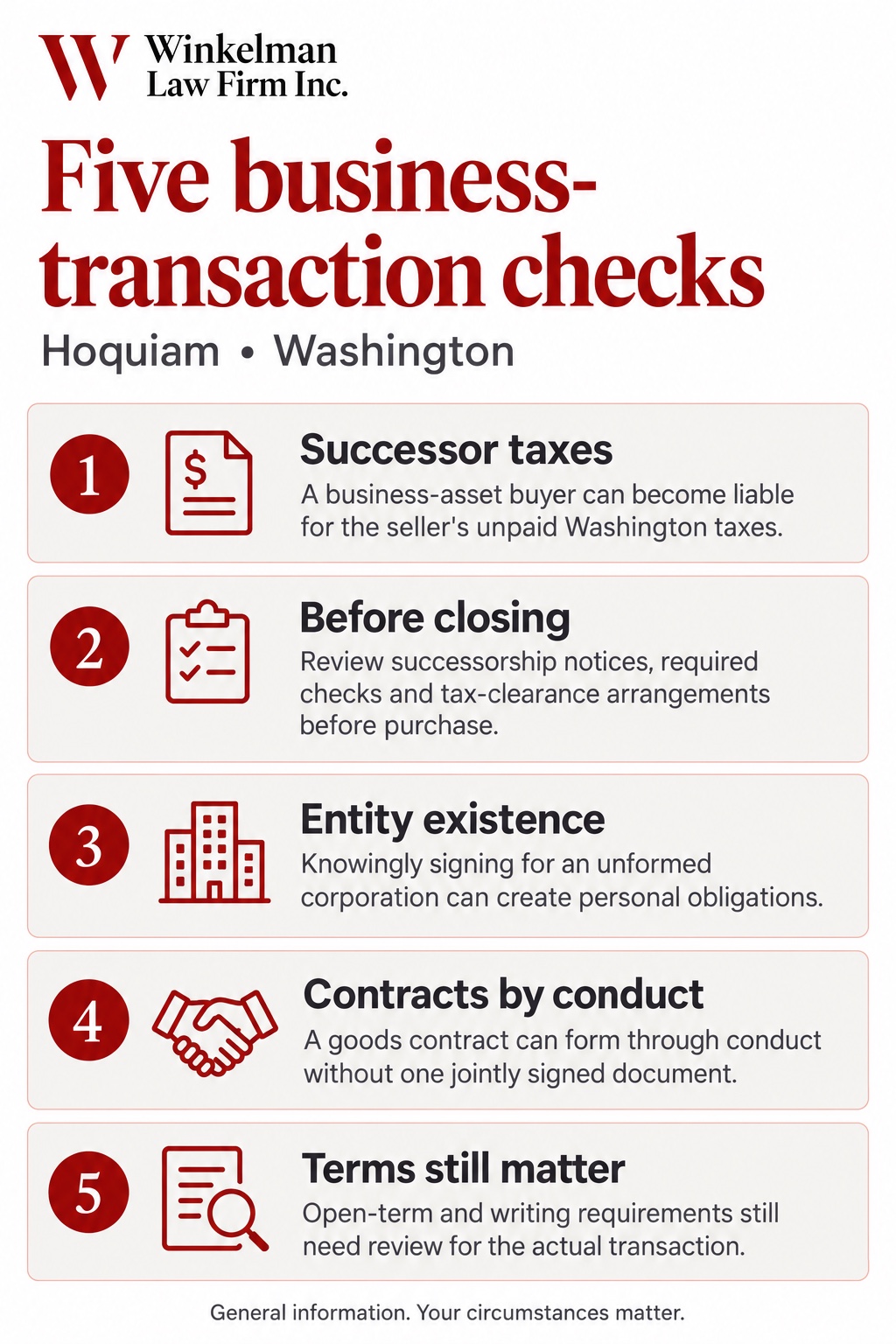
Yes. Washington DOR warns that a business buyer can become liable for the seller's unpaid taxes. Review the successorship notice procedure, required checks and any withholding or clearance arrangements before closing rather than relying only on the purchase agreement. See Washington business asset purchases and successor taxes.
Yes. Washington law addresses personal liability for people who knowingly act for a corporation that has not yet been incorporated, subject to a stated exception. Confirm the entity's existence and signing authority before entering obligations in its name. See RCW 23B.02.040: Preincorporation transaction liability.
For a sale of goods, Washington law can recognize an agreement through conduct and other evidence even when no single jointly signed document fixes the moment of formation. That does not mean every open term or writing requirement disappears, so review the actual exchange and applicable rules. See RCW 62A.2-204: Sales contract formation.
The IRS identifies a $2,000 general Form 1099-NEC reporting threshold for payments made in 2026. Exceptions and other information-return rules can apply, including reporting when backup withholding occurred. Review payment records and tax requirements separately from deciding whether a worker is properly classified as an independent contractor. See IRS: information-return reporting requirements.
We assist clients with Hoquiam business formation from our office in Hoquiam, Washington. You can contact us and mention your main concerns, any existing documents and upcoming dates. We can then discuss your circumstances and the next steps for a consultation.