Trusts can provide individuals and families with greater flexibility in determining how property is managed, protected, and ultimately distributed. Depending on your circumstances, a trust may help address concerns involving incapacity, beneficiaries, real estate, business interests, or the long-term transfer of family wealth.
At Winkelman Law Firm, our Hoquiam trusts attorneys help clients determine whether trust planning makes sense for their needs and, when appropriate, develop trusts designed around their objectives. We serve individuals and families in Hoquiam, throughout Grays Harbor County, and across surrounding Western Washington communities.
There is no single trust that works for every estate plan. The appropriate structure depends on what you want to accomplish, the property involved, and the people who will manage and benefit from the trust. Our lawyers can help you understand your options and coordinate a trust with the other components of your estate plan.
A trust is a legal arrangement through which property is held and managed according to terms established for the benefit of one or more beneficiaries. Although trust structures can range from relatively straightforward to highly sophisticated, understanding several basic roles makes the concept easier to navigate.
The person who creates the trust may be referred to as the settlor, trustor, or grantor. The trustee is responsible for administering the trust property according to the terms of the trust and applicable law. The beneficiaries are the individuals or organizations entitled to benefit from the trust according to its terms.
Depending on the type of trust, one person may occupy more than one of these roles. For example, someone establishing a revocable living trust may initially serve as trustee and retain significant control over the trust property while also identifying successor trustees and future beneficiaries.
The trust document establishes the rules governing the arrangement. Those provisions may address issues such as:
Creating the document, however, is only part of effective trust planning. Property intended to be governed by a trust generally must be properly transferred or otherwise coordinated with the trust. This process is commonly referred to as funding the trust.
The appropriate funding process depends on the property involved. Real estate, financial accounts, business interests, and other assets can require different transfer or ownership considerations. Beneficiary designations and other nonprobate arrangements may also need to be reviewed as part of the overall plan.
Our Hoquiam trust lawyers help clients consider both the structure of a trust and how it fits with their property and broader estate planning objectives.
People establish trusts for many different reasons. For some Hoquiam families, the primary objective is creating a structured way to manage and transfer assets. For others, trust planning may involve concerns about incapacity, young beneficiaries, family wealth, business interests, privacy, or the administration of property after death.
The usefulness of a trust depends on its terms and structure. Simply establishing a trust does not guarantee a particular tax, asset protection, or probate outcome. Effective planning starts by identifying the client's objective and then determining whether a trust is an appropriate tool for achieving it.
Depending on the circumstances, trust planning may help a client:
Control over the timing and circumstances of distributions can be particularly important. A client may not want a beneficiary to receive a substantial inheritance outright at a particular age or immediately after the client's death. A properly structured trust can establish terms governing when and how trust property is used or distributed.
Trusts may also help address continuity. If the trust terms provide for a successor trustee, that individual or institution can assume responsibility for managing trust property when circumstances described in the trust occur. This can be relevant to both incapacity planning and administration after death.
For Hoquiam residents considering a trust, the important question is not simply, “Do I need a trust?” It is what problem or objective would the trust address?
Our attorneys help clients throughout Grays Harbor County answer that question before selecting a particular planning strategy. When a trust is appropriate, it should serve a defined purpose and work together with the client's other estate planning arrangements.
The word “trust” describes a broad category of legal arrangements rather than a single estate planning product. Different trusts provide different levels of control, flexibility, and permanence, and the legal consequences can vary considerably depending on how a trust is structured.
Understanding the broad distinctions can help Hoquiam residents have more productive conversations about which options may fit their circumstances.
A revocable living trust is established during the settlor's lifetime and generally can be amended or revoked while the settlor retains the legal authority to do so. Many people who establish these trusts initially serve as their own trustee, allowing them to continue managing trust property while they are able.
The trust can also identify a successor trustee to take responsibility under circumstances established by the document, including after the settlor's death. This structure can make revocable living trusts useful for clients interested in continuity of asset management, incapacity planning, and the administration of properly funded trust property.
Flexibility is one of the defining characteristics of a revocable trust, but that flexibility also affects what the trust can and cannot accomplish. Our Hoquiam trusts attorneys help clients evaluate those considerations before deciding whether a revocable living trust belongs in their estate plan.
An irrevocable trust generally involves greater restrictions on the settlor's ability to change or revoke the arrangement after it has been established. Because the settlor may give up rights or control that would ordinarily be retained with a revocable trust, creating an irrevocable trust requires careful consideration.
Depending on the structure and purpose, irrevocable trusts may be considered in connection with certain wealth-transfer, estate tax, asset protection, or other specialized planning objectives. However, an irrevocable trust is not automatically appropriate simply because a client wants to protect assets or reduce taxes.
Our trust lawyers work with Hoquiam clients to examine the intended objective, property involved, and consequences of the proposed arrangement before determining whether an irrevocable structure should be considered.
Trust planning is not limited to choosing between a revocable living trust and an irrevocable trust. Trust provisions can also be incorporated into a will, and trusts may be designed to address particular beneficiaries, property, or family circumstances.
For example, parents may want assets held and managed for children rather than distributed outright. Other families may need to consider beneficiaries who require additional financial oversight or whose circumstances call for more carefully structured distributions.
The right approach depends on the purpose of the trust.
At Winkelman Law Firm, our Hoquiam trust attorneys focus first on what the client wants to accomplish. Once those objectives are clear, we can help evaluate which trust structure and estate planning tools are appropriate for the client's family, assets, and long-term goals.

Creating a trust requires more than deciding what should happen to property. You also need to determine who will be responsible for carrying out the trust's terms and who should benefit from the arrangement.
The trustee can have significant responsibilities. Depending on the trust, those duties may include managing investments or other property, maintaining records, making distributions to beneficiaries, addressing tax and administrative matters, and following the instructions established in the trust document. Washington law also imposes fiduciary duties on trustees, making the selection of an appropriate person or institution an important decision.
When choosing a trustee, Hoquiam residents may want to consider qualities such as:
Family members are often selected, but a relative is not automatically the right choice simply because that person is close to the settlor. Trust administration can involve financial decisions, legal responsibilities, and sometimes competing interests among beneficiaries. The individual selected should be capable of carrying out the role the trust requires.
Beneficiary planning deserves equally careful attention. A trust can do more than identify who will ultimately receive property. Its terms may establish when distributions occur, what circumstances permit distributions, and how long assets remain in trust.
For example, a parent may prefer that a child receive an inheritance gradually rather than all at once. Other beneficiaries may have financial, personal, or family circumstances that make outright distribution less desirable.
Our Hoquiam trust attorneys help clients think through both sides of the arrangement. Selecting the right trustee and establishing thoughtful terms for beneficiaries can be just as important as deciding which assets will be placed in the trust.
A trust only governs property that is legally connected to it. This makes trust funding one of the most important parts of trust planning.
Signing a trust document does not automatically transfer every asset a person owns into the trust. Depending on the property, additional steps may be required to change ownership, assign an interest, or otherwise coordinate the asset with the trust.
Assets that may be considered as part of trust planning include:
The appropriate treatment of an asset depends on its nature and the client's objectives. Transferring real property, for example, involves different considerations from addressing a financial account or an ownership interest in a closely held business.
Some assets may also have beneficiary designations or other transfer arrangements that require separate analysis. Retirement accounts and life insurance, for instance, raise considerations that differ from simply retitling an ordinary asset. The fact that a trust exists does not mean every asset should automatically be transferred to it.
This is why funding should be part of the planning process rather than an afterthought.
A Hoquiam resident might have a carefully drafted trust intended to govern substantial property, but if ownership and beneficiary arrangements are never properly coordinated with that plan, the trust may not control those assets in the manner expected.
Changes over time matter as well. A family may purchase additional real estate, open new financial accounts, sell property, acquire a business interest, or make other changes years after establishing a trust. Those developments can create a reason to review how the new property fits within the existing plan.
At Winkelman Law Firm, our Hoquiam trust lawyers help clients consider not only the terms of a trust but also how relevant assets should be coordinated with it. Proper trust planning requires attention to both the document and the property the document is intended to govern.
Probate is often one of the reasons people begin researching trusts. While certain trust arrangements can affect which property must be administered through probate, the relationship between trusts and probate deserves a more careful explanation than simply saying that a trust “avoids probate.”
Property properly held in a trust generally remains subject to the terms of that trust. After the settlor's death, a successor trustee may be able to administer and distribute trust property according to those terms without having that property administered as part of the probate estate.
That can be an important feature of trust planning.
However, merely signing a trust does not guarantee that probate will be unnecessary. If property that was intended for the trust was never properly transferred to it, that asset may remain outside the trust. Other property may also be subject to probate depending on ownership, beneficiary designations, the overall estate, and Washington law.
In addition, trust administration itself still requires work. A successor trustee may need to identify and value trust property, maintain records, address debts or expenses where applicable, communicate with beneficiaries, handle tax matters, manage assets, and make distributions according to the trust's terms.
For some families, that process may be more private or administratively different from probate, but a trust should not be presented as a way to eliminate every responsibility associated with settling a person's affairs.
The appropriate objective is effective estate administration, not avoiding a legal process at any cost.
Our Hoquiam trust attorneys help clients consider how trusts and probate fit within their broader plans. For some individuals, a properly funded trust may significantly reduce the property requiring probate administration. For others, a will-centered plan may remain appropriate.
By examining the client's assets and goals in advance, our lawyers can help Hoquiam and Grays Harbor County residents understand what a trust realistically can—and cannot—accomplish.
A trust is generally most effective when it is coordinated with the rest of an estate plan. Even clients who use a trust as a central planning tool may still need a will and documents addressing decisions that have little or nothing to do with trust property.
A comprehensive plan may include:
Each component performs a different function.
A trust can establish rules for managing and distributing trust property, but it does not necessarily replace a will. Likewise, neither a will nor a trust substitutes for documents granting authority to handle certain financial or health care matters during a person's lifetime.
Many trust-based estate plans also use a will to address property that remains outside the trust at death and other matters appropriately handled through a will. Depending on the plan, a will may direct certain probate property into an existing trust, although whether that property must first pass through probate depends on the circumstances.
Beneficiary designations and asset ownership also need to be considered. If those arrangements conflict with assumptions made when the trust was created, the overall result may differ from what the client intended.
Business owners may face another layer of coordination. Trust provisions, business ownership documents, succession arrangements, and the owner's broader estate plan should be evaluated together rather than developed independently.
At Winkelman Law Firm, our Hoquiam trust lawyers help clients consider these connections. We serve individuals, families, and business owners throughout Hoquiam and Grays Harbor County who want estate planning documents that function as a coordinated whole.
The goal is not to accumulate as many documents as possible. It is to create an estate plan in which each document has a clear purpose and the various components work together to carry out the client's intentions.
Creating a trust is not necessarily the end of the planning process. Family circumstances, property, financial goals, and the people selected to serve important roles can all change over time. Periodic review can help determine whether an existing trust continues to reflect the settlor's intentions.
Depending on the type of trust, making changes may be relatively straightforward or significantly more complicated. Revocable trusts generally provide greater flexibility for amendment during the settlor's lifetime, while irrevocable trusts involve different legal considerations and limitations. Clients should not assume that every trust can be changed in the same manner.
Events that may warrant reviewing a trust include:
Trust funding should also be considered during a review. A Hoquiam family may establish and fund a trust properly when it is created but acquire substantial new property years later. Reviewing asset ownership can help determine whether those additions have been incorporated into the plan as intended.
Changes in beneficiaries can be equally important. Children grow older, family relationships evolve, financial circumstances change, and the distribution terms selected years ago may no longer reflect the settlor's priorities.
Our Hoquiam trust attorneys can review existing trust documents and related estate planning arrangements to help clients understand their current plans and determine whether changes should be considered. When modification is possible and appropriate, our lawyers can help clients evaluate the available options under Washington law.
Trust planning can involve important decisions about property, family, financial management, and the people who will carry out your wishes. Clients should understand not only what a proposed trust says, but why a particular structure may or may not be appropriate for their objectives.
At Winkelman Law Firm, ourattorneys bring decades of combined legal experience serving individuals, families, and businesses in Hoquiam, throughout Grays Harbor County, and beyond. Founding shareholder Ben Winkelman has practiced law for more than 20 years, with experience involving trusts, wills, estate planning, and probate. Associate attorney Ryan M. Pesicka also brings estate planning experience from his broader background in private practice, business law, and civil matters.
Our Hoquiam trust lawyers take an individualized approach to planning. We begin by considering what the client wants to accomplish, the property involved, the intended beneficiaries, and the people who may be entrusted with managing trust assets.
From there, our attorneys can help determine whether a trust is appropriate and how it should coordinate with the client's broader estate plan. When a trust is already in place, we can also help evaluate whether the document and trust funding continue to reflect the client's current circumstances and intentions.
For clients throughout Hoquiam and Grays Harbor County, our goal is to provide practical trust planning grounded in each family's actual needs rather than relying on a one-size-fits-all approach.
Whether you are considering a trust for the first time or reviewing an arrangement created years ago, understanding how the trust fits your family, property, and long-term goals is an important part of the planning process.
At Winkelman Law Firm, our Hoquiam trust attorneys help individuals and families evaluate, create, fund, and review trusts as part of comprehensive estate planning. We serve clients in Hoquiam, throughout Grays Harbor County, and across surrounding Western Washington communities.
If you have questions about establishing a trust or want to review an existing plan,contact our Hoquiam trust attorneys to discuss your needs and schedule an appointment. Our lawyers can help you evaluate your options and determine how a trust may fit within your broader estate plan.
Reviewed for legal accuracy by Benjamin R Winkelman on October 18, 2026
For Hoquiam trusts, we suggest asking the institution what documentation it needs to recognize the trustee and the proposed account ownership. A statement that an account is 'for the trust' may not resolve its actual registration. We can review the institution's request alongside the trust rather than assuming signing the trust completes the process.
When discussing Hoquiam trusts, we consider how co-trustees will communicate, approve transactions and address a deadlock. Practical questions include who receives statements and how decisions are documented. We review the trust's actual decision-making provisions before recommending changes or assuming either trustee can act alone.
We recommend keeping a clear inventory for Hoquiam trusts that identifies the document, amendments and assets associated with the arrangement. Contact information for financial institutions and professional advisers can also help. We can review what should be accessible without putting account passwords into a document circulated to everyone.
Our work with Hoquiam trusts includes checking how amendments fit together. An isolated amendment may be difficult to interpret without the original trust and intervening changes. We suggest keeping the complete signed history organized so a later review starts with the documents that actually govern.
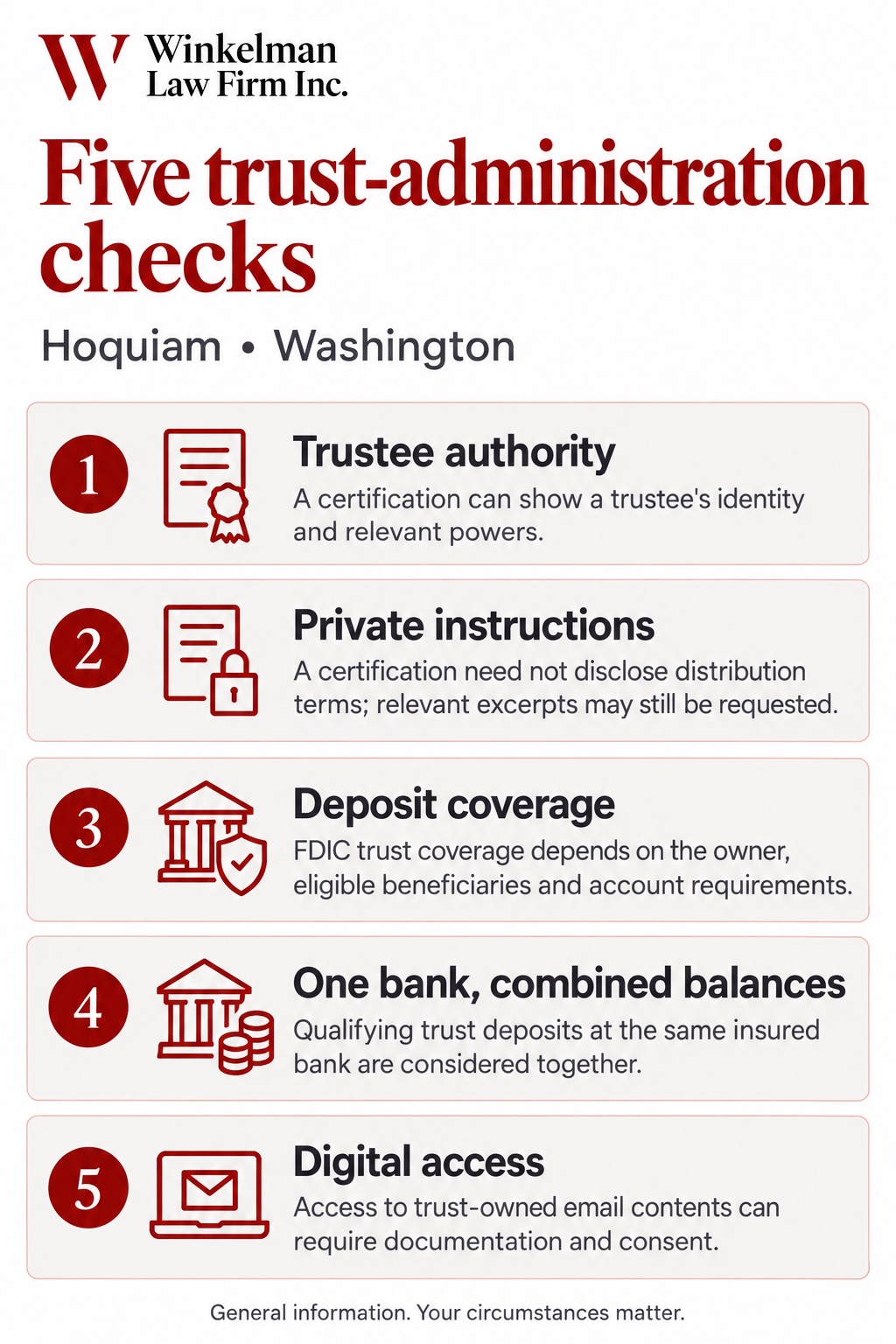
A trustee can often provide a certification of trust to a bank or other nonbeneficiary instead of disclosing the entire trust instrument. The certification supplies specified facts about the trust and trustee's powers without requiring the dispositive terms, although relevant excerpts or reasonable additional information may still be requested. See RCW 11.98.075 : Certification of trust.
No. FDIC trust-account coverage depends on the owner, eligible beneficiaries, account requirements and combined trust deposits at the same insured bank. The current rule generally provides up to $250,000 per eligible beneficiary, capped at $1,250,000 per owner at that bank when five or more eligible beneficiaries are named. See FDIC trust account coverage.
Not automatically. For a trust-owned account where the trustee was not the original user, Washington law sets documentation and consent requirements for obtaining the contents of electronic communications. Review the trust's digital-asset provisions and the custodian's process before assuming trustee status alone provides access. See RCW 11.120.120 : Trust electronic communications.
If estimated payments are required, the 2026 Form 1041-ES schedule lists April 15, June 15 and September 15, 2026, and January 15, 2027. A trustee should confirm the trust's filing status and applicable exceptions with its tax preparer. See IRS: 2026 Form 1041-ES.
We assist clients with Hoquiam trusts from our office in Hoquiam, Washington. You can contact us and mention your main concerns, any existing documents and upcoming dates. We can then discuss your circumstances and the next steps for a consultation.