A will gives you an opportunity to make important decisions about your estate rather than leaving those matters entirely to Washington's default inheritance laws. It can identify who should receive property governed by your will, designate the person you want to administer your estate, and address other important wishes for the future.
At Winkelman Law Firm, our Hoquiam wills attorneys help individuals and families prepare wills that reflect their circumstances and long-term intentions. We serve clients in Hoquiam, throughout Grays Harbor County, and across surrounding Western Washington communities.
Whether you are preparing your first will, replacing an outdated document, or reviewing your will as part of a broader estate plan, our lawyers can help you understand your options. We approach each client's planning individually, taking into account family relationships, property, beneficiaries, existing documents, and the objectives the client wants the will to accomplish.
A will is a legal document through which a person, known as the testator, can provide instructions concerning the disposition of property after death. In Washington, a properly prepared will can serve several important functions within an estate plan.
Most notably, a will allows you to identify the people or organizations you want to receive property that passes through your probate estate. Depending on your circumstances, those beneficiaries might include a spouse, children, other relatives, friends, or charitable organizations. A will can also address how the remainder of the estate should be distributed after specific gifts, expenses, and other obligations have been addressed.
Another important decision involves selecting a personal representative. This is the individual or qualified entity responsible for administering the probate estate. Responsibilities can include gathering estate property, addressing valid debts and expenses, handling required filings, and ultimately distributing property according to the will and Washington law.
For parents of minor children, a will also provides an opportunity to nominate a person to serve as guardian if circumstances require one. While a court ultimately addresses guardianship according to applicable law and the child's interests, documenting a parent's wishes can be an important part of planning.
A will can therefore address several different concerns at once, including:
However, a will does not necessarily control every asset a person owns. Some property can pass through beneficiary designations, rights of survivorship, trusts, or other arrangements outside the terms of a will. That is one reason our Hoquiam wills lawyers consider the client's broader circumstances rather than viewing the will as an isolated document.
The contents of a will should reflect the person creating it. A Hoquiam resident with young children and a recently purchased home may have very different planning priorities from a retired business owner with adult children and multiple properties. Effective planning begins by identifying those differences.
One of the first considerations is who should inherit your property. A will can identify beneficiaries and establish how property governed by the will should be divided among them. Some clients want assets distributed equally among children or other relatives. Others have specific property they want a particular person or organization to receive.
It is also important to consider what should happen if a beneficiary dies before you. Addressing contingencies can reduce uncertainty and provide clearer instructions for circumstances that may be difficult to anticipate.
Another major decision is the selection of a personal representative. Because this person may be responsible for handling important financial and administrative matters after your death, the choice should be made carefully. Reliability, judgment, willingness to serve, and the person's ability to carry out the responsibilities involved may all be relevant considerations.
Parents of minor children may also want their wills to document their preferences concerning a potential guardian. For many Hoquiam families, this can be one of the most significant and emotionally difficult decisions involved in preparing a will.
Depending on your situation, issues to consider when creating a will may include:
The will should also make sense in light of the rest of the estate plan. For example, naming someone in a will does not automatically override a valid beneficiary designation governing an account that transfers outside probate.
Our Hoquiam wills attorneys can help identify these potential coordination issues and prepare a document based on the client's intentions. The goal is not to make the will more complicated than necessary. It is to make deliberate decisions, document them appropriately, and reduce avoidable uncertainty about what the client intended.
When a Washington resident dies without a valid will, the person is generally described as having died intestate. This does not mean that the person's property simply becomes ownerless or automatically passes to the state. Instead, Washington's intestate succession laws determine how property subject to those laws is distributed.
The outcome depends on the family members who survive the person and the character of the property involved. Under Washington law, for example, a surviving spouse or registered domestic partner may receive the decedent's share of community property, while the distribution of separate property can depend on whether the decedent also leaves descendants, parents, siblings, or descendants of siblings.
If there is no surviving spouse or registered domestic partner, Washington law establishes an order of inheritance that can include descendants, parents, siblings and their descendants, grandparents, and certain other relatives.
Those statutory rules provide an orderly method for distributing an intestate estate, but they cannot account for every individual's personal preferences.
A Hoquiam resident might want to leave property to a close friend, unmarried partner, charity, or another person who would not inherit under the applicable intestacy rules. Someone may want different beneficiaries to receive different property or may simply prefer a distribution that differs from Washington's statutory formula. Without a valid will or another effective estate planning arrangement, those wishes may not control the distribution of probate property.
Dying without a will can also mean losing the opportunity to nominate the person you would prefer to administer your probate estate or to document certain wishes concerning guardianship of minor children.
Creating a will allows you to make many of these decisions yourself. Our Hoquiam wills lawyers help clients throughout Grays Harbor County understand how Washington's default rules compare with their own wishes and prepare estate planning documents designed to reflect the choices they want to make.
A will must satisfy Washington's legal requirements to be effective. Because the document may not be relied upon until after the person who created it has died, careful preparation and execution are particularly important.
Under Washington law, a person generally must be at least 18 years old and of sound mind to make a will. With limited exceptions recognized by state law, the will must be in writing and signed by the testator or by another person acting at the testator's direction and in the testator's presence.
Washington law also generally requires two competent witnesses. The witnesses must sign the will or an affidavit that complies with state law while in the testator's presence and at the testator's direction or request.
These formalities may appear straightforward, but problems involving execution can create significant questions later. A document that clearly expresses someone's wishes is not necessarily a legally valid will simply because those wishes were written down.
Washington also recognizes electronic wills when statutory requirements are satisfied. Electronic wills have their own execution requirements, including rules governing electronic presence, signatures, and attesting witnesses. The existence of electronic-will legislation does not eliminate the importance of ensuring that the document is properly prepared and executed.
Another consideration is whether a will is self-proving. Washington law permits a will to be supported by an affidavit from the testator and witnesses that satisfies statutory requirements. A properly executed self-proving affidavit can simplify proof of the will during probate by providing sworn evidence concerning its execution.
Our Hoquiam wills attorneys can help clients prepare and execute wills in accordance with Washington law while also considering the substance of the document. Legal formalities matter, but so do the decisions contained within the will. Both should receive careful attention when creating or revising an estate plan.
One of the most important concepts in estate planning is that a will does not necessarily determine what happens to every asset you own.
A will generally governs property that becomes part of the probate estate and is subject to disposition under the document. Other assets may transfer according to separate legal arrangements regardless of what the will says.
For example, assets that may pass outside the terms of a will can include, depending on how they are owned or designated:
This distinction can have significant practical consequences.
Suppose a person changes a will to leave an estate equally among several beneficiaries but never reviews beneficiary designations on substantial accounts. If those accounts have valid designations naming someone else, changing the will alone may not produce the overall distribution the person expected.
A will also generally does not replace documents designed to operate during your lifetime. It does not serve the same purpose as a durable power of attorney authorizing another person to handle specified matters during incapacity, nor does it substitute for planning concerning health care decisions.
That is why our Hoquiam estate planning lawyers look beyond the will itself when appropriate. Preparing a strong will is important, but the document should be coordinated with beneficiary designations, ownership arrangements, trusts, powers of attorney, health care planning, and other components of the client's estate plan.
For residents of Hoquiam and throughout Grays Harbor County, reviewing the broader picture can help identify inconsistencies before they create problems. The objective is for the different parts of an estate plan to work together toward the client's intended result.

A will should reflect your current wishes and circumstances. Even a carefully prepared document can become outdated as families, finances, relationships, and priorities change.
There is no single schedule that determines when every person should rewrite a will. Instead, certain events should prompt a review to determine whether changes may be appropriate.
Consider reviewing your will after:
Changes in marital status deserve particular attention. Washington law contains provisions addressing the effect of marriage and dissolution or invalidation of marriage on certain testamentary provisions. Rather than assuming an old will will automatically produce the desired result after a major family change, it is prudent to have the document reviewed.
The people named in a will can also become a reason for an update. A personal representative who seemed like the right choice 15 years ago may no longer be available or appropriate. Beneficiaries may die, relationships may change, and children who were minors when the will was written may now be adults with families of their own.
Updating a will also requires appropriate legal formalities. Simply crossing out language, writing new instructions in the margins, or informally telling family members that your wishes have changed may not accomplish the intended legal result.
Our Hoquiam wills attorneys can review existing estate planning documents and help determine whether revisions are appropriate. Sometimes a client's existing will remains suitable. In other situations, preparing a new will or revising other components of the estate plan may better reflect the client's current objectives.
A will is often one of the foundational documents in an estate plan, but effective planning rarely begins and ends there.
A comprehensive plan considers both what happens after death and what could happen during the client's lifetime. That distinction is important because a will primarily addresses matters associated with death and estate administration. Other documents and strategies can address incapacity, health care decisions, asset management, beneficiary arrangements, trusts, tax considerations, and long-term wealth planning.
For example, a durable power of attorney may authorize a trusted person to handle specified financial or legal matters if assistance becomes necessary. Health care planning can document treatment preferences and identify who has authority to participate in certain medical decisions. Trusts can provide additional options for managing and transferring assets under terms established by the person creating the trust.
A coordinated estate plan may therefore involve some combination of:
Not every Hoquiam resident needs every available estate planning tool. The appropriate combination depends on the individual's family, property, finances, health care preferences, business interests, and long-term objectives.
Coordination is what matters. A well-drafted will cannot correct every inconsistency elsewhere in an estate plan. Likewise, creating a trust without considering the will, beneficiary designations, and ownership of assets can leave important gaps.
At Winkelman Law Firm, our Hoquiam wills lawyers help individuals and families consider the role a will should play within their larger estate plan. Whether the client's needs are relatively straightforward or involve more complex family, business, or financial circumstances, our attorneys focus on developing documents that work together and reflect the client's intentions.
Preparing a will involves decisions that may affect your family and property for years to come. Working with an attorney gives you an opportunity to understand how Washington law applies to those decisions, identify potential issues elsewhere in your estate plan, and create a document tailored to what you actually want to accomplish.
Winkelman Law Firm combines estate planning experience with deep roots in Hoquiam and Grays Harbor County. Founding shareholder Ben Winkelman has practiced law for more than two decades, including work involving wills, trusts, estate planning, and probate. Associate attorney Ryan M. Pesicka also brings estate planning experience from a varied legal background that includes operating his own law practice.
Ourexperienced attorneys serve individuals and families throughout Hoquiam and Grays Harbor County, providing counsel informed by decades of combined legal experience. We understand that preparing a will can involve sensitive decisions about family members, property, finances, and the future. Our team approaches those conversations with care while providing practical guidance based on each client's circumstances.
A will should not simply fill in blanks. Our Hoquiam wills lawyers work to understand your objectives, explain the available options, and help you create a document that fits within your broader estate plan.
Whether you are creating your first will or reconsidering a document prepared years ago, thoughtful planning can help ensure that your current wishes are clearly documented.
At Winkelman Law Firm, our Hoquiam wills attorneys help clients prepare, review, and update wills as part of a comprehensive approach to estate planning. We serve individuals and families in Hoquiam, throughout Grays Harbor County, and across surrounding Western Washington communities.
If you have questions about preparing a will or believe your existing documents may need to be updated,contact our Hoquiam wills attorneys to discuss your estate planning needs and schedule an appointment. Our lawyers can help you evaluate your options and create a will designed around your family, property, and long-term intentions.
Reviewed for legal accuracy by Benjamin R Winkelman on October 18, 2026
We suggest listing each beneficiary's full legal name and relationship when preparing Hoquiam wills. Note similar family names and any name changes so we can distinguish the intended recipients. Keep addresses in your planning records rather than assuming an old address will remain current.
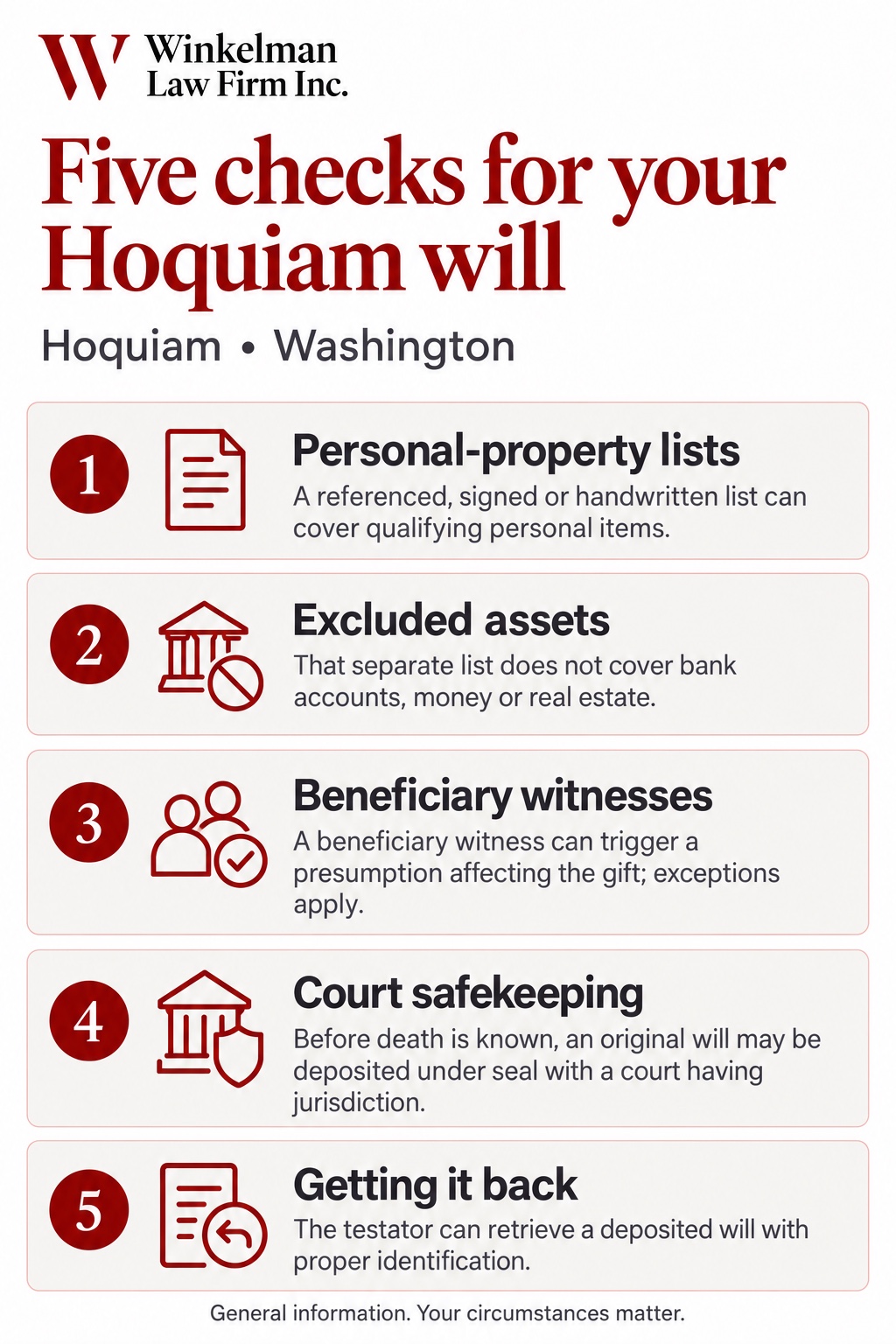
For Hoquiam wills, we review lists about jewelry, tools, photographs and other belongings alongside the signed document. Keep the notes dated and identify the items clearly. We can explain whether a separate property list fits the will instead of assuming every informal note changes an inheritance.
We address document storage when updating a will for clients in Hoquiam, Washington. Several signed versions can leave family members uncertain about which document expresses your current wishes. Before destroying or marking an older original, let us review the replacement and explain an appropriate recordkeeping approach.
Our Hoquiam wills planning includes practical information for the people you nominate. Keep a separate record of where originals are stored and how to reach important financial and professional contacts. We can help distinguish useful administration instructions from gifts or legal directions that belong in the will itself.
No. Washington's separate-writing procedure concerns qualifying tangible personal property and excludes bank deposits, money, securities and real estate. The writing must also satisfy the statute's reference, signature or handwriting, and identification requirements. See RCW 11.12.260 : Separate writing for tangible personal property.
An interested witness does not by itself invalidate a Washington will. However, unless at least two other subscribing witnesses are disinterested, a rebuttable presumption can affect the gift to that witness. Have the circumstances reviewed before relying on the gift. See RCW 11.12.160 : Interested witness.
Washington permits an original will to be deposited under seal with a court having jurisdiction before the court knows of the person's death. The statute also addresses withdrawal and identification, so ask the appropriate clerk about its filing procedure and keep a record of the deposit. See RCW 11.12.265 : Filing original will before death.
No. The federal estate-tax filing threshold is $15 million for 2026, with adjusted taxable gifts considered in the filing test. That tax threshold does not decide who receives property or who should administer an estate. We can review a Hoquiam will for those separate planning decisions. See IRS: estate tax.
We assist clients with Hoquiam wills from our office in Hoquiam, Washington. You can contact us and mention your main concerns, any existing documents and upcoming dates. We can then discuss your circumstances and the next steps for a consultation.