Spousal support can become one of the most important financial issues in a divorce, particularly when spouses have substantially different incomes, earning abilities, or financial resources. In Washington, this form of support is generally called spousal maintenance, although many people refer to it as alimony or spousal support.
Winkelman Law Firm represents clients in Hoquiam, throughout Grays Harbor County, and across surrounding Western Washington communities in spousal maintenance matters. Our Hoquiam spousal support attorneys represent individuals seeking maintenance as well as those responding to support requests.
Maintenance decisions can affect both spouses' financial circumstances after divorce. Our lawyers evaluate income, property, financial needs, earning circumstances, and the other factors relevant to the case so clients can understand how a maintenance request fits into the larger financial resolution of their divorce.
Spousal maintenance is financial support that one spouse may be ordered to provide to the other during or after a divorce or legal separation. Unlike child support, maintenance is not determined by applying one statewide economic table or universal mathematical formula.
A court instead evaluates the circumstances of the spouses under Washington law.
Maintenance is not automatically awarded simply because one spouse earns more than the other. Likewise, a difference in income does not by itself determine the amount or duration of support.
Depending on the case, the analysis may involve:
These considerations can interact with one another. A spouse's income, for example, may look very different when evaluated alongside housing costs, debts, retirement assets, or the property received in the divorce.
The circumstances can also differ significantly between marriages. A maintenance dispute following a relatively short marriage between two financially independent spouses may present different questions from a divorce following a lengthy marriage in which one spouse spent substantial time outside the workforce.
Our Hoquiam spousal maintenance lawyers evaluate the complete financial picture rather than focusing on a single factor. We help clients understand how Washington's maintenance standards may apply and develop positions supported by the financial and personal circumstances of the marriage.
Whether maintenance is appropriate depends on the circumstances surrounding the marriage and the spouses at the time of the divorce.
One common issue is financial disparity. A spouse who has substantially less income or fewer financial resources may request support, particularly when becoming financially independent immediately after divorce would be difficult.
However, income disparity is only part of the analysis.
A spouse may have spent years caring for children or managing the household while the other spouse developed a career. Another spouse may need education or professional training before returning to full-time employment. In a long-term marriage, the spouses may be approaching retirement with substantially different earning capacity or financial resources.
Circumstances that may become important in a maintenance case include:
No single circumstance necessarily determines whether maintenance will be awarded.
The court must evaluate the legally relevant factors based on the evidence presented. That makes accurate financial information particularly important when maintenance is disputed.
Our Hoquiam alimony attorneys represent clients on both sides of these cases. We help individuals requesting maintenance document the circumstances supporting their position, while also representing spouses who believe a requested amount or duration is unsupported by the financial facts.
Because Washington does not use one universal formula to calculate spousal maintenance, determining an appropriate amount can require detailed analysis of both spouses' finances.
Income is an important starting point, but gross earnings alone may not provide an accurate picture of either spouse's circumstances.
A maintenance analysis may require reviewing:
The objective is not simply to compare paychecks. The financial circumstances of both spouses matter, including the needs of the spouse requesting maintenance and the other spouse's ability to pay while meeting personal financial obligations.
Disagreements may arise over what income should be considered, whether stated expenses are reasonable, or whether a spouse has the ability to earn more than current income suggests. Business owners and individuals with variable compensation can present additional financial questions.
Property division may also influence the analysis. A spouse receiving income-producing assets or substantial financial resources may be in a different position from a spouse leaving the marriage with limited liquid assets or earning ability.
Our Hoquiam spousal support attorneys review the financial information underlying maintenance requests and proposed payments. When the parties disagree about the appropriate amount, we help clients identify the relevant evidence, evaluate potential resolutions, and present their position through negotiation, mediation, or court proceedings when necessary.
The duration of spousal maintenance depends on the circumstances of the marriage and the financial position of the spouses. Washington does not impose one standard maintenance period that applies to every divorce.
In some cases, maintenance may be intended to provide financial support while a spouse works toward greater independence. That could involve completing education, obtaining professional training, returning to the workforce, or rebuilding earning capacity after spending significant time away from employment.
Other marriages may present substantially different circumstances. A spouse leaving a long-term marriage later in life, for example, may have fewer realistic opportunities to develop earning capacity comparable to that of the other spouse.
Factors relevant to duration can overlap with those considered when deciding whether maintenance should be awarded at all, including:
Maintenance should therefore be evaluated based on the individual case rather than assumptions about a predetermined number of months or years.
Our Hoquiam spousal support attorneys help clients evaluate proposed maintenance terms in light of both current finances and realistic future circumstances. Whether a client is requesting support or responding to a request, we consider how the proposed duration fits within the larger financial resolution of the divorce.
Financial needs do not necessarily wait until a divorce is final. When spouses separate, one household becomes two, and a spouse may have difficulty meeting expenses while property, support, and other divorce issues remain unresolved.
Temporary maintenance may be requested while a divorce is pending. Its purpose is to address financial circumstances during the case rather than determine automatically what support, if any, should continue under the final divorce orders.
Temporary support disputes may involve questions about:
The distinction between temporary and final maintenance is important. Circumstances during the divorce may differ from the financial situation that exists after property and debts have been divided and final orders are entered.
Our Hoquiam alimony lawyers represent clients requesting temporary maintenance and those responding to temporary support requests. We evaluate immediate financial needs while also considering how temporary positions may relate to the broader financial issues that still need to be resolved.
Long-term marriages can raise particularly significant maintenance questions when the spouses leave the marriage with substantially different incomes, earning abilities, or financial resources.
Over the course of a lengthy marriage, spouses may have made decisions that affected their individual economic positions. One spouse may have concentrated on a career or business while the other spent substantial time caring for children, managing the household, working reduced hours, or otherwise limiting career development.
By the time the marriage ends, recreating comparable earning opportunities may not be realistic.
Long-term marriage cases may involve issues such as:
The length of the marriage is important, but it does not create an automatic maintenance result. Courts still evaluate the relevant circumstances of the spouses and the financial evidence presented.
These cases can also require careful coordination between maintenance and property division. Retirement accounts, real estate, investments, and other assets may substantially affect each spouse's post-divorce financial position.
Our Hoquiam spousal maintenance attorneys help clients evaluate these interconnected issues rather than treating support as an isolated monthly payment. That broader analysis can be especially important when the financial consequences of divorce will extend into retirement.
Spousal maintenance and property division are separate issues, but they can be closely connected when determining each spouse's financial circumstances after divorce.
The assets and debts allocated to a spouse may affect available financial resources, monthly expenses, and the ability to become financially independent. For example, retaining a home may provide stability while also creating ongoing mortgage, tax, insurance, and maintenance expenses. Retirement or investment assets can have different practical consequences from receiving cash or other immediately available property.
Relevant considerations may include:
This is one reason maintenance should not be negotiated without considering the rest of the divorce settlement. An agreement that appears reasonable when looking only at monthly income may produce a different result once property, debts, housing, and retirement resources are considered.
Our Hoquiam spousal support lawyers evaluate maintenance alongside the client's broader financial position. Winkelman Law Firm's experience with family law, business matters, real estate, and estate planning also allows our team to recognize financial issues that can extend beyond the support payment itself.
Spousal maintenance disputes do not always center on whether one spouse currently earns more than the other. In some cases, the disagreement concerns what each spouse actually earns, what financial resources are available, or what a spouse can reasonably be expected to earn in the future.
Income analysis can become more complicated when compensation is not limited to a predictable salary.
Disputes may involve:
A spouse who owns a business, for example, may have financial circumstances that cannot be understood from a single paycheck. Business records, tax returns, compensation history, and legitimate business expenses may require closer review.
Earning capacity can create different questions. A spouse who has spent years outside the workforce may not be able to immediately earn income comparable to someone with an established career. Conversely, a dispute may arise when one spouse believes the other is voluntarily earning substantially less than circumstances reasonably support.
These issues are highly dependent on the facts. Assumptions about what someone “should” earn are not a substitute for examining employment history, education, experience, health, available opportunities, and other relevant circumstances.
Our Hoquiam spousal maintenance attorneys help clients evaluate the financial evidence underlying disputed support requests. When income or earning capacity is contested, we work to develop a clear financial picture that supports the client's position during negotiation, mediation, or court proceedings.
A maintenance obligation may continue after the divorce is finalized, which can raise questions when circumstances later change.
Whether an existing maintenance order can be modified depends on Washington law and the terms of the order itself. The circumstances surrounding the requested change also matter.
A modification dispute may arise after a significant change affecting the financial circumstances of either former spouse. Other events may affect whether maintenance continues under the terms of an existing order or applicable law.
Importantly, a person paying maintenance should not simply reduce or stop court-ordered payments based on a personal determination that circumstances have changed. Likewise, a person receiving maintenance should not assume that every financial change will support an increase or extension.
The existing divorce orders should be reviewed carefully before deciding how to proceed.
Our Hoquiam spousal support lawyers help clients evaluate existing maintenance provisions and determine what options may be available when circumstances change. We represent individuals seeking modification as well as those opposing requested changes to established maintenance obligations.
Spousal maintenance can require detailed analysis of income, property, debts, employment, business interests, and long-term financial circumstances. Effective representation requires understanding how those issues fit within the larger divorce.
Winkelman Law Firm'sattorneys bring decades of combined legal experience to clients facing family law and financial disputes in Hoquiam and throughout Grays Harbor County.
Founding shareholder Ben Winkelman has more than 20 years of legal experience, including substantial work involving family law, trial practice, and mediation. His background includes service on the Washington State Bar Family Law Section Executive Committee from 2007 through 2013, including serving as chair.
Associate attorney Ryan M. Pesicka brings additional family law and litigation experience, including representing clients in family law matters in Grays Harbor County.
Our Hoquiam spousal support attorneys represent clients seeking maintenance as well as those responding to support requests. We focus on the financial evidence, the circumstances of the marriage, and the client's broader position in the divorce rather than treating maintenance as an isolated issue.
Spousal maintenance can have lasting consequences for both parties to a divorce. Understanding how income, earning capacity, property, and other financial circumstances affect the issue can help you make informed decisions before agreeing to support terms or presenting the matter to the court.
Winkelman Law Firm represents clients in Hoquiam, throughout Grays Harbor County, and across surrounding Western Washington communities.
If spousal support or alimony is an issue in your divorce,contact our Hoquiam spousal support attorneys to schedule an appointment. Our team can evaluate the financial circumstances involved, explain your options, and help you pursue an appropriate resolution under Washington law.
Reviewed for legal accuracy by Benjamin R Winkelman on October 18, 2026
For Hoquiam spousal support, we suggest identifying the source and date of bonuses, sale proceeds and other unusual receipts. Keep the supporting statements as well as ordinary pay records. We can assess the overall financial picture instead of assuming every deposit represents recurring earnings.
In Hoquiam spousal support matters, a realistic plan can identify tuition, necessary materials and the expected schedule. Keep the supporting program information and distinguish estimates from confirmed costs. We can review how the plan relates to the legal issues without promising that any particular request will be awarded.
For Hoquiam spousal support, the wording and history of the obligation matter to a review. Keep the signed agreement, decree and any later modification together. We can examine those terms before evaluating a proposed change or relying on a summary of the arrangement.
We recommend coordinating Hoquiam spousal support proposals with appropriate tax advice. Federal treatment can depend on the governing agreement and its date. We review the legal language with that context rather than assuming every maintenance payment has the same tax consequences.
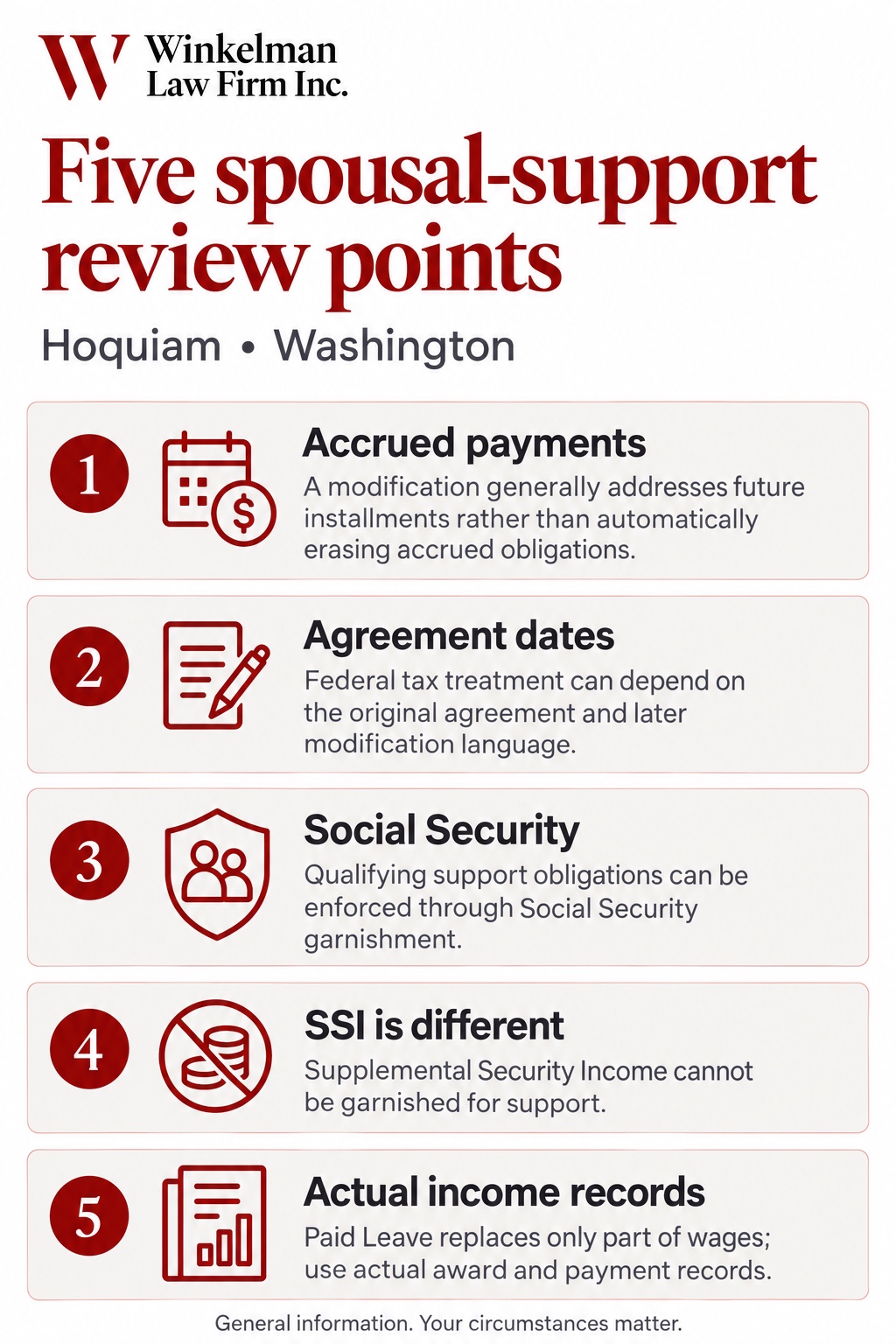
A later maintenance modification generally concerns installments accruing after the request, rather than automatically erasing obligations that already accrued. The decree, any written agreement and statutory exceptions still need review before calculating what remains payable. See RCW 26.09.170: Modification of support, maintenance and property orders.
It can. For certain agreements executed before 2019, a later modification changes the federal alimony treatment only if it expressly provides that the post-2018 rules apply. Review the original agreement and modification language before changing how payments are reported. See IRS: Alimony tax treatment.
Social Security benefits can be garnished to enforce qualifying child-support or alimony obligations. Supplemental Security Income, or SSI, is treated differently and cannot be garnished, so identify the actual benefit type before assuming the same rule applies. See SSA: Garnishment and SSI distinction.
No. Paid Leave benefits replace only part of wages, and the program lists a $1,647 maximum weekly benefit for 2026. Actual awards can be lower, and the claim's starting year matters. Bring award and payment records to a maintenance review instead of substituting regular salary or the maximum benefit for actual receipts. See Washington Paid Leave: benefit amounts.
We assist clients with Hoquiam spousal support from our office in Hoquiam, Washington. You can contact us and mention your main concerns, any existing documents and upcoming dates. We can then discuss your circumstances and the next steps for a consultation.