Advance health care planning allows you to document important medical treatment preferences before circumstances arise in which you may be unable to communicate those wishes yourself. It can also give the people closest to you clearer guidance during difficult decisions.
At Winkelman Law Firm, our Hoquiam advance health care directive attorneys help individuals and families prepare health care planning documents that reflect their values, preferences, and broader estate plans. We serve clients in Hoquiam, throughout Grays Harbor County, and across surrounding Western Washington communities.
Health care directives are not limited to people facing an immediate medical concern. Preparing these documents in advance gives you an opportunity to make thoughtful decisions while you are able to communicate your wishes clearly. Our lawyers help clients understand their options and coordinate health care directives with powers of attorney and other important estate planning documents.
An advance health care directive is a legal document through which an individual can provide instructions concerning certain health care decisions if circumstances arise in which the individual cannot make or communicate those decisions.
These documents are sometimes referred to as health care directives or living wills. Their purpose is different from a traditional will. A will primarily addresses matters that arise after death, while a health care directive concerns medical treatment decisions during life.
A directive allows an individual to consider certain treatment preferences in advance rather than leaving those questions entirely unresolved during a medical crisis.
Depending on the circumstances addressed by the document, a health care directive may provide instructions concerning whether particular life-sustaining treatment should be provided or withheld when specified medical conditions exist.
Advance planning can be valuable for several reasons. It can:
Preparing a directive requires personal decisions. Two people with similar family or financial circumstances may have very different preferences concerning medical treatment.
For that reason, our Hoquiam advance health care directive lawyers focus on helping clients understand the legal purpose and effect of the document so they can make choices consistent with their own values.
Advance health care planning is ultimately about preserving the client's ability to express those choices in advance, while the client can consider them carefully.
A health care directive allows an individual to document preferences concerning treatment under the circumstances covered by the directive. In Washington, these documents can be particularly important when a person is unable to communicate and is facing specified medical circumstances involving life-sustaining treatment.
The decisions involved can be deeply personal. Some individuals want medical treatment continued for as long as possible under particular circumstances. Others may not want certain interventions used when the conditions identified in their directive have been met.
Advance planning gives individuals an opportunity to consider those choices before an emergency occurs.
Depending on the document and the client's wishes, planning may address preferences involving matters such as:
A health care directive does not require everyone to make the same choices. Its purpose is to communicate the individual's decisions.
Clients should also understand the difference between legal planning and medical advice. An attorney can help prepare a directive that documents a client's wishes and complies with applicable legal requirements, but questions about particular treatments, medical conditions, or likely outcomes are appropriately discussed with qualified health care professionals.
For some Hoquiam residents, conversations with both an attorney and a physician can be helpful when preparing or reviewing advance health care documents.
Clarity is important. Vague assumptions about what someone “would probably want” can be difficult for family members and decision-makers to apply during stressful circumstances. Written instructions provide a clearer expression of the client's preferences.
Our Hoquiam health care directive attorneys help clients establish those instructions as part of a broader plan for lifetime decision-making.
Advance health care directives and health care powers of attorney are related, but they perform different functions.
An advance health care directive primarily communicates the individual's own treatment instructions for circumstances covered by the document. It answers questions about what the individual wants.
A health care power of attorney, by contrast, concerns who has authority to make health care decisions when the individual cannot make those decisions personally and the agent's authority applies.
Having one does not necessarily make the other unnecessary.
A written directive can provide valuable guidance, but medical situations do not always fit neatly within circumstances someone anticipated years earlier. A trusted health care decision-maker may need to address questions that are not specifically answered by the directive.
Likewise, appointing someone to make health care decisions does not necessarily communicate everything the individual wants that person to consider.
Using the documents together can establish both:
The individual selected for health care decision-making should understand the client's values and be willing to follow the client's expressed wishes even when those choices differ from what the decision-maker might personally prefer.
Health care planning should also remain distinct from financial planning. The person authorized to make medical decisions does not automatically receive authority to manage bank accounts, property, or other financial affairs. Those responsibilities are generally addressed separately through financial powers of attorney or other estate planning arrangements.
Our Hoquiam estate planning attorneys help clients coordinate these different documents so that financial authority, health care decision-making, and written medical instructions each have a clearly defined role.
Selecting someone to make health care decisions can be one of the most personal parts of advance planning. The person chosen may eventually need to communicate with medical professionals, consider treatment options, and make difficult decisions when the individual cannot speak for themselves.
Trust is essential, but it is not the only consideration. Hoquiam residents choosing a health care decision-maker should consider whether the person:
It can also be helpful to identify an alternate decision-maker in case the first person selected cannot or will not serve when needed.
Once someone is selected, communication matters. Discussing treatment preferences in advance can give the decision-maker context that a legal document alone may not fully provide. The individual can explain what matters most to them and make sure the person selected knows where relevant documents are kept.
Our Hoquiam estate planning lawyers help clients establish clear health care decision-making arrangements and coordinate them with written directives. Thoughtful planning can give the selected person both legal guidance and a better understanding of the client's wishes.

Advance health care planning allows individuals to make important choices before a medical crisis places those decisions in someone else's hands.
Without clear instructions, loved ones may be asked to make difficult decisions while trying to determine what the individual would have wanted. Even family members who know someone well may have different understandings of that person's preferences.
A health care directive can reduce that uncertainty by documenting the individual's wishes in advance.
For Hoquiam residents, advance planning can provide several practical benefits. It can create a written record of treatment preferences, provide guidance to health care decision-makers, and encourage important conversations with family members before urgent circumstances arise.
It can also preserve personal choice. The purpose of a directive is not to dictate which medical decisions are right for everyone. Instead, it gives each individual an opportunity to express what is right for them within the circumstances the document addresses.
Advance planning is therefore relevant well before someone develops a serious illness. Adults of different ages and health circumstances can benefit from considering who should make decisions if they cannot and what guidance that person should have.
At Winkelman Law Firm, our Hoquiam advance health care directive attorneys help clients address these questions proactively. The goal is to create clear legal documents while the client can thoughtfully consider and communicate personal preferences.
A comprehensive estate plan addresses more than what happens to property after death. It can also establish who has authority to act and what instructions should guide important decisions during life.
Advance health care directives are one part of that larger structure.
Depending on the client's circumstances, an estate plan may include:
Each serves a different purpose.
A will or trust can address the eventual disposition and administration of property, but those documents do not substitute for health care planning. Likewise, a financial agent's authority over property does not automatically give that person authority to make medical decisions.
Coordinating these documents helps reduce gaps and confusion. A Hoquiam resident may select one person to manage financial matters and another to make health care decisions, or may decide that the same trusted individual is appropriate for both roles. Either approach should be reflected clearly in the relevant documents.
Our Hoquiam estate planning attorneys help clients consider these relationships as part of a coordinated plan. The objective is not to create unnecessary paperwork, but to make sure each document addresses a defined need and works consistently with the client's overall intentions.
Advance health care directives are best prepared before an urgent medical situation develops. Creating one while healthy gives an individual time to consider treatment preferences, discuss questions with appropriate professionals, and communicate with the people who may eventually be involved in decision-making.
An existing directive should also be reviewed periodically.
Circumstances that may prompt a review include:
A review does not necessarily mean the directive needs to be changed. It provides an opportunity to confirm that the existing instructions and decision-makers remain appropriate.
Communication should be revisited as well. If treatment preferences change, the people expected to participate in health care decisions should understand those changes and know that updated documents exist.
Our Hoquiam advance health care directive lawyers help clients create new directives and review existing planning documents. Keeping health care instructions current can help ensure that the written plan continues to reflect the individual's choices.
Advance health care planning involves personal decisions that deserve careful attention and clear documentation. At Winkelman Law Firm, ourattorneys bring decades of combined legal experience to individuals and families in Hoquiam, throughout Grays Harbor County, and beyond.
Founding shareholder Ben Winkelman has more than 20 years of legal experience, including work involving wills, trusts, estate planning, and probate. Associate attorney Ryan M. Pesicka also brings estate planning experience from his broader legal background.
Our Hoquiam estate planning attorneys help clients understand the purpose of advance health care documents and how those documents coordinate with powers of attorney and other parts of an estate plan. We approach these conversations with care while providing practical guidance that allows each client to make decisions based on personal values and circumstances.
The goal is clear, individualized planning that documents the client's wishes and gives trusted decision-makers meaningful guidance when it may be needed most.
Advance health care planning gives you an opportunity to document important wishes before someone else may need to make decisions on your behalf.
Winkelman Law Firm helps individuals and families in Hoquiam, throughout Grays Harbor County, and across surrounding Western Washington communities prepare and review advance health care directives as part of comprehensive estate planning.
To create a directive or review an existing plan,contact our Hoquiam advance health care directive attorneys to schedule an appointment. Our lawyers can help you document your wishes, establish appropriate decision-making arrangements, and coordinate your health care planning with the rest of your estate plan.
Reviewed for legal accuracy by Benjamin R Winkelman on October 18, 2026
When discussing Hoquiam advance health care directives, we distinguish legal planning documents from medical orders used by treating professionals. A POLST is a portable medical order and does not simply replace an advance directive. We recommend discussing the medical choices with your clinician while we review how your legal documents fit together.
For Hoquiam advance health care directives, we suggest keeping a readable copy available for new medical providers. Ask how the provider will add it to your record and confirm that the copy reflects your current document. We can review conflicting versions or questions about the legal paperwork before they create confusion.
Our work with Hoquiam advance health care directives can include discussing the values you want your agent to understand. A separate note may explain concerns about independence, communication or important personal beliefs. We help distinguish that guidance from the formal document and encourage clinical questions to be discussed with your provider.
We suggest checking dates and signatures when reviewing Hoquiam advance health care directives. Family members and providers may have copies from different planning periods. We can help identify which legal documents need review before you distribute an updated set and explain how to reduce uncertainty about older copies.
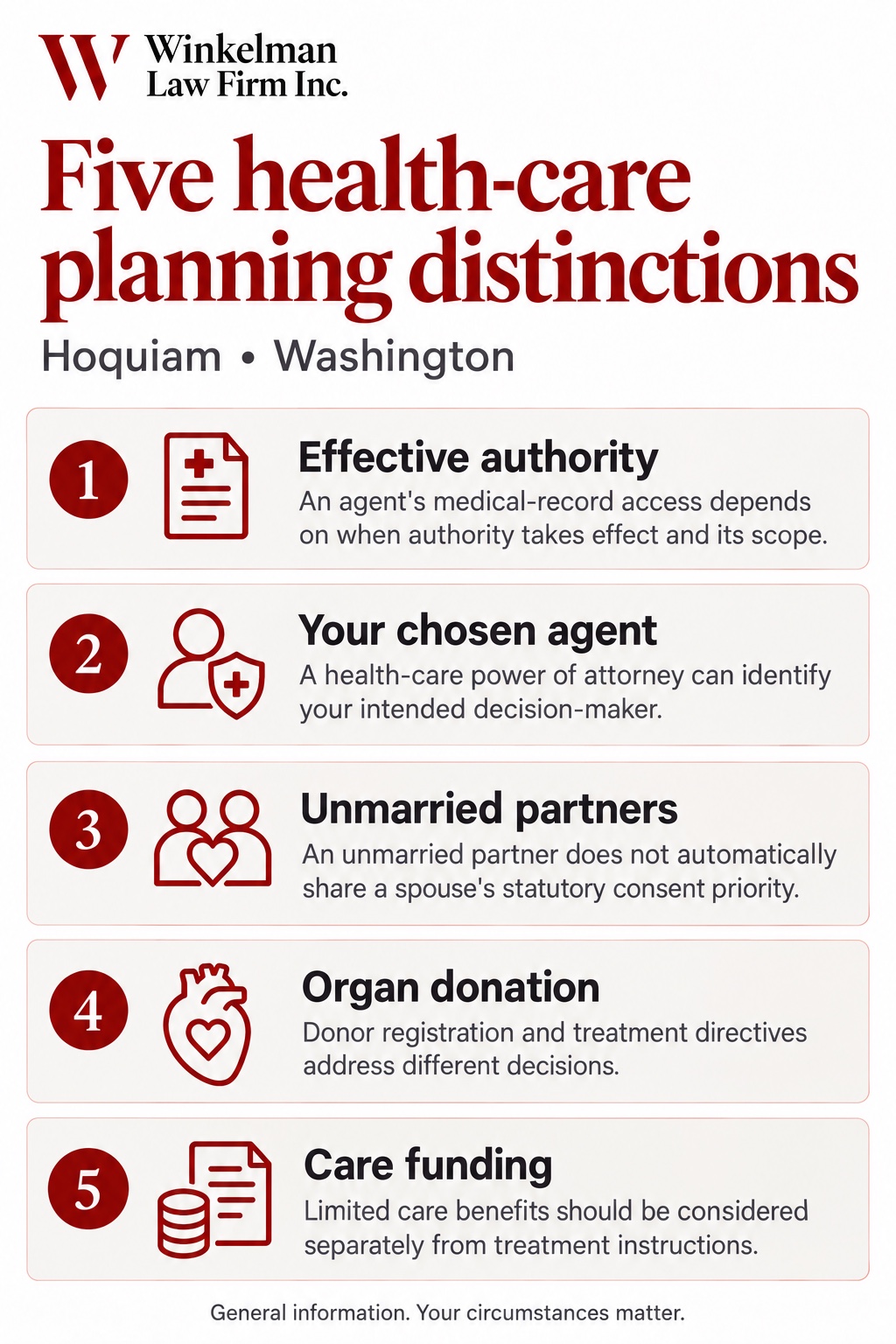
Access depends on whether the health-care power of attorney is currently effective and on the scope of the agent's authority. HHS explains that some documents operate immediately while others become effective only upon incapacity, with additional HIPAA exceptions that may limit access. See HHS: Health care agents and medical records.
Being an unmarried partner alone does not place someone in the same statutory priority class as a spouse or state-registered domestic partner. A health-care power of attorney can identify the intended agent; without one, the statutory priority and qualifying close-friend provisions require careful review. See RCW 7.70.065: Health care consent priority.
No. Organ-donor registration records donation decisions to be carried out at death, while a health-care directive addresses separate treatment instructions. Keep both choices consistent and share the relevant documents with the people involved in your care. See Washington organ donor registration.
No. The full WA Cares benefit is a $36,500 lifetime amount in 2026, and some people qualify for a prorated amount. Contribution and care-needs requirements apply. When discussing future care preferences, consider this limited funding separately from treatment instructions and decision-maker documents. See WA Cares: covered benefits.
We assist clients with Hoquiam advance health care directives from our office in Hoquiam, Washington. You can contact us and mention your main concerns, any existing documents and upcoming dates. We can then discuss your circumstances and the next steps for a consultation.