Protecting property requires more than reacting after a financial or legal problem develops. Effective asset protection planning begins by identifying potential risks, evaluating how property is owned, and considering legal strategies that can reduce unnecessary exposure before a claim or dispute arises.
At Winkelman Law Firm, our Hoquiam asset protection planning attorneys help individuals, families, property owners, and business owners evaluate strategies for protecting what they have built. We serve clients in Hoquiam, throughout Grays Harbor County, and across surrounding Western Washington communities.
Asset protection does not mean hiding property or placing assets beyond every possible creditor. Instead, our lawyers focus on lawful, proactive planning tailored to each client's property, business interests, family circumstances, and long-term objectives. The appropriate strategy may involve several legal and financial considerations working together rather than relying on a single document or entity.
Asset protection planning is the process of evaluating potential financial and legal risks and structuring property and business interests in ways designed to reduce unnecessary exposure. It is generally most effective when completed proactively, before a specific claim, lawsuit, or creditor issue develops.
The appropriate strategy depends on both the assets a person owns and the risks that person faces. A Hoquiam business owner, for example, may have different concerns from someone who owns several rental properties or a family primarily focused on preserving accumulated wealth for future generations.
Asset protection planning may involve evaluating:
No single strategy provides complete protection against every possible claim. An LLC, trust, insurance policy, or particular ownership structure may address certain risks while doing little to address others.
Effective planning therefore begins with understanding the client's exposure.
Our Hoquiam asset protection lawyers work with clients to identify the property they want to protect, the sources of potential liability, and the legal structures already in place. From there, we can evaluate whether changes should be considered as part of a broader planning strategy.
Asset protection should also be coordinated with other goals. A structure that addresses liability but interferes with estate planning, business operations, financing, or long-term ownership objectives may create new problems rather than solve existing ones.
The objective is a practical plan that balances protection, control, flexibility, and the client's long-term needs.
Asset protection planning is not limited to extremely wealthy individuals. The need for planning is often driven by the type of property someone owns, the activities that create potential liability, and the financial consequences of an unexpected claim.
Business owners are one group that may benefit from reviewing asset protection strategies. Operating a company can create risks involving contracts, customers, employees, property, financing, and other business relationships. Appropriate entity structure and disciplined separation between personal and business affairs can be important components of broader risk planning.
Real estate owners may have different concerns. Someone who owns rental or investment property may want to evaluate how those assets are titled, how liability associated with the property is addressed, and how ownership fits within an estate or succession plan.
Other individuals who may have reasons to consider asset protection planning include:
The existence of risk does not necessarily mean complicated planning is required. Some Hoquiam clients may benefit primarily from reviewing business structures, insurance, and ownership arrangements. Others may have circumstances that justify considering trusts or more specialized strategies.
Planning should also account for the client's need to retain access and control. A strategy that technically separates someone from an asset but prevents that person from using or managing property as intended may not be appropriate.
Our Hoquiam asset protection attorneys help clients evaluate those tradeoffs. Rather than beginning with a predetermined solution, we consider the client's assets, potential exposure, existing legal structures, and broader estate or business planning objectives.
Effective asset protection planning often involves several complementary strategies. The appropriate combination depends on what a client owns, how those assets are used, and the types of liability the client is attempting to address.
For Hoquiam residents and business owners, potential strategies may include:
Business entities are a common component of asset protection planning, but forming an entity alone is not the end of the process. How the business is operated, documented, financed, and kept separate from personal affairs can remain important.
Insurance can provide another layer of risk management. Legal planning and insurance serve different purposes, and one should not automatically be viewed as a substitute for the other. Reviewing them together can help identify unnecessary gaps.
Trusts may also play a role in certain circumstances. However, transferring assets to a trust does not automatically shield them from creditors. The type of trust, the rights retained by the person creating it, the timing of transfers, and applicable law all matter.
For clients with multiple businesses, real estate holdings, or significant family assets, coordination becomes especially important. A structure designed solely around liability concerns may conflict with financing requirements, tax considerations, estate planning, or succession goals if those issues are not evaluated together.
Our Hoquiam asset protection planning lawyers help clients consider these strategies as parts of an overall plan. The goal is not to create unnecessary layers of entities and documents. It is to identify meaningful risks and use appropriate legal tools to address them while preserving the flexibility clients need to manage their property and businesses.

Business ownership and real estate can create distinct liability concerns that make proactive planning particularly important. The appropriate strategy should account for both the risks associated with the asset and the owner's need to operate, finance, manage, and eventually transfer that property.
For business owners, entity structure can be an important starting point. Depending on the circumstances, operating through an appropriate business entity may help separate certain business liabilities from personal ownership. However, forming an entity does not mean every personal asset is automatically protected from every business-related obligation.
How the business operates matters as well. Maintaining appropriate financial separation, following governing documents, documenting important transactions, and avoiding unnecessary personal guarantees can all be relevant to a broader asset protection strategy.
Real estate owners face different considerations. Rental properties, commercial real estate, and other investment properties can create liabilities associated with ownership and operation. Clients may want to evaluate how individual properties are owned, whether multiple properties should be treated differently, and how liability planning coordinates with financing and insurance.
Business and real estate planning should also account for the future. A structure that works while the original owner is actively managing property may need to address what happens if the owner becomes incapacitated, retires, sells an interest, or dies.
For clients in Hoquiam and throughout Grays Harbor County, these concerns often overlap with estate and business succession planning.
Our Hoquiam asset protection attorneys help business and property owners consider liability, ownership, management, and succession together. A coordinated approach can address current risks while preserving flexibility for future transactions and long-term ownership goals.
Trusts can play a role in some asset protection strategies, but the level of protection depends heavily on the type of trust and the rights retained by the person transferring property.
A standard revocable living trust generally allows the person creating it to retain substantial control over trust assets. That flexibility can make revocable trusts useful for estate planning, incapacity planning, and administration, but it does not automatically provide meaningful protection from the settlor's own creditors.
Certain irrevocable trust arrangements may present different possibilities because the settlor can relinquish rights or control over transferred property. Even then, protection is not automatic.
The effectiveness of a trust can depend on factors including:
Clients should also consider the practical consequences of transferring assets. A strategy that requires relinquishing substantial control may not be appropriate when the client expects to continue using or managing the property freely.
Our Hoquiam asset protection lawyers evaluate trusts within the context of the client's overall objectives. When a trust is appropriate, it should serve a defined estate, wealth-transfer, or protection purpose rather than being created based on the assumption that placing an asset in a trust makes it unreachable.
Asset protection planning is fundamentally proactive. Strategies implemented before a specific dispute, debt, lawsuit, or creditor issue develops generally present very different considerations from transfers attempted after a claim has arisen.
Washington law places limits on transfers made for the purpose of improperly preventing legitimate creditors from reaching property that would otherwise be available to satisfy an obligation. As a result, asset protection should not be viewed as a method for hiding assets or moving property beyond reach after someone already faces a known liability.
Planning earlier provides an opportunity to evaluate risks and establish appropriate ownership structures for legitimate purposes before a crisis dictates the client's decisions.
For example, a business owner may consider entity structure and insurance when establishing or expanding a company. A real estate investor may evaluate ownership arrangements when acquiring property. A family with accumulated wealth may address trusts, succession, and estate planning long before a specific creditor concern develops.
Waiting until a serious problem exists can substantially narrow the available options.
Timing also matters when circumstances change. A Hoquiam resident who purchases investment property, starts a business, assumes new contractual obligations, or accumulates significant assets may develop risks that were not present when an earlier estate or financial plan was created.
Periodic review can help identify those changes before they become urgent.
Our Hoquiam asset protection planning attorneys help clients evaluate potential exposure and consider lawful strategies based on their current circumstances. The objective is forward-looking risk management—not an attempt to evade existing legal responsibilities.
Asset protection and estate planning often address different concerns, but they should work together.
Estate planning determines how property will be managed during incapacity and transferred after death. Asset protection planning focuses more directly on identifying exposure and considering ways to reduce unnecessary risk during life. Decisions made for one purpose can affect the other.
For example, changing ownership of real estate or business interests for liability purposes can affect how those assets pass at death. Transferring property to a trust may change who controls the asset and how it is ultimately distributed. Business entity structures may also need to coordinate with succession arrangements.
A comprehensive plan may consider:
Asset protection can also extend beyond protecting the current owner. Some estate plans use appropriately structured trusts or other arrangements to control how inherited property is managed for beneficiaries rather than requiring immediate outright distribution.
The right strategy depends on the family's objectives and circumstances. Not every client needs complex entities or trusts, and adding unnecessary layers can make property more difficult to manage.
At Winkelman Law Firm, our Hoquiam asset protection attorneys consider estate planning, ownership, and risk management together. For clients throughout Grays Harbor County, that coordinated approach can help protect current interests while keeping long-term family, business, and succession goals in view.
Asset protection planning can become less effective when clients rely on assumptions about how entities, trusts, or ownership arrangements work. A strategy should be based on the client's actual risks and property rather than a general belief that a particular legal structure protects everything.
Common mistakes include:
Overcomplication can also be a problem. Creating multiple entities or transferring property into sophisticated structures does not necessarily produce better protection. Additional complexity can create administrative burdens and unintended consequences when the structure does not address a genuine risk.
For Hoquiam residents and business owners, effective planning starts with identifying the exposure that actually exists. From there, legal structures, insurance, estate planning, and business practices can be evaluated together.
Our Hoquiam asset protection lawyers help clients distinguish useful planning from unnecessary complexity. A thoughtful strategy should address identifiable risks while remaining practical enough to work with the client's business, property, and long-term goals.
Asset protection planning often overlaps with estate planning, business law, real estate, and long-term succession concerns. Winkelman Law Firm'sattorneys bring decades of combined legal experience serving individuals, families, and businesses in Hoquiam, throughout Grays Harbor County, and beyond.
Founding shareholder Ben Winkelman has more than 20 years of legal experience across estate planning, business law, real estate, and related civil matters. Associate attorney Ryan M. Pesicka brings experience involving estate planning, business law, contracts, entity formation, and real property matters.
That broader perspective allows our Hoquiam asset protection attorneys to consider how a proposed strategy may affect other parts of a client's financial and legal planning. Our team focuses on practical solutions designed around the client's actual assets, risks, and objectives rather than relying on one-size-fits-all structures.
Asset protection is most effective when potential risks are addressed before they become urgent legal or financial problems.
Winkelman Law Firm helps individuals, families, property owners, and business owners in Hoquiam and throughout Grays Harbor County evaluate proactive strategies for protecting their assets and coordinating those strategies with broader estate and business planning.
To discuss your property, business interests, and potential exposure,contact our Hoquiam asset protection planning attorneys to schedule an appointment. Our lawyers can help you identify potential risks and evaluate legal strategies appropriate for your circumstances.
Reviewed for legal accuracy by Benjamin R Winkelman on October 18, 2026
In Hoquiam asset protection planning, we ask about personal guarantees as well as the company's ownership structure. A loan, lease or supplier agreement may create obligations that need individual review. We consider the signed terms before assuming that operating through an entity resolves a particular exposure.
We use Hoquiam asset protection planning to look at legal structures alongside available coverage. Policy limits, exclusions and named insureds can matter as much as the policy's title. We can identify coordination questions for your insurance professional without assuming every potential loss is insured.
For Hoquiam asset protection planning, we review deeds, ownership agreements, loans and information about how the property is used. Different owners may have different obligations or expectations. We use the actual records to assess options before recommending a transfer or change in title.
We need to know about threatened claims when evaluating Hoquiam asset protection planning. Washington law can expose certain transfers to challenge, so a demand letter is important context. We review the facts and timing before discussing any proposed movement of property.
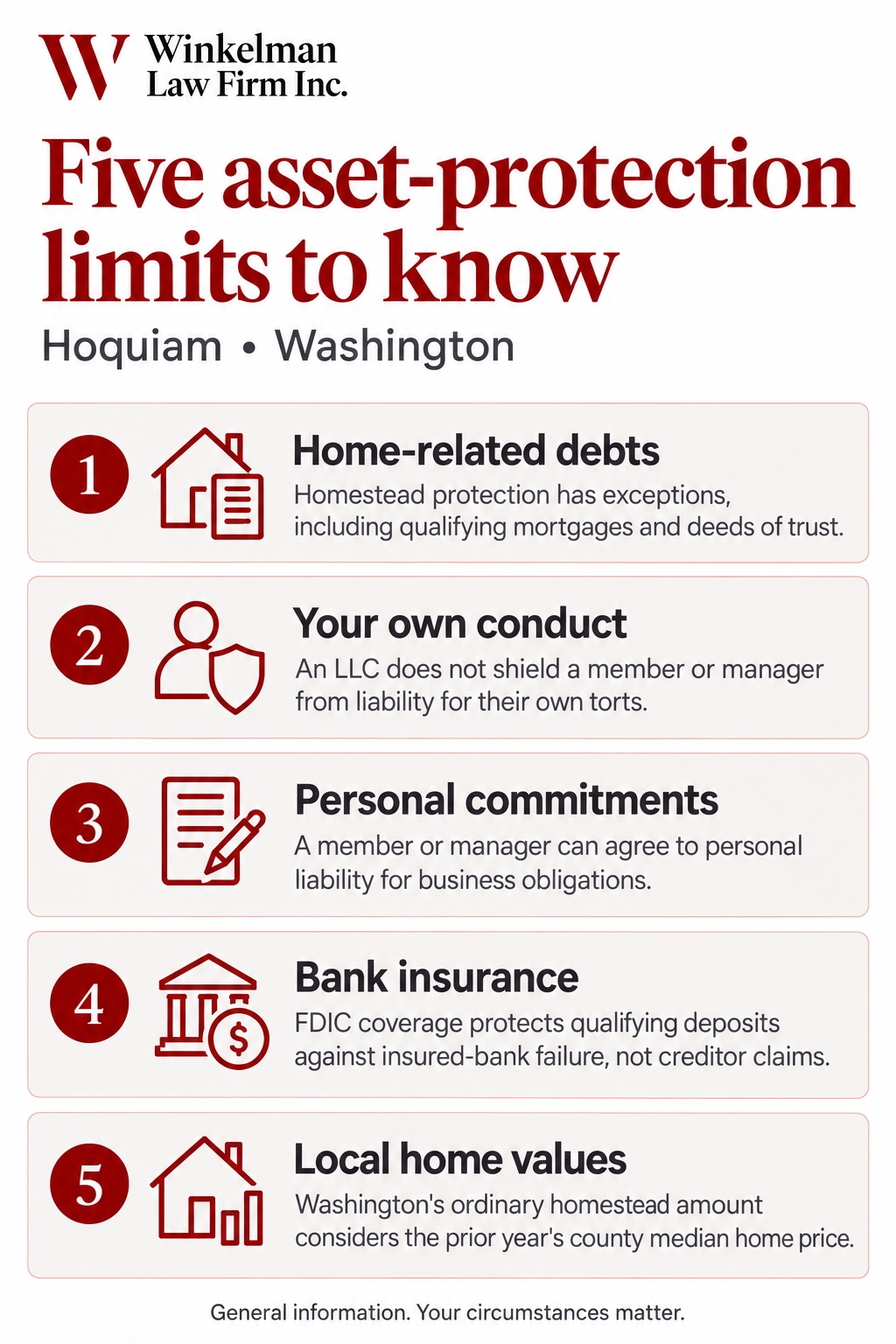
No. Washington's homestead statute has exceptions, including qualifying mortgages, deeds of trust and other specified obligations. Review the particular lien and debt before assuming that a homestead exemption prevents a forced sale. See RCW 6.13.080: Homestead exceptions.
An LLC's liability shield does not eliminate a member's or manager's liability for that person's own torts. Washington also permits personal obligations by agreement, so entity planning should be coordinated with conduct, contracts and appropriate insurance. See RCW 25.15.126: Member and manager liability.
FDIC insurance concerns covered deposits when an insured bank fails. It should not be treated as a legal exemption from a depositor's creditors, because creditor protection depends on separate ownership and exemption rules. See FDIC deposit insurance purpose.
No. The ordinary statutory amount is the greater of $125,000 or the county's median single-family home sale price in the preceding calendar year. A 2026 review therefore calls for the relevant 2025 county data and consideration of applicable exceptions, rather than assuming one statewide dollar cap. See RCW 6.13.030: homestead exemption amount.
We assist clients with Hoquiam asset protection planning from our office in Hoquiam, Washington. You can contact us and mention your main concerns, any existing documents and upcoming dates. We can then discuss your circumstances and the next steps for a consultation.