Building a successful business can take decades, but ownership and leadership eventually change. A business succession plan establishes how that transition should occur and can help protect the company, its owners, employees, and the family members who depend on its continued success.
At Winkelman Law Firm, our Hoquiam business succession planning attorneys help business owners prepare for retirement, incapacity, death, ownership transfers, and other significant transitions. We work with clients in Hoquiam, throughout Grays Harbor County, and across surrounding Western Washington communities.
Effective succession planning involves more than deciding who should receive a business interest. It requires consideration of future ownership, management authority, estate planning, business agreements, family objectives, and the financial realities of a transition. Our lawyers help clients bring those considerations together into a practical plan for the future of the business.
Business succession planning is the process of preparing for changes in the ownership, control, and management of a business. A succession plan can address anticipated events, such as an owner's retirement or planned sale, as well as unexpected circumstances involving incapacity or death.
The appropriate plan depends heavily on the business and its owners. A family-owned company being transferred to the next generation may require a different strategy from a business with several unrelated owners or a company that will eventually be sold to an employee or outside buyer.
Succession planning can address questions such as:
Ownership and management are particularly important to distinguish. The person who inherits or purchases an ownership interest does not necessarily have to be the person responsible for operating the company. In some businesses, separating those roles can provide greater flexibility when planning for the next generation.
Our Hoquiam business succession planning lawyers help owners identify these issues before a transition occurs. A written plan can establish expectations while the current owners are available to make deliberate decisions rather than leaving important questions to family members, co-owners, or employees during an unexpected event.
Succession planning should also evolve with the company. Changes in ownership, business value, family circumstances, and long-term objectives can all affect whether an existing plan remains appropriate.
Closely held businesses often depend heavily on a small number of owners or key individuals. When one of those people retires, becomes unable to work, dies, or decides to leave the company, the consequences can extend far beyond the ownership interest itself.
Employees may need to know who has authority to make decisions. Customers, vendors, lenders, and other business relationships may depend on continuity. Family members may have financial interests in the company without having experience operating it. Remaining owners may also have different expectations about what should happen next.
A succession plan creates a framework for addressing those issues.
For Hoquiam business owners, planning may help clarify:
Planning can also help preserve flexibility. An owner who expects to transfer a company to children may later decide to sell. A key employee may emerge as a potential successor. One child may become actively involved in operations while others pursue different careers.
A succession plan should be capable of adapting as those circumstances change.
Without advance planning, important decisions may instead be controlled by default legal rules, outdated agreements, or estate planning documents that were never coordinated with the business.
Our Hoquiam business succession attorneys help closely held business owners prepare for both expected and unexpected transitions. The goal is to establish a workable path forward while preserving the owner's ability to revise that path as the business and family evolve.
One of the most important succession decisions is determining who should own the business and who should operate it. Those roles may be filled by the same person, but they do not have to be.
A business owner may have a child who understands the company and wants to assume leadership. Another child may have no interest in working in the business but is still intended to share in the family's wealth. In other situations, a long-term employee may be well suited to manage operations even though ownership will remain within the family.
Businesses with multiple owners present additional considerations. The remaining owners may want the right to purchase a departing owner's interest rather than unexpectedly becoming business partners with that owner's heirs.
Potential succession paths can include:
The financial consequences for family members also deserve attention. Dividing a business equally among several beneficiaries may appear straightforward, but equal ownership may create practical problems when only one beneficiary works in the company. Conversely, transferring the entire business to one child can require planning for how other beneficiaries will be treated under the broader estate plan.
There is no universal solution.
Our Hoquiam business succession planning attorneys help owners evaluate potential successors based on the realities of the company, family objectives, and long-term ownership goals. By separating the questions of who should own the business, who should manage it, and how other beneficiaries should be provided for, clients can develop a succession structure designed to remain workable after the current owner's role changes.
A business succession plan should address both transitions an owner can anticipate and circumstances that occur unexpectedly.
Retirement provides an opportunity to plan a gradual transition. An owner may transfer management responsibilities over time, sell ownership interests in stages, remain involved in a limited advisory role, or establish a specific date for stepping away. Planning in advance can give successors time to develop experience while allowing the owner to evaluate whether the transition is working as intended.
Incapacity presents different challenges. If an owner becomes unable to make decisions, the business may still need someone with authority to handle banking, contracts, payroll, property, employees, and other operational matters. Powers of attorney and estate planning documents can be important, but they should be reviewed alongside the company's governing documents and ownership structure.
Death requires similar coordination. A will or trust may determine who receives an ownership interest, while a shareholder agreement, operating agreement, buy-sell agreement, or other business document may impose separate requirements or restrictions on that transfer.
For Hoquiam business owners, these documents should not be developed independently of one another.
A succession plan can identify who will have authority to act, what happens to ownership, and how the business can continue during a transition. It can also address whether the owner's family will remain involved in the company or receive value through another arrangement.
Our Hoquiam business succession planning lawyers help clients prepare for these possibilities before decisions become urgent. Planning for retirement, incapacity, and death together can create greater continuity while reducing uncertainty about who is authorized to move the business forward.

Businesses with multiple owners often need clear rules governing what happens when an owner leaves the company. A buy-sell agreement can establish those rules before a triggering event creates disagreement among owners, family members, or successors.
Depending on the business, a buy-sell agreement may address events such as:
The agreement may also establish who has the right or obligation to purchase an interest and how the purchase price will be determined.
Valuation deserves particular attention. A formula that appears reasonable when an agreement is signed may become outdated as the company grows. Some businesses instead use periodic valuations, appraisal procedures, or another agreed method for determining value when a transfer occurs.
Funding is another consideration. Establishing a purchase obligation without considering where the money will come from can create financial pressure on the business or remaining owners. The appropriate funding strategy depends on the company, the owners, and the events being addressed.
For Hoquiam business owners, buy-sell planning should also coordinate with personal estate plans. An owner's will or trust should not assume that a business interest will pass freely to a beneficiary if an enforceable business agreement requires or restricts a transfer.
Our Hoquiam business succession attorneys help clients evaluate ownership-transfer provisions within the larger succession plan. Clear agreements can establish expectations in advance while supporting an orderly transition when ownership eventually changes.
Family businesses can present succession questions that extend beyond ownership and management. Parents may want children to benefit from the company while also recognizing that different family members have different interests, abilities, and levels of involvement.
One child may have spent years working in the business while another has built a career elsewhere. Some children may want ownership but no management responsibility. Others may prefer to receive different assets rather than become business owners.
These circumstances can make a simple equal division of the company difficult in practice.
Family business succession planning may involve questions such as:
Fairness does not always require every beneficiary to receive identical assets. A Hoquiam business owner may decide that one beneficiary should receive a larger business interest while another receives real estate, investments, insurance proceeds, or other property. Whether that approach is appropriate depends on the family's assets and objectives.
Communication can also be valuable. A succession plan may be legally sound but still create conflict when family members have dramatically different expectations about the future of the company.
Our Hoquiam business succession planning attorneys help family business owners evaluate these decisions alongside their broader estate plans. The objective is to create a structure that reflects the owner's intentions while giving the business a practical foundation for continuing into the next generation.
For many business owners, the company is one of the most valuable assets in the estate. A business succession plan and personal estate plan should therefore be developed with each other in mind.
A will or trust can address who receives an ownership interest at death, but business governing documents may contain transfer restrictions, purchase rights, or other provisions that affect what can actually happen to that interest.
Powers of attorney can also matter during life. If an owner becomes incapacitated, the person authorized to handle personal financial matters may need to interact with the business. The authority granted through personal documents should be considered alongside the authority established by the company's governing structure.
A coordinated plan may involve:
Liquidity can be particularly important when a large portion of family wealth is concentrated in the company. The estate plan should consider how expenses, taxes, inheritances, or buyout obligations will be addressed without unnecessarily disrupting business operations.
For Hoquiam business owners, coordination can also prevent contradictory instructions. A personal estate plan should not direct a transfer that conflicts with obligations the owner has already accepted through a business agreement.
Our Hoquiam business succession planning lawyers help clients review these documents as parts of one overall strategy. Aligning the owner's estate plan with the company's succession structure can provide clearer direction for family members, co-owners, and future business leaders when a transition occurs.
Business succession planning is most useful when it begins well before an owner expects to leave the company. Starting early provides time to evaluate potential successors, prepare future leaders, consider ownership-transfer options, and coordinate the business plan with personal estate planning.
A succession plan should also be reviewed as the company and the owner's circumstances change.
Events that may justify a review include:
A review does not necessarily require changing the entire succession strategy. It can confirm that the intended successors, valuation provisions, transfer arrangements, and estate planning documents still reflect the owner's objectives.
For Hoquiam business owners, periodic review can be particularly important when a company has grown substantially since the original documents were prepared. A plan designed for a smaller business with different owners or family circumstances may no longer provide an appropriate path forward.
Our Hoquiam business succession planning attorneys help owners create new plans and evaluate existing arrangements. Addressing succession before a transition becomes imminent gives owners more opportunity to make deliberate decisions about the future of the company.
Business succession planning requires an understanding of both the company and the owner's broader estate planning objectives. Winkelman Law Firm'sattorneys bring decades of combined legal experience serving individuals, families, and businesses in Hoquiam, throughout Grays Harbor County, and beyond.
Founding shareholder Ben Winkelman has more than 20 years of legal experience involving estate planning, business law, real estate, probate, and related civil matters. Associate attorney Ryan M. Pesicka brings experience in estate planning, business law, contracts, entity formation, and business-related disputes.
That combination allows our Hoquiam business succession planning lawyers to consider ownership transitions from multiple perspectives. Our team can evaluate how business agreements, estate planning documents, family objectives, and long-term ownership plans interact rather than treating succession as an isolated transaction.
We focus on practical planning designed around the business the client has built and the future the owner wants to create for it.
A business succession plan can provide clearer direction for owners, family members, employees, and future leaders when ownership or management eventually changes.
Winkelman Law Firm helps business owners in Hoquiam and throughout Grays Harbor County prepare for retirement, incapacity, death, ownership transfers, and other important transitions.
To begin planning for the future of your company,contact our Hoquiam business succession planning attorneys to schedule an appointment. Our lawyers can help you coordinate business ownership, succession arrangements, and estate planning around your long-term goals.
Reviewed for legal accuracy by Benjamin R Winkelman on October 18, 2026
We encourage clients considering Hoquiam business succession planning to identify essential accounts, contracts and professional contacts. Access instructions should be stored securely and shared only with appropriate people. We can review who has legal authority to act without treating possession of a password as permission to manage the company.
In Hoquiam business succession planning, we compare the transfer terms with the proposed source of payment. Insurance, installment payments and available cash can raise different practical questions. We review the agreement alongside current funding information before assuming a future purchase can close as written.
Our Hoquiam business succession planning includes reviewing important contracts for ownership-change and consent provisions. A planned transfer may need coordination with a lender, landlord or other contracting party. We examine the signed documents before assuming an estate plan can independently complete the business transition.
For Hoquiam business succession planning, we ask whether an advance was documented as a loan, an investment or another arrangement. Keep the agreement, bank records and any repayment history together. We review those records before assuming the transfer has the same treatment as an owner's existing equity.
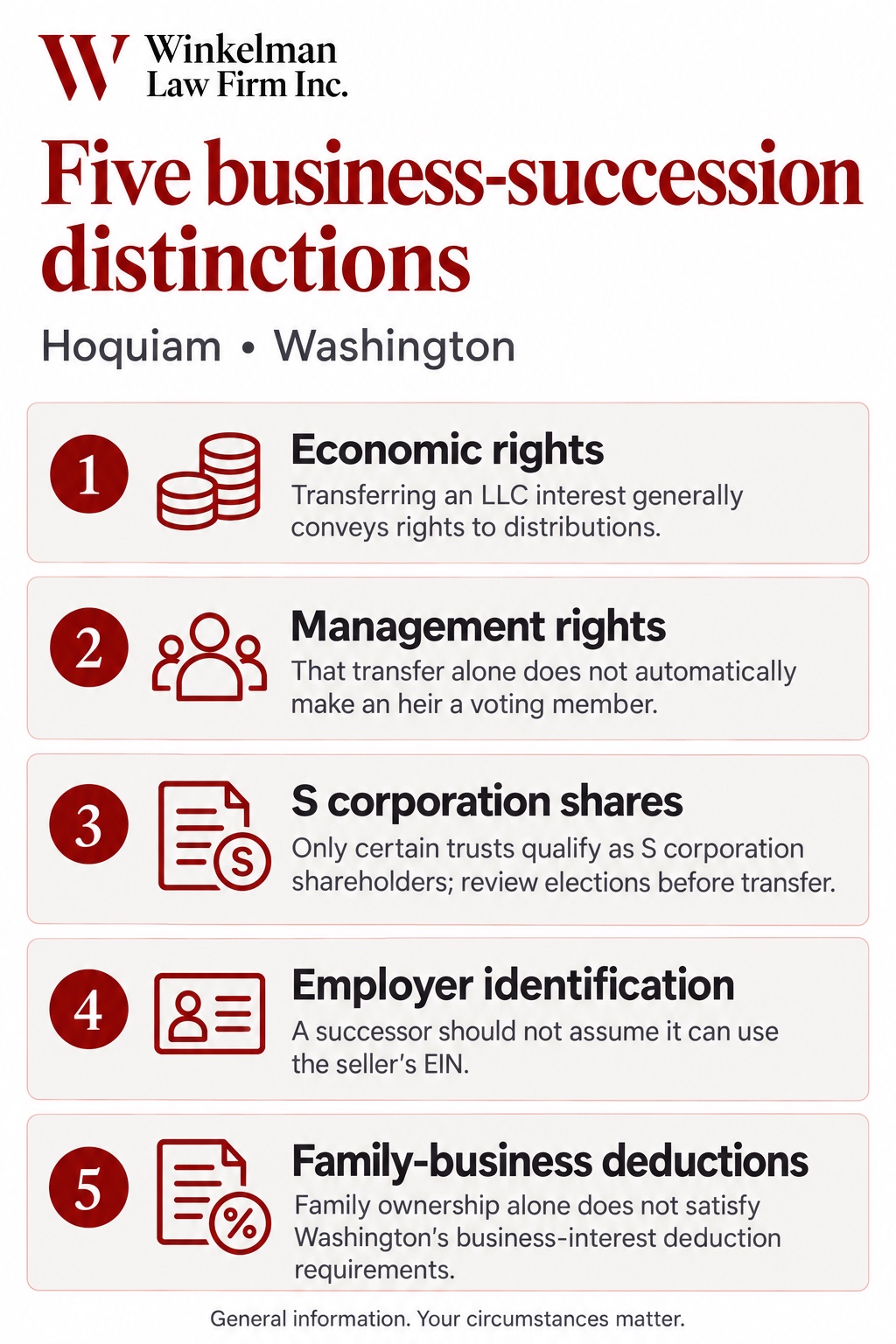
A transfer of an LLC's transferable interest generally conveys the right to distributions without itself granting management rights. Review the operating agreement, admission provisions and succession documents before assuming an heir becomes a voting member. See RCW 25.15.251: Transferable interest and management.
No. Federal S corporation rules allow only specified categories of shareholders, including certain trusts rather than every trust. Review the proposed recipient and any required trust election before transferring shares. See IRS S corporation shareholder eligibility.
Do not assume the seller's EIN transfers to the buyer. IRS employer guidance specifically warns a successor taking over another employer's business against using that employer's EIN; the entity and transaction structure need to be reviewed before payroll or tax filings continue. See IRS employer identification and successor employers.
Washington lists a maximum qualified family-owned business interest deduction of $3,076,000 for 2026 deaths. A business does not qualify simply because relatives own it. Ownership, value, operational and heir requirements need review before relying on the deduction in a succession plan. See Washington DOR: qualified family-owned business interests.
We assist clients with Hoquiam business succession planning from our office in Hoquiam, Washington. You can contact us and mention your main concerns, any existing documents and upcoming dates. We can then discuss your circumstances and the next steps for a consultation.