Child custody disputes can affect where children live, how parents participate in important decisions, and the relationships parents maintain with their children. Whether custody issues arise during divorce, between unmarried parents, or because circumstances have changed, parents need to understand how Washington law approaches these decisions.
Winkelman Law Firm represents parents in Hoquiam, throughout Grays Harbor County, and across surrounding Western Washington communities in child custody and parenting disputes. Our Hoquiam child custody attorneys help parents understand their rights, evaluate proposed arrangements, negotiate when productive agreements are possible, and address contested issues when court involvement becomes necessary.
Our focus is on developing practical legal strategies that account for the needs of the children, the rights and responsibilities of the parents, and the circumstances of each family.
Parents commonly use terms such as “custody” and “visitation” when discussing where their children will live and how parenting responsibilities will be divided. Washington family law generally addresses these issues through parenting plans rather than relying exclusively on traditional custody labels.
A parenting plan establishes the legal framework governing important aspects of the parents' relationship with their children after separation.
Depending on the circumstances, a parenting plan can address:
This framework matters because child custody is not simply about determining which parent “wins” custody. The resulting court orders need to establish workable arrangements governing the children's residential lives and the parents' responsibilities.
Parenting plans may be established during divorce, but marriage is not a prerequisite for a custody dispute. Unmarried parents may also need court orders defining residential arrangements and parental responsibilities.
Some parents are able to agree on a proposed parenting plan. When parents cannot agree, the court may be asked to resolve disputed issues and establish the terms that will govern the family.
Our Hoquiam child custody lawyers help parents understand how Washington's parenting-plan framework applies to their circumstances. We identify the issues requiring resolution, evaluate proposed arrangements, and help clients pursue parenting orders that address both immediate concerns and the practical realities of raising their children after separation.
A parenting plan creates structure for parents who will raise children while living in separate households. The plan can address both where children spend their time and how certain parental responsibilities will be handled.
Although every family is different, parenting plans commonly address three broad areas: residential arrangements, decision-making, and methods for resolving certain disagreements.
Residential provisions establish when children are scheduled to reside with each parent. Decision-making provisions address responsibility for significant choices affecting the children. Other provisions can establish procedures the parents will use when particular disagreements arise.
Parenting plans may also include restrictions or conditions when circumstances make them legally appropriate.
The details matter because parents will rely on the plan after the legal case is completed. Ambiguous arrangements can create uncertainty about responsibilities and expectations, while a carefully developed plan can provide a clearer framework for both households.
At the same time, a parenting plan should reflect the actual circumstances of the family. School schedules, parents' work obligations, children's needs, transportation, and the distance between households may all affect whether a proposed arrangement is practical.
Our Hoquiam child custody attorneys help parents evaluate proposed parenting plans from both a legal and practical perspective. When agreement is possible, we work to ensure the resulting terms are sufficiently clear to guide the parents after the case concludes. When significant provisions remain disputed, our lawyers can advocate for the client's position through negotiation, mediation, or court proceedings.
When parents cannot agree on custody and parenting arrangements, Washington courts consider the circumstances of the family under the state's parenting-plan laws. The analysis focuses on establishing arrangements for the children rather than rewarding or punishing either parent for the end of the parents' relationship.
Custody disputes can involve many different facts. The history of each parent's involvement with the children, the children's relationships within the family, the practical circumstances of the parents, and issues affecting the children's well-being may all become relevant depending on the case.
Courts may also need to consider whether circumstances exist that require limitations or restrictions within a parenting plan.
For parents involved in a contested custody matter, presenting the family circumstances clearly can be important. Relevant information may concern:
Custody cases are highly fact-dependent. An arrangement that works well for one family may be impractical for another, which is why broad assumptions about what a court will decide can be misleading.
Our Hoquiam child custody lawyers help parents identify the facts and legal issues that matter to their particular case. We work with clients to develop realistic parenting proposals, respond to disputed allegations or proposals when necessary, and present contested issues to the court when the parents cannot reach an appropriate agreement.
One of the central issues in a child custody case is determining how children will divide their residential time between parents. Washington parenting plans establish residential arrangements rather than simply awarding one parent “custody” and giving the other parent visitation.
The appropriate arrangement depends on the circumstances of the family. Parents may agree that the children should spend substantial time in both households, or they may disagree about where the children should primarily reside and how parenting time should be allocated.
Practical considerations can include the children's ages and needs, school schedules, parents' work obligations, transportation, the distance between households, and the family's existing routines.
Residential disputes can become particularly significant when parents propose substantially different arrangements. One parent may believe continuity with an existing schedule is important, while the other may seek greater residential time or a different structure.
Our Hoquiam child custody attorneys help parents evaluate proposed residential arrangements and the circumstances supporting their positions. We work to develop proposals that are legally supportable and practical for the children and parents involved.
When parents reach an agreement, clear terms can reduce uncertainty after the case ends. When they cannot agree, our lawyers can help present the relevant circumstances to the court and advocate for an appropriate parenting arrangement.
Parenting plans can also establish how significant decisions concerning children will be made after parents separate.
Decision-making issues are distinct from the amount of residential time a child spends with each parent. A parent does not necessarily receive authority over every significant decision simply because the child resides with that parent more frequently.
Depending on the circumstances, parenting plans may address decision-making involving matters such as:
Parents may be able to share responsibility for certain decisions, while other circumstances may support allocating particular decision-making authority differently.
Disagreements can arise when parents have substantially different views about a child's education, medical care, or other important matters. Existing patterns of parental involvement and the parents' ability to make decisions under the structure of the parenting plan may become relevant to resolving these issues.
Our Hoquiam child custody lawyers help parents understand how decision-making provisions may affect their rights and responsibilities. We also help clients evaluate proposed terms carefully so the final parenting plan provides a workable framework for making important decisions after the case concludes.
Parents do not always agree about where their children should live or how parenting responsibilities should be allocated. When significant disagreements cannot be resolved, a child custody matter may become contested.
A contested case can involve competing parenting plans, disputes over residential time, disagreements about decision-making authority, requests for restrictions, or conflicting accounts of circumstances affecting the children.
The existence of a dispute does not automatically mean the case will proceed to trial. Parents and their attorneys may continue negotiating while the case is pending, and mediation may provide an opportunity to resolve some or all of the contested issues.
When an appropriate agreement cannot be reached, however, the court may need to decide the disputed terms.
Preparing for a contested custody case can require careful attention to the facts. Depending on the issues involved, relevant information may include existing parenting arrangements, communications between the parents, school or child-related records, work schedules, residential circumstances, and other evidence related to the disputed parenting issues.
Parents should also keep the focus on legally relevant concerns. Custody proceedings are not designed to resolve every disagreement that occurred during the parents' relationship.
Our Hoquiam child custody attorneys help clients distinguish between personal conflict and the facts that matter to the parenting case. Ben Winkelman's experience in family law, mediation, and trial practice allows our team to pursue negotiated solutions where appropriate while remaining prepared to advocate in contested proceedings when significant custody issues require court resolution.
Some child custody cases involve circumstances that raise concerns about whether unrestricted parenting arrangements are appropriate. Washington law permits or requires parenting-plan limitations in certain circumstances.
Restrictions are serious issues and should be evaluated based on the specific facts and applicable legal standards rather than assumptions or generalized accusations.
Depending on the circumstances, concerns presented in a custody case may involve issues such as:
The existence, nature, and legal significance of an alleged concern can be disputed. One parent may seek restrictions that the other believes are unsupported, or a parent may believe meaningful safeguards are necessary to address documented circumstances affecting a child.
Possible limitations depend on the facts and the court's findings. Cases involving restrictions therefore require careful attention to both the evidence and the governing legal requirements.
Our Hoquiam child custody lawyers represent parents seeking appropriate protections as well as parents responding to requests for restrictions. We help clients evaluate the allegations and evidence involved, understand the potential effect on a parenting plan, and present their position through the appropriate family law process.
Parents do not need to be married for questions about residential arrangements, decision-making, and parenting responsibilities to require legal resolution.
When unmarried parents separate or do not live together, establishing clear court orders can provide structure for both parents and children. Informal arrangements may work for a period of time, but disagreements can arise when expectations change or the parents have different understandings about schedules and responsibilities.
Depending on the circumstances, unmarried parents may need to address:
Obtaining enforceable orders can provide greater clarity than relying solely on informal agreements. A parenting plan can define each parent's rights and responsibilities and create a framework the family can follow as the child grows.
Disputes between unmarried parents can involve many of the same concerns that arise during divorce, including disagreements about residential time, major decisions, transportation, and the child's needs.
Our Hoquiam child custody attorneys represent unmarried parents who need to establish or resolve parenting arrangements. We help clients understand the legal process, identify the issues requiring resolution, and pursue orders that provide a workable structure for their family.
A parenting plan may remain in place for years, but family circumstances can change significantly during that time. Children grow older, parents' work or living situations change, and arrangements that once functioned effectively may no longer reflect the family's circumstances.
Washington law allows parenting plans to be modified under certain conditions. However, changing an existing parenting plan is different from establishing an initial plan, and the legal requirements depend in part on the nature and extent of the requested change.
A parent might consider seeking a modification because of significant changes affecting the child, problems with the existing residential arrangement, circumstances involving a parent, or other developments that may be legally relevant.
Not every inconvenience or disagreement will justify changing an established parenting plan.
Our Hoquiam child custody lawyers help parents evaluate whether circumstances may support a requested modification and respond when another parent seeks changes they believe are inappropriate. Because modification cases involve their own requirements and strategic considerations, careful review of the existing orders and the developments since those orders were entered is important before proceeding.
A disagreement over custody does not necessarily require a trial. Parents may be able to resolve some or all parenting issues through negotiation, mediation, or another appropriate settlement process.
An agreed parenting arrangement can give parents greater involvement in developing terms that account for their children's schedules, the parents' responsibilities, and the practical needs of both households.
Mediation can provide a structured setting for parents to work through disputed issues with a neutral third party. Attorneys can also negotiate proposed terms and help clients evaluate whether a potential agreement adequately addresses their concerns.
Settlement can be particularly valuable when parents will need to communicate and coordinate for years after the legal case concludes. At the same time, reaching an agreement should not require a parent to overlook significant concerns simply to avoid court.
Some custody disputes involve substantial disagreements that cannot be resolved through negotiation. When court intervention is necessary, the focus shifts to presenting the relevant facts and legal issues so the court can establish the disputed terms.
Our Hoquiam child custody attorneys consider both settlement and litigation based on the circumstances. We work toward practical agreements when appropriate while remaining prepared to advocate for parents in contested proceedings when important custody issues cannot otherwise be resolved.
Child custody cases require an understanding of Washington family law as well as the ability to handle negotiation, mediation, and contested proceedings when necessary.
Winkelman Law Firm'sattorneys bring decades of combined legal experience to parents in Hoquiam and throughout Grays Harbor County.
Founding shareholder Ben Winkelman has more than 20 years of legal experience, including substantial work in family law, trial practice, and mediation. His background includes service on the Washington State Bar Family Law Section Executive Committee from 2007 through 2013, including serving as chair. He also received a CALI Excellence for the Future Award in Family Law.
Associate attorney Ryan M. Pesicka brings additional family law and litigation experience, including family law representation in Grays Harbor County.
Our Hoquiam child custody lawyers understand that parenting disputes can involve both important legal rights and deeply personal concerns. We focus on the facts that matter, practical parenting arrangements, and legal strategies tailored to the circumstances of each family.
Child custody decisions can shape a family's daily life for years. Whether you need to establish an initial parenting arrangement, resolve a contested custody dispute, or address concerns involving an existing order, experienced legal guidance can help you understand the options available.
Winkelman Law Firm represents parents in Hoquiam, throughout Grays Harbor County, and across surrounding Western Washington communities.
If you are facing a child custody or parenting dispute,contact our Hoquiam child custody attorneys to schedule an appointment. Our team can evaluate your circumstances, explain the applicable legal process, and help you determine how to move forward.
Reviewed for legal accuracy by Benjamin R Winkelman on October 18, 2026
In Hoquiam child custody matters, we suggest recording actual dates, exchanges and significant schedule changes. Keep the entries factual and preserve related messages. We can compare the calendar with the current order without treating every minor inconvenience as proof of a legal violation.
For Hoquiam child custody, we suggest identifying the records relevant to the disputed parenting issue. Keep dates, providers and school contacts organized rather than gathering unrelated private material. We can review appropriate ways to obtain and present information while considering the child's privacy.
Our Hoquiam child custody review considers actual work schedules and the child's routine. A sample calendar can reveal transportation or child-care problems that a general statement overlooks. We can evaluate practical options without assuming every work change requires the same legal response.
In Hoquiam child custody matters, we encourage parents to keep adult legal communications between the appropriate adults. Preserve necessary information through suitable channels and follow applicable orders. We can discuss communication provisions without placing responsibility for the dispute on the child.
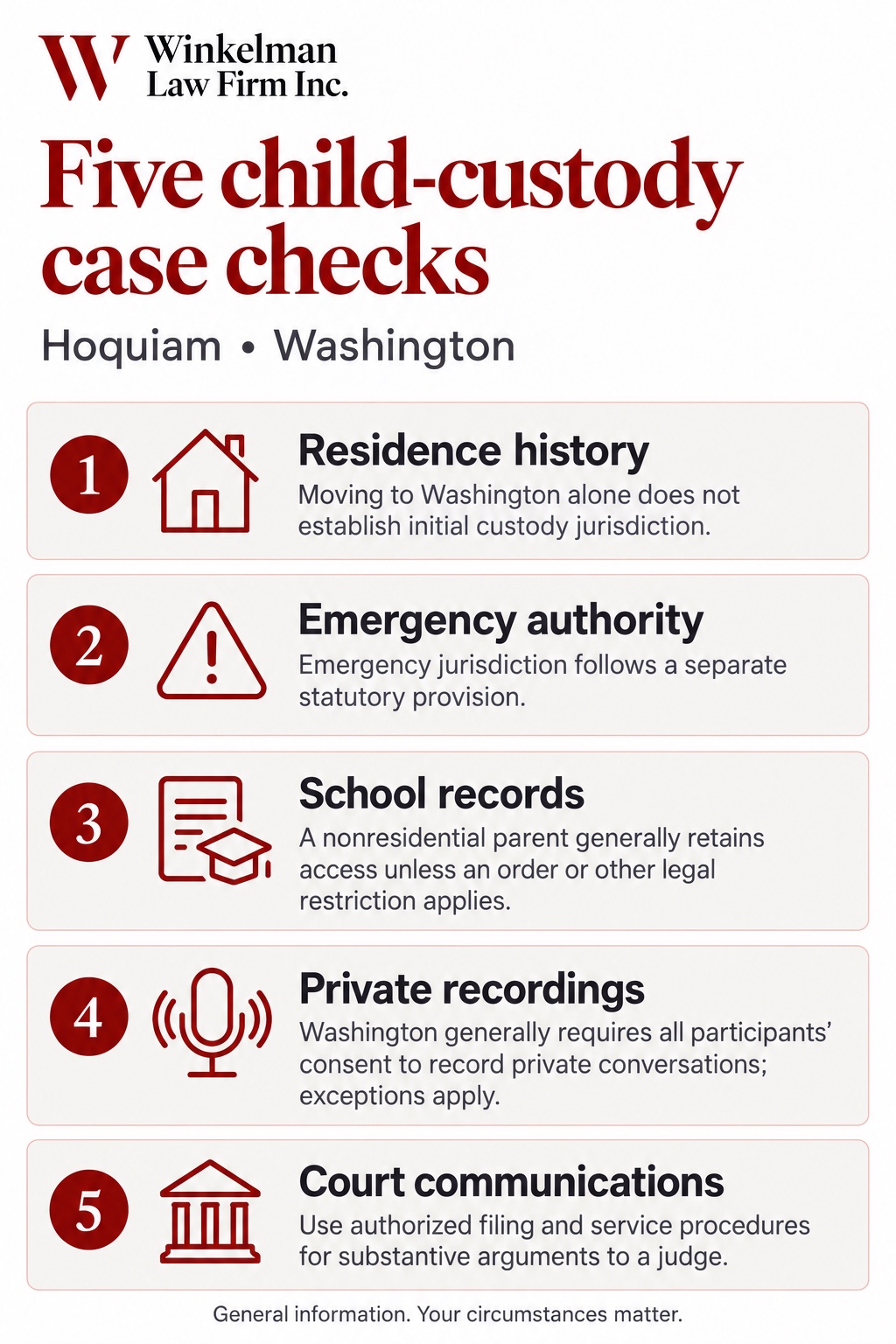
Not by moving alone. Washington's initial custody jurisdiction generally follows the home-state framework and other statutory grounds, with a separate emergency-jurisdiction provision. Review the child's residence history and any existing proceedings before choosing where to file. See RCW 26.27.201: Initial child custody jurisdiction.
Not solely because the child primarily lives with the other parent. Federal education-record rules generally recognize both custodial and noncustodial parents' access unless a court order or other binding legal document restricts that right. Give the school any relevant order and review applicable exceptions. See US Education Department: Parent education records access.
Check the law before recording. Washington generally requires all participants' consent to record private communications or conversations, with specific statutory exceptions that should not be assumed to apply to an ordinary parenting dispute. See RCW 9.73.030: Recording private communications.
Use the court's authorized filing and service process rather than privately sending substantive custody arguments or evidence to the judge. Washington's judicial conduct rule generally restricts ex parte communications, with defined exceptions. A scheduling inquiry and an argument about the merits of a case are different matters. See Washington Code of Judicial Conduct: Rule 2.9.
We assist clients with Hoquiam child custody from our office in Hoquiam, Washington. You can contact us and mention your main concerns, any existing documents and upcoming dates. We can then discuss your circumstances and the next steps for a consultation.