Moving can become a significant family law issue when a parent wants to relocate with a child who is already subject to a Washington parenting plan or residential schedule. A move may affect school, transportation, parenting time, holidays, and the ability of the other parent to maintain an established relationship with the child.
Winkelman Law Firm represents parents in Hoquiam, throughout Grays Harbor County, and across surrounding Western Washington communities in child relocation matters. Our Hoquiam child relocation attorneys assist parents planning a move as well as parents who have received notice of a proposed relocation and want to understand their options.
Washington has specific procedures governing relocation with children. Addressing those requirements before a move occurs can be critical. Our team helps clients evaluate the proposed relocation, understand applicable notice and objection procedures, and address any resulting changes to the parenting plan.
Washington's relocation law applies within the framework of an existing court order concerning residential time or visitation with a child. The requirements and available procedures can depend on where the child is moving and the terms of the existing order.
One important distinction is whether the proposed new residence is within or outside the child's current school district.
A move outside the child's school district generally triggers more extensive notice and objection procedures. A person entitled to residential time or visitation under an existing court order may have the opportunity to object to the child's relocation and to proposed changes to the parenting plan.
Moves within the same school district are treated differently under Washington's relocation statutes, although notice requirements may still apply in qualifying circumstances.
A proposed move can affect much more than the child's address. Parents may need to consider:
For parents in Hoquiam and throughout Grays Harbor County, even a move within Western Washington can substantially affect a schedule that was designed when both households were located near one another.
Our Hoquiam relocation lawyers help parents evaluate the move within the context of the existing parenting plan and Washington's relocation requirements. The earlier these issues are addressed, the more opportunity there may be to develop a workable proposal or prepare for a contested relocation proceeding.
When Washington's relocation notice requirements apply, the relocating parent generally must provide advance notice to every person entitled to residential time or visitation with the child under a court order.
For a proposed move outside the child's current school district, Washington law generally requires notice at least 60 days before the intended relocation. When a parent could not reasonably have known about the move in time to provide 60 days' notice, different timing provisions may apply.
The notice serves an important purpose. It gives the other parent or another person with court-ordered residential time an opportunity to understand the proposed move, evaluate its effect on the existing parenting arrangement, and decide whether to object.
Relocation notice generally addresses information concerning the proposed move and may be accompanied by proposed changes to the parenting plan when the existing schedule will no longer work.
Parents planning relocation should avoid treating notice as a formality. A proposed move may require careful consideration of:
There are circumstances in which Washington law may permit certain information to be withheld or notice requirements to be addressed differently, including some situations involving safety concerns. Those cases require individualized legal analysis.
Our Hoquiam child relocation attorneys help parents determine what notice requirements apply and how the proposed move interacts with the existing parenting plan. Addressing the process correctly before relocating can help avoid creating additional legal disputes.
Receiving notice of a proposed relocation does not mean the other parent must simply accept the move or the relocating parent's proposed changes to the parenting schedule.
When the statutory relocation procedures apply, a person entitled to residential time or visitation may object to the relocation and may also object to proposed changes to the parenting plan.
Timing is important. Under Washington's current relocation statute, an objection generally must be served within 30 days after the relocation notice is received. Failing to object within the applicable period can significantly affect what happens next.
An objection may raise issues involving:
Objecting to relocation does not automatically determine the outcome. It initiates a process in which the disputed move can be evaluated under Washington's relocation framework.
The parents may still be able to negotiate a resolution. For example, disagreement over the initial proposal may lead to a revised residential schedule that provides longer periods of parenting time during school breaks or summer.
When agreement cannot be reached, the relocation dispute may require court resolution.
Our Hoquiam relocation attorneys represent both parents proposing moves and parents objecting to relocation. We help clients evaluate the existing parenting plan, the practical effects of the proposed move, and the evidence relevant to the issues the court may need to decide.
When a qualifying relocation is contested, Washington law provides a specific framework for deciding whether the child should move.
In many relocation cases, Washington law creates a rebuttable presumption that the intended relocation will be permitted. A person objecting to the move can attempt to overcome that presumption by showing that the detrimental effect of relocation outweighs the benefit of the change to the child and the relocating parent.
The court considers multiple factors, including:
Washington law does not assign predetermined weight to these relocation factors.
There is also an important exception when the parents have substantially equal residential time. Under Washington law, this generally includes arrangements in which each parent has at least 45 percent of the child's residential time. In those cases, the ordinary relocation presumption does not apply, and the court determines the issue based on the child's best interests while considering the statutory relocation factors.
Our Hoquiam child relocation attorneys help clients develop evidence addressing the factors that actually matter to the proposed move. Whether representing the relocating or objecting parent, our team focuses on the practical effect relocation would have on the child, the parents, and the existing residential arrangement.
A relocation dispute frequently involves two related questions: whether the child should relocate and how the parenting arrangement should operate if the move occurs.
A residential schedule designed for parents living near each other may become impractical when substantial distance separates the households. Weekday parenting time, school transportation, exchanges, and short weekend visits may need to be reconsidered.
A revised parenting plan may address:
A revised schedule may use longer blocks of residential time to compensate for parenting opportunities that become impractical because of distance. Summer and school-break schedules can become especially important when regular weekday time is no longer feasible.
The details should reflect the actual geography involved. A move from Hoquiam to another community within Western Washington can create different logistical issues than an interstate relocation, but either can significantly affect an existing schedule.
Our Hoquiam relocation lawyers help parents evaluate proposed parenting-plan changes alongside the relocation itself. The objective is to develop clear terms that account for school, travel, parenting time, and the practical realities created by the new distance between households.
Transportation can become one of the most important practical issues after a child relocates.
A parenting schedule may look workable until the parents calculate travel time, transportation costs, school schedules, and how exchanges will actually occur.
Depending on the distance involved, parents may need to consider:
For families in Hoquiam and Grays Harbor County, geography can matter considerably. A relocation elsewhere in Western Washington may turn a short exchange into hours of driving, while a move farther away may require an entirely different approach to residential time.
Long-distance arrangements may therefore rely more heavily on extended parenting periods rather than frequent short visits. School breaks, holidays, and summer vacation can provide opportunities for meaningful residential time when regular midweek exchanges are no longer realistic.
Transportation provisions should also be specific enough to reduce recurring disagreements about who is responsible for travel and where transitions occur.
Our Hoquiam child relocation lawyers help clients evaluate these practical considerations when negotiating or litigating a revised residential schedule. A workable relocation plan should address not only how much parenting time occurs, but how the child will realistically move between households.
A contested relocation may not be resolved immediately. When the proposed moving date approaches before a final decision can be made, temporary orders can become important.
Washington law allows courts, under qualifying circumstances, to temporarily prevent a child's relocation or order the child's return if a move has already occurred. The court may consider issues such as failure to provide required notice, relocation without the necessary agreement or authorization, and the evidence concerning whether the move is likely to be approved at the final hearing.
Washington courts may also temporarily authorize a proposed relocation before the final hearing when the statutory requirements are satisfied.
Temporary proceedings can therefore have significant practical consequences. Parents may be dealing simultaneously with housing, employment, school enrollment, transportation, and an existing parenting schedule while waiting for the relocation dispute to be resolved.
A temporary decision does not necessarily determine the final outcome. It addresses what should happen while the case remains pending.
Our Hoquiam relocation attorneys help parents seeking or opposing temporary relocation orders prepare for these time-sensitive proceedings. We focus on the applicable legal requirements, the existing parenting arrangement, and the evidence relevant to what should occur while the court considers the relocation dispute.
Not every relocation results in a contested court proceeding. Parents may agree that the move should occur and also reach an agreement about how the parenting plan should change.
Even when both parents support the relocation, the resulting parenting arrangements should be addressed carefully. A move that substantially increases the distance between households may make portions of the existing parenting plan impractical.
Parents may need to agree on revised terms involving:
Washington's relocation framework provides procedures for addressing proposed parenting-plan changes when relocation is not contested. Formalizing appropriate changes can provide both parents with a clear order reflecting the family's new circumstances.
Our Hoquiam child relocation attorneys help parents evaluate agreed relocations and develop parenting arrangements that account for the practical effects of the move. Reaching agreement can reduce conflict, but clearly documenting the resulting terms remains important.
A parent who receives notice that the other parent intends to relocate with the child may have immediate concerns about how the move will affect the existing parenting relationship.
The first step is understanding exactly what is being proposed. The distance of the move, proposed school arrangements, new residential schedule, transportation requirements, and effect on existing parenting time may all deserve consideration.
Because Washington imposes deadlines for relocation objections, parents should evaluate a notice promptly rather than waiting until the proposed moving date approaches.
Preparing an objection may involve reviewing:
An objecting parent may oppose the relocation itself, proposed changes to the parenting plan, or both, depending on the circumstances.
Relocation disputes can also involve negotiation. A parent may strongly oppose the initial proposal while remaining willing to consider a different arrangement that better preserves the parent-child relationship.
Our Hoquiam relocation lawyers represent parents who need to respond to proposed moves. We help clients understand the applicable deadlines, evaluate the proposed relocation, develop relevant evidence, and pursue their position through negotiation, mediation, or court proceedings when necessary.
Relocation cases can become more complicated when a parent moves with a child without providing notice required by Washington law or attempts to relocate before an objection has been resolved.
Washington's relocation statutes provide procedures for addressing moves that occur without compliance with applicable requirements. Depending on the circumstances, a court may have authority to issue temporary orders restraining relocation or directing that a child be returned while the dispute is pending.
The appropriate response depends on the facts. Questions may include whether notice was required, whether notice was properly provided, whether an objection was timely made, and whether an exception or other statutory provision applies.
Parents should also avoid assuming that a suspected notice violation automatically determines the ultimate relocation decision. Procedural compliance and the final merits of a relocation dispute can involve related but distinct questions.
Our Hoquiam child relocation attorneys help parents evaluate situations involving disputed or allegedly insufficient notice. When timing is urgent, our team can assess the existing parenting order, relocation circumstances, and available legal procedures for addressing the move.
Relocation disputes combine family-law requirements with practical questions about parenting, geography, school, transportation, work, and the ability to maintain important relationships after a move.
Winkelman Law Firm'sattorneys bring decades of combined legal experience to families in Hoquiam and throughout Grays Harbor County.
Founding shareholder Ben Winkelman has more than 20 years of legal experience involving family law, trial practice, and mediation. His family-law background includes service on the Washington State Bar Family Law Section Executive Committee from 2007 through 2013, including serving as chair.
Associate attorney Ryan M. Pesicka brings additional family-law and litigation experience, including substantial work representing clients in family matters after relocating to Grays Harbor County.
Our Hoquiam child relocation attorneys represent parents on both sides of these disputes. We assist parents planning a move, parents objecting to relocation, and families working to revise parenting arrangements when a relocation is agreed upon.
Whether the case can be resolved through negotiation or requires court intervention, our team focuses on the Washington relocation requirements, the existing parenting arrangement, and the practical consequences of the proposed move.
Relocation disputes can move quickly, particularly when a proposed moving date is approaching or a parent has received formal notice of an intended move. Understanding the applicable requirements and deadlines early can be important.
Winkelman Law Firm represents parents in Hoquiam, throughout Grays Harbor County, and across surrounding Western Washington communities.
Whether you are planning to relocate with your child or objecting to a proposed move,contact our Hoquiam child relocation attorneys to schedule an appointment. Our team can review the existing parenting plan, evaluate the proposed relocation, and help you determine the appropriate next steps.
Reviewed for legal accuracy by Benjamin R Winkelman on October 18, 2026
For Hoquiam child relocation, we suggest keeping the current parenting plan and the proposed address, timing and school information together. Identify how transportation and the existing residential schedule would be affected. We can review the applicable notice process before you rely on an informal conversation about the move.
In Hoquiam child relocation matters, keep the complete notice, attachments and information about how and when it arrived. Dates can matter when evaluating a response. We review the actual documents promptly rather than calculating obligations from a partial message or another person's summary.
For Hoquiam child relocation, we distinguish confirmed plans from proposals that may change. Keep relevant offer letters, housing information and a realistic timeline organized. We can assess how those uncertainties affect the legal planning without assuming a tentative opportunity resolves the parenting issues.
Our Hoquiam child relocation review considers travel time, costs, school dates and the child's routine. A calendar and realistic transportation estimates can make the proposal easier to evaluate. We can identify unresolved details without assuming online contact is an automatic substitute for ordered residential time.
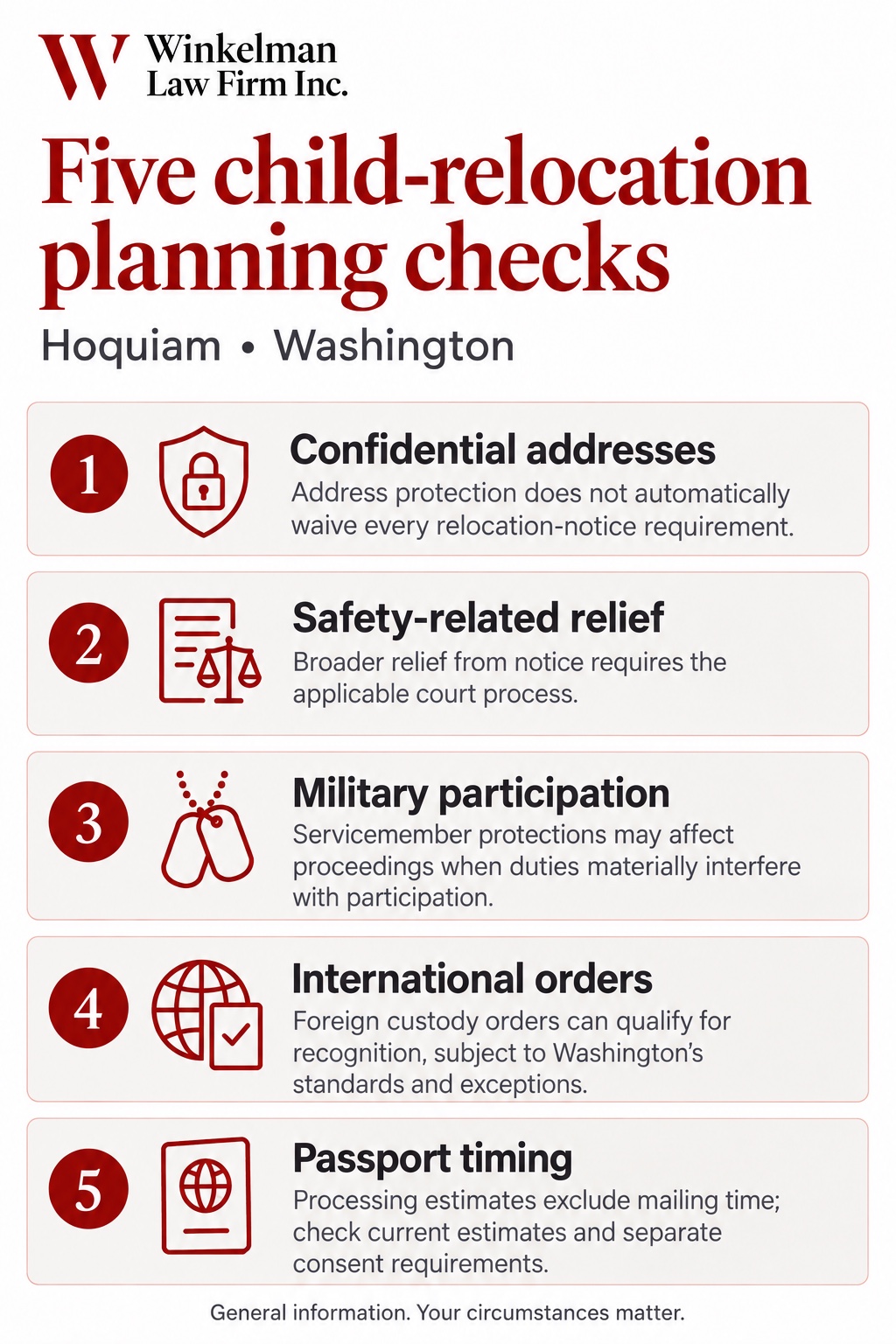
The Address Confidentiality Program can protect specified confidential information from disclosure in a relocation notice. That is different from waiving every notice requirement; Washington law provides a separate court process for broader safety-related relief. See RCW 26.09.460: Limitations on relocation notices.
Yes. Federal servicemember protections can affect civil proceedings, including custody matters, when military duties materially interfere with participation. A stay depends on applicable requirements and supporting information, so review service status and the hearing papers promptly rather than assuming every deadline disappears. See Justice Department: SCRA civil proceedings.
It can. Washington generally recognizes a foreign-country custody determination made under circumstances substantially conforming to its jurisdictional standards, with statutory exceptions. Provide the complete foreign order and relevant background before assuming either automatic recognition or no effect. See RCW 26.27.051: International custody application.
The State Department currently lists routine passport processing at four to six weeks and expedited processing at two to three weeks, excluding mailing time. Estimates can change. Check the current timetable alongside custody, consent and relocation requirements rather than treating a passport estimate as permission to move. See U.S. State Department: current passport processing times.
We assist clients with Hoquiam child relocation from our office in Hoquiam, Washington. You can contact us and mention your main concerns, any existing documents and upcoming dates. We can then discuss your circumstances and the next steps for a consultation.