Child support can have a substantial effect on both a child's financial well-being and each parent's household budget. Whether support is being established for the first time or parents disagree about income, expenses, or the appropriate obligation, understanding how Washington calculates child support is an important starting point.
Winkelman Law Firm represents parents in Hoquiam, throughout Grays Harbor County, and across surrounding Western Washington communities in child support matters. Our Hoquiam child support attorneys help clients evaluate financial information, understand the Washington child support framework, address disputed income, and pursue support orders that reflect the circumstances of the family.
Child support cases are not always simple calculations. Variable earnings, self-employment, additional child-related expenses, and changes in financial circumstances can create questions that require careful review.
Washington uses a statewide child support schedule to establish support obligations. The process generally begins by determining the parents' income and applying the Washington State Child Support Schedule to calculate the basic support obligation.
The resulting support order can affect the finances of both households. For that reason, accurate financial information is essential.
The child support process may require consideration of:
Although Washington provides worksheets and an economic table, the final support analysis can involve issues that are not apparent from a simple online estimate.
For example, parents may disagree about the income that should be attributed to one of them. A parent may receive bonuses or commissions that fluctuate throughout the year. Self-employed parents may have business income and expenses requiring closer review. Other cases may involve questions about unemployment, underemployment, or income from multiple sources.
The support calculation also exists within the larger circumstances of the family. Child care, health insurance, uninsured medical costs, and other qualifying expenses may need to be addressed in addition to the basic support obligation.
Our Hoquiam child support lawyers help parents understand the information used in the calculation and evaluate whether the proposed support order accurately reflects their circumstances. When the financial information is disputed, we can help identify the records and issues that require closer attention.
Washington's child support system uses a standardized framework rather than allowing each case to begin with an arbitrary support amount.
The calculation generally requires determining each parent's monthly income, applying appropriate deductions to reach net income, and combining the parents' net incomes. The Washington State Child Support Schedule then provides a basic support obligation based on the applicable income level and children covered by the calculation.
Each parent's proportional share of the combined income is relevant to allocating that basic obligation.
The calculation may involve several steps:
This framework promotes consistency, but it does not mean every child support case produces an obvious result.
The quality of the calculation depends heavily on the financial information used. Incorrect income figures, missing compensation, disputed business expenses, or incomplete documentation can affect the analysis.
There may also be circumstances in which a parent asks the court to deviate from the standard calculation. Whether a deviation is appropriate depends on the facts and Washington's child support standards rather than simply a parent's preference for a higher or lower payment.
Our Hoquiam child support attorneys review the underlying financial information rather than focusing only on the number at the bottom of a worksheet. We help clients understand how the calculation was reached, identify potential disputes, and evaluate whether the proposed support obligation is consistent with the information and legal standards applicable to the case.
Determining income can be one of the most important parts of a child support case. For parents earning a consistent salary from a single employer, the analysis may be relatively straightforward. Other financial situations require considerably more review.
Washington's child support rules recognize multiple potential sources of income. Depending on the parent's circumstances, the analysis may involve:
Variable income can require looking beyond a single paycheck. A parent whose compensation changes throughout the year may need to provide records showing a broader earnings history so that income can be evaluated appropriately.
Self-employment can present additional questions. Business revenue is not necessarily the same as personal income, and legitimate business expenses may need to be distinguished from expenditures that should not reduce income for child support purposes.
Washington law can also permit income to be imputed in certain circumstances involving unemployment or underemployment. Because the rules governing imputed income depend on the facts, assumptions about what a parent “could earn” should not replace a proper legal and financial analysis.
Our Hoquiam child support lawyers help clients evaluate income records, identify inconsistencies, and address disputes about the figures being used to calculate support. Careful income analysis can be especially important when compensation is variable, a parent owns a business, or the available financial records do not provide a complete picture.

The basic child support obligation is not always the only financial responsibility parents need to address. Raising children can involve additional expenses for health care, child care, education, and other needs that may need to be allocated between the parents.
Washington child support orders can address expenses beyond the basic support calculation. Depending on the circumstances, these may include:
How these costs are allocated can be important to both parents' budgets. An order should provide enough clarity for parents to understand which expenses are covered, how responsibility is divided, and how qualifying costs will be handled.
Disputes may arise over whether an expense falls within an existing order, whether the amount is reasonable, or whether one parent has provided adequate information about the cost.
Child care expenses can also change over time as children enter school, parents' employment changes, or care arrangements become unnecessary. Health care costs may likewise change with insurance coverage and the children's needs.
Our Hoquiam child support attorneys help parents evaluate the full financial picture rather than focusing exclusively on the basic monthly support amount. We can address disputes involving additional expenses and work toward support orders that clearly define the parents' financial responsibilities.
Child support and parenting arrangements both concern the same children, but they address different legal responsibilities.
A parenting plan determines residential arrangements and other parenting responsibilities. Child support addresses the financial obligations associated with supporting the children. One should not assume that a disagreement involving one automatically changes the other.
Parents sometimes have questions about whether the amount of residential time affects child support. Parenting arrangements can become relevant to the support analysis in certain circumstances, but residential time does not simply replace the Washington child support calculation.
Likewise, disputes about whether a parent is following the parenting plan should generally be addressed through the appropriate family law process rather than by independently stopping or changing court-ordered support payments.
This distinction is particularly important when circumstances change. Parents may informally alter their parenting schedule without obtaining corresponding changes to existing court orders. That can create confusion when the written parenting plan and support order no longer appear to reflect how the family is actually operating.
Our Hoquiam child support lawyers help parents understand the relationship between parenting arrangements and financial support. When changes in the family raise questions about both issues, we can evaluate the existing orders and determine which legal steps may be appropriate rather than relying on informal assumptions.
A parent's obligation to support a child is not limited to cases involving divorce. Unmarried parents may also need to establish child support and parenting arrangements through the legal system.
Depending on the circumstances, parentage may need to be legally established before or in connection with orders addressing support and parenting responsibilities. Once the necessary legal relationship is established, child support can be determined under Washington's child support framework.
Unmarried parents may need to address many of the same financial questions that arise when divorcing parents establish support, including:
Informal payment arrangements may work temporarily for some families, but they may not provide the clarity of a court order. Disagreements can arise over how much should be paid, which expenses are included, or whether prior payments satisfied a parent's obligations.
A formal support order can establish defined responsibilities and provide a legal framework for addressing future issues.
Our Hoquiam child support attorneys represent unmarried parents seeking to establish support as well as parents responding to support proceedings. We help clients understand the financial information involved, address related parentage or parenting issues when necessary, and pursue clear support orders under Washington law.
Child support disputes frequently involve the financial information behind the calculation rather than disagreement with the concept of supporting a child.
One parent may believe the other is understating income. A self-employed parent may have business deductions that require closer examination. Compensation may fluctuate substantially from year to year, or financial records may appear inconsistent with the income reported for support purposes.
Potential areas of disagreement include:
Resolving these disputes can require reviewing more than a recent pay stub. Tax returns, employment records, business documents, bank records, and other financial information may become relevant depending on the issues involved.
The goal should be to establish support using financial information that accurately reflects the circumstances addressed by Washington law. Neither parent benefits from a calculation built on incomplete or misunderstood figures.
Our Hoquiam child support lawyers help clients identify disputed income issues and evaluate the records supporting the calculation. When the parties cannot agree about the appropriate financial figures, our attorneys can present the relevant information and legal arguments through the appropriate court process.
A child support order may remain in effect for years, while the financial circumstances of parents and the needs of children can change considerably during that time.
A parent may experience a significant change in income, employment, or other circumstances. Children may have different financial needs as they grow older. In other cases, enough time may have passed or circumstances may have changed in a way that allows an existing support obligation to be reviewed under Washington law.
Potential reasons a parent may consider seeking a child support modification include:
A change in circumstances does not necessarily change a court-ordered support obligation automatically. Parents should be cautious about relying solely on informal agreements to pay a different amount when an existing court order remains in place.
The legal requirements for changing support also depend on the circumstances and the type of relief being requested.
Our Hoquiam child support attorneys help parents review existing orders, evaluate the changes that have occurred, and determine whether modification may be appropriate. We represent parents seeking changes as well as those responding to modification requests.
When a court enters a child support order, the required payments and other financial obligations are legally enforceable. Problems can arise when payments are missed, support becomes substantially overdue, or parents disagree about whether required child-related expenses have been paid.
Enforcement matters can involve questions about:
Accurate records can be particularly important when the parties disagree about payment history. A parent may contend that payments were made outside the usual payment system, while the other parent may dispute whether those payments satisfied the support obligation.
Parents facing enforcement issues should use the legal process rather than making unilateral changes to other court-ordered responsibilities. Likewise, a parent who is having difficulty meeting an existing obligation should not assume that falling income automatically changes the amount required by the current order.
Our Hoquiam child support lawyers represent parents seeking compliance with support orders and parents responding to enforcement proceedings. We help clients review the existing order, payment history, and disputed amounts so the matter can be addressed through the appropriate legal process.
Child support cases can require careful financial analysis alongside a strong understanding of Washington family law. Income disputes, business earnings, changing employment, additional child-related expenses, and existing parenting arrangements can all affect the issues that need to be addressed.
Winkelman Law Firm'sattorneys bring decades of combined legal experience to family law matters in Hoquiam and throughout Grays Harbor County.
Founding shareholder Ben Winkelman has more than 20 years of legal experience, including substantial work in family law, trial practice, and mediation. His family law background includes service on the Washington State Bar Family Law Section Executive Committee from 2007 through 2013, including serving as chair.
Associate attorney Ryan M. Pesicka also brings family law and litigation experience, including representing clients in family law matters in Grays Harbor County.
Our Hoquiam child support attorneys focus on the financial information and family circumstances that matter to each case. Whether support is being established, disputed, modified, or enforced, our team helps clients understand the applicable process and pursue a clear resolution.
Child support decisions can affect both a child's financial needs and a parent's household finances for years. Accurate financial information and properly structured court orders are important whether support is being established for the first time or an existing obligation is in dispute.
Winkelman Law Firm represents parents in Hoquiam, throughout Grays Harbor County, and across surrounding Western Washington communities.
If you need help establishing, reviewing, modifying, or enforcing child support,contact our Hoquiam child support attorneys to schedule an appointment. Our team can evaluate the financial and legal issues involved and help you determine the appropriate next steps.
Reviewed for legal accuracy by Benjamin R Winkelman on October 18, 2026
For Hoquiam child support, we suggest gathering records across a meaningful period rather than selecting one unusually high or low month. Include pay records, tax information and details about recurring additional compensation. We can review how the information fits the calculation without assuming a single deposit establishes ongoing income.
In Hoquiam child support matters, keep invoices, proof of payment and the request sent to the other parent. Note which child and expense period the payment concerns. We compare those records with the order's actual terms before assessing reimbursement questions.
We review Hoquiam child support payment records alongside the order and any agency accounting. Keep confirmations for payments and identify the dates or amounts you believe are missing. We can investigate a discrepancy without assuming an informal cash payment was recorded by the system.
For Hoquiam child support, earlier worksheets can help explain the information used when an order was entered. Keep them with the signed order and any later adjustments. We can compare the old and current records before evaluating whether a proposed change uses the right starting point.
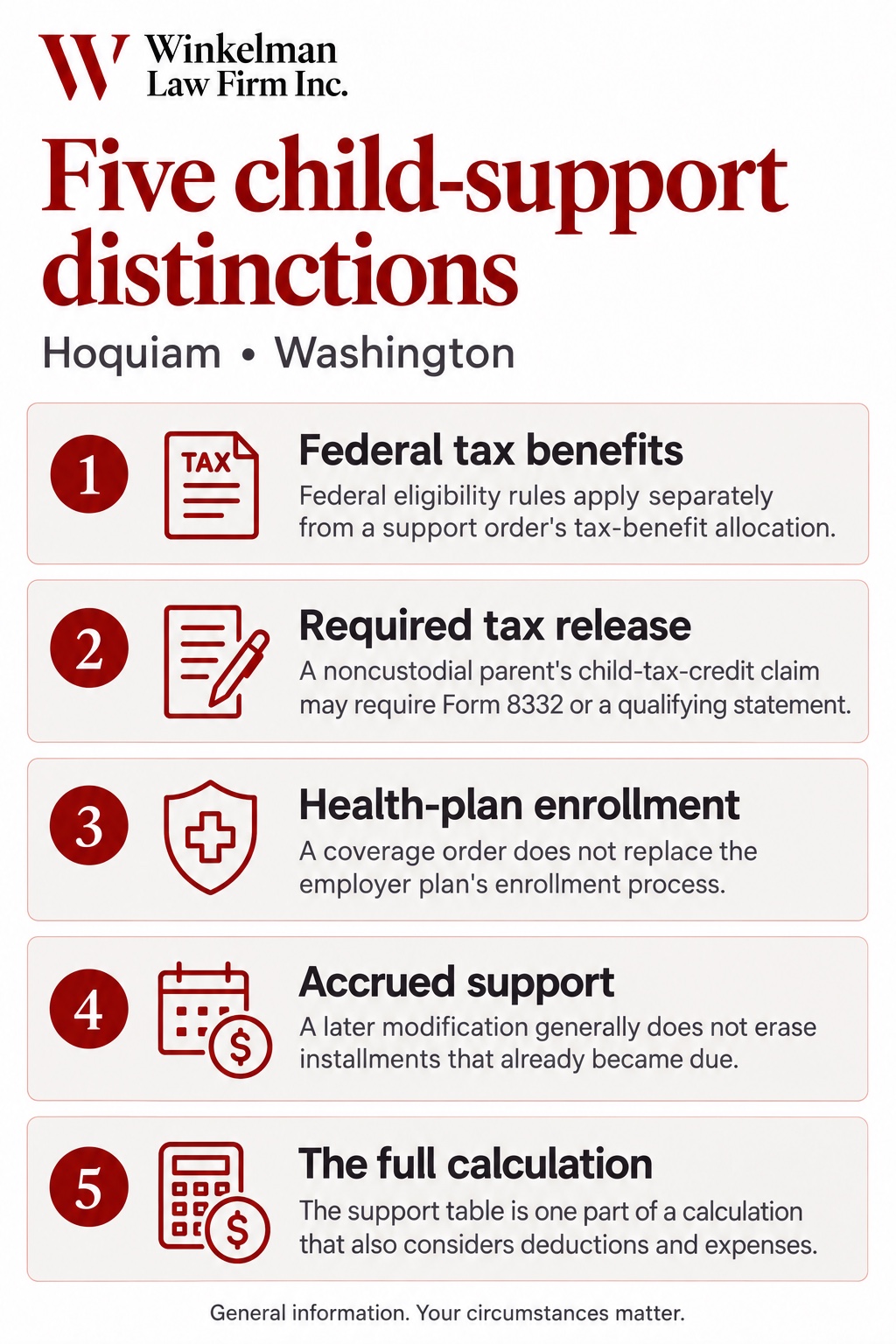
No. Federal eligibility rules govern child-related tax benefits, and a noncustodial parent's child-tax-credit claim can require a signed Form 8332 or qualifying statement in addition to meeting other requirements. Review the tax rules separately from the support order's allocation. See IRS child tax credit and noncustodial parents.
An order requiring coverage does not replace the employer plan's enrollment steps. Washington DSHS uses the National Medical Support Notice to direct employers and plan administrators through that process, so confirm actual enrollment rather than assuming the signed order activated coverage. See DSHS medical insurance enrollment.
A later modification generally applies to installments accruing after the modification petition or adjustment motion, subject to statutory exceptions. Previously accrued support should not be treated as erased merely because a new order is requested or entered. See RCW 26.09.170: Modification of support, maintenance and property orders.
The current 2026 schedule makes the economic table presumptive for combined monthly net incomes through $50,000. Above that level, a court may exceed the maximum presumptive support amount with written findings. The table is one part of the calculation; the applicable deductions, expenses and deviation rules also need review. See Washington Courts: 2026 child-support schedule.
We assist clients with Hoquiam child support from our office in Hoquiam, Washington. You can contact us and mention your main concerns, any existing documents and upcoming dates. We can then discuss your circumstances and the next steps for a consultation.