Disagreements over an estate can place additional pressure on families already dealing with the loss of a loved one. Questions about a will, inheritance, estate property, or the conduct of a personal representative can quickly turn a routine administration into a contested legal matter.
At Winkelman Law Firm, our Hoquiam estate litigation attorneys represent beneficiaries, heirs, personal representatives, and other interested parties in disputes involving estates and probate proceedings. We serve clients in Hoquiam, throughout Grays Harbor County, and across surrounding Western Washington communities.
Estate disputes can involve significant property, longstanding family relationships, and important legal rights. Our lawyers help clients understand the issues involved, evaluate available options, and pursue practical resolutions through negotiation, mediation, or litigation when court intervention becomes necessary.
Estate litigation involves legal disputes that arise over the validity or interpretation of estate planning documents, the administration of an estate, the rights of beneficiaries or heirs, or the ownership and distribution of property after someone dies.
It differs from routine probate administration. In an uncontested probate, the personal representative generally works through the legal and financial responsibilities required to settle the estate. Estate litigation arises when an interested party challenges some aspect of that process or when conflicting claims require resolution.
A dispute might involve questions about whether a will is valid, whether a personal representative has properly managed estate assets, who is entitled to particular property, or how language in a will should be interpreted.
Estate litigation can involve several different parties, including:
The appropriate response depends on the nature of the disagreement. Some matters can be resolved through communication, negotiation, or mediation. Others require motions, hearings, discovery, or additional court proceedings.
Our Hoquiam estate litigation lawyers evaluate both the disputed issue and the underlying administration. A resolution should address the immediate conflict while also considering what must happen for the estate to continue toward proper distribution and completion.
Estate disputes can arise from the terms of a will, the actions of a personal representative, disagreements among beneficiaries, or uncertainty about who owns particular property. Some conflicts begin shortly after death, while others emerge only after administration is underway.
Common estate and probate disputes can involve:
Not every disagreement requires a lawsuit. In some cases, the parties primarily need clarification about the estate documents or applicable legal requirements. Other conflicts may be resolved through negotiated agreements that allow the administration to continue.
More serious disputes may require court involvement. For example, allegations that estate property has been misused, a will is invalid, or a personal representative has failed to fulfill legal responsibilities can require formal proceedings and evidence.
The parties involved may also have very different perspectives. A beneficiary may believe a personal representative is unnecessarily delaying distributions, while the representative may be dealing with unresolved debts, taxes, property issues, or other obligations that must be addressed first.
Our Hoquiam probate litigation attorneys examine the documents, property, administration history, and legal claims involved before determining how a dispute should be approached. Understanding the source of the disagreement can help identify whether the matter is suited to negotiated resolution or requires more direct court intervention.
A will contest is a legal challenge to whether a will should be recognized and given effect. Disagreeing with an inheritance or being disappointed with the terms of a will does not, by itself, establish a basis for invalidating the document.
A challenge generally requires a legally recognized basis supported by evidence.
Depending on the circumstances, issues raised in a Washington will contest may involve:
Will contests are highly dependent on the facts surrounding the creation and execution of the document. Relevant evidence may include the will itself, earlier estate planning documents, communications, witness testimony, medical information when legally relevant, financial records, and evidence concerning relationships among the people involved.
A will contest can affect the broader probate administration as well. While the validity of a document is being disputed, questions may remain about who should ultimately receive property and what distributions can appropriately be made.
Personal representatives may also become involved even when they are not the party initiating the dispute. They may need guidance regarding the continued administration and preservation of estate property while the challenge is pending.
Our Hoquiam will contest attorneys represent clients on different sides of contested estate matters. We help beneficiaries, heirs, personal representatives, and other interested parties evaluate the evidence, understand the legal issues, and determine an appropriate strategy for addressing a disputed will.
Questions about undue influence and testamentary capacity can become central issues when someone challenges the validity of a will. These disputes are highly fact-specific and generally require more than disagreement with the choices reflected in the estate plan.
Testamentary capacity concerns whether the person making the will had the legal capacity required to execute the document at the relevant time. A diagnosis, advanced age, illness, or physical limitation does not by itself determine whether someone possessed testamentary capacity. The legal question focuses on the circumstances surrounding the execution of the will and the applicable requirements under Washington law.
Undue influence presents a different issue. A dispute may arise when someone alleges that another person improperly influenced the person making the will to such an extent that the resulting document did not reflect the will-maker's independent intentions.
Evidence relevant to these disputes can vary significantly and may include:
None of these factors automatically establishes that a will is valid or invalid. They must be evaluated in context.
Our Hoquiam estate litigation attorneys help clients examine the evidence surrounding disputed estate planning documents. Whether representing someone challenging a will or responding to allegations of undue influence or lack of capacity, our lawyers focus on the evidence and legal standards relevant to the specific dispute.
Personal representatives have significant responsibilities during estate administration. They may control estate accounts, manage property, address creditor claims, oversee sales, and ultimately distribute assets to beneficiaries or heirs.
Those responsibilities can become a source of litigation when interested parties believe the estate is being administered improperly.
Disputes may involve allegations that a personal representative has:
An allegation does not necessarily mean the personal representative has acted improperly. Estate administration can take time, particularly when property must be sold, creditor issues remain unresolved, taxes require attention, or beneficiaries disagree about how an issue should be handled.
Personal representatives may therefore need legal representation when responding to accusations concerning their conduct. In other cases, beneficiaries may need counsel when legitimate concerns about estate management are not being addressed.
Depending on the circumstances, a court may be asked to review conduct, require information or an accounting, resolve a disputed transaction, provide instructions, or consider other appropriate relief.
Our Hoquiam estate litigation lawyers represent parties on different sides of personal representative disputes. We work to identify the actual administration issue, evaluate the available records, and determine whether the dispute can be resolved while allowing the estate to continue toward completion.
Beneficiaries and heirs do not always agree about what an estate plan means or how property should be distributed. These disagreements can involve significant financial interests as well as longstanding family relationships.
Some disputes concern interpretation. A provision in a will may be unclear, property described in an older document may no longer exist in the same form, or multiple provisions may appear inconsistent when applied to the assets actually owned at death.
Other disputes concern who is legally entitled to property.
Beneficiary and inheritance conflicts may involve:
Resolving these matters often begins with determining which document or legal arrangement controls the property. A will does not necessarily govern assets subject to separate ownership or beneficiary arrangements.
For Hoquiam families, the practical value of the property may also be different from its emotional significance. Disagreements over family homes, heirlooms, vehicles, or other personal property can become difficult even when those assets are not the largest part of the estate.
Our Hoquiam estate dispute attorneys help beneficiaries, heirs, and personal representatives determine the legal rights involved and evaluate potential paths toward resolution. When possible, resolving a specific disagreement without disrupting the entire administration can benefit everyone with an interest in completing the estate.
Estate litigation can become particularly complex when the estate contains real estate, investment property, or an ownership interest in a closely held business.
A dispute may arise over whether property belongs to the estate at all. A family member, business partner, co-owner, or other party may claim an ownership interest that conflicts with the position taken by the personal representative.
Other disagreements may involve what should happen to an asset once ownership is established.
For example, beneficiaries may disagree about whether real estate should be sold or distributed. A closely held business may create questions about valuation, management authority, transfer restrictions, or the rights of surviving owners. Existing operating agreements, shareholder agreements, buy-sell provisions, deeds, contracts, and estate planning documents may all affect the analysis.
Business interests can also require immediate attention while a dispute is pending. Employees may still need direction, contracts may remain active, property may need maintenance, and the value of the company may depend on continued operations.
These disputes require attention to both the estate proceeding and the underlying property or business issues.
Winkelman Law Firm's Hoquiam estate litigation attorneys help clients address contested estate assets with those overlapping considerations in mind. Our team's experience involving probate, real estate, business law, contracts, and civil litigation can be particularly useful when resolving the estate dispute requires understanding more than the terms of a will alone.
Estate litigation does not always have to end in a trial. Depending on the dispute and the willingness of the parties to participate, negotiation or mediation may provide a way to resolve contested issues while avoiding some of the time, expense, and uncertainty associated with continued litigation.
Potential resolutions may address issues such as:
Settlement can also provide flexibility that may not be available through a court decision. Families may be able to structure an agreement around practical considerations involving property, businesses, or other assets rather than leaving every disputed issue for judicial determination.
However, negotiated resolution is not appropriate or achievable in every case. Some disputes involve fundamental disagreements over the validity of a will, ownership of valuable property, alleged fiduciary misconduct, or other issues that require court intervention.
Our Hoquiam estate litigation attorneys evaluate the available options based on the facts and objectives involved. Ben Winkelman's experience includes both trial practice and mediation, allowing our team to approach estate disputes with an understanding of negotiated resolution as well as contested proceedings when litigation is necessary.
Estate disputes should be evaluated promptly. Washington probate matters can involve legal deadlines, and estate administration may continue while a disagreement remains unresolved.
Property can be sold, debts and expenses may be paid, and distributions may eventually be proposed or completed. Waiting to address a concern can make an already complicated situation more difficult.
Prompt legal review can help determine:
Acting promptly does not necessarily mean filing a lawsuit immediately. In some cases, the appropriate first step may be obtaining information, reviewing estate documents, requesting an accounting, or communicating with the personal representative or other interested parties.
Personal representatives should also seek guidance promptly when a dispute arises. Continuing to administer a contested Hoquiam estate without considering the legal issues involved can create additional complications.
Our Hoquiam estate litigation lawyers help clients evaluate concerns early and determine a response appropriate to the circumstances rather than allowing uncertainty to dictate the next step.
Estate litigation can involve probate procedure, estate planning documents, fiduciary responsibilities, real estate, businesses, contracts, and contested court proceedings. Winkelman Law Firm'sattorneys bring decades of combined legal experience to disputes involving these overlapping issues.
Founding shareholder Ben Winkelman has more than 20 years of legal experience involving probate, wills and trusts, estate planning, trial practice, mediation, business law, and real estate matters. Associate attorney Ryan M. Pesicka brings experience in estate planning, civil litigation, business law, contracts, real property, and other contested matters.
That breadth allows our Hoquiam estate litigation attorneys to evaluate both the dispute itself and the underlying estate administration. Our team represents beneficiaries, heirs, personal representatives, and other interested parties while focusing on practical strategies suited to the facts and legal issues involved.
Whether a dispute can be resolved through negotiation or requires court intervention, we help clients understand their options and determine how to move forward.
Estate disputes can affect inheritances, family property, businesses, and the administration of an entire estate. Addressing those concerns early can help clarify the available options and protect important legal interests.
Winkelman Law Firm represents beneficiaries, heirs, personal representatives, and other interested parties in Hoquiam and throughout Grays Harbor County.
If you are involved in a disputed estate or have concerns about a will, inheritance, personal representative, or estate property,contact our Hoquiam estate litigation attorneys to schedule an appointment. Our lawyers can evaluate the dispute and help determine an appropriate path toward resolution.
Reviewed for legal accuracy by Benjamin R Winkelman on October 18, 2026
For Hoquiam estate litigation, we suggest keeping each version intact and noting where and when it was obtained. Include related envelopes, correspondence and any information about signatures or witnesses. We can assess the chronology without adding notes to an original document.
We review communications in Hoquiam estate litigation when they relate to the issues being disputed. Preserve complete conversations and original files rather than only selected screenshots. We can evaluate relevance and appropriate disclosure without suggesting that every private family exchange belongs in a public filing.
Our Hoquiam estate litigation review may involve account statements, receipts and available administration reports. Identify the transactions that concern you and distinguish what you know from what you suspect. We use those records to evaluate potential issues rather than assuming an unexplained payment proves wrongdoing.
For Hoquiam estate litigation, we review who will participate and what authority each person has to negotiate. We also identify missing documents and the issues that a proposed agreement would need to address. That preparation helps evaluate settlement terms without assuming attendance alone resolves the dispute.
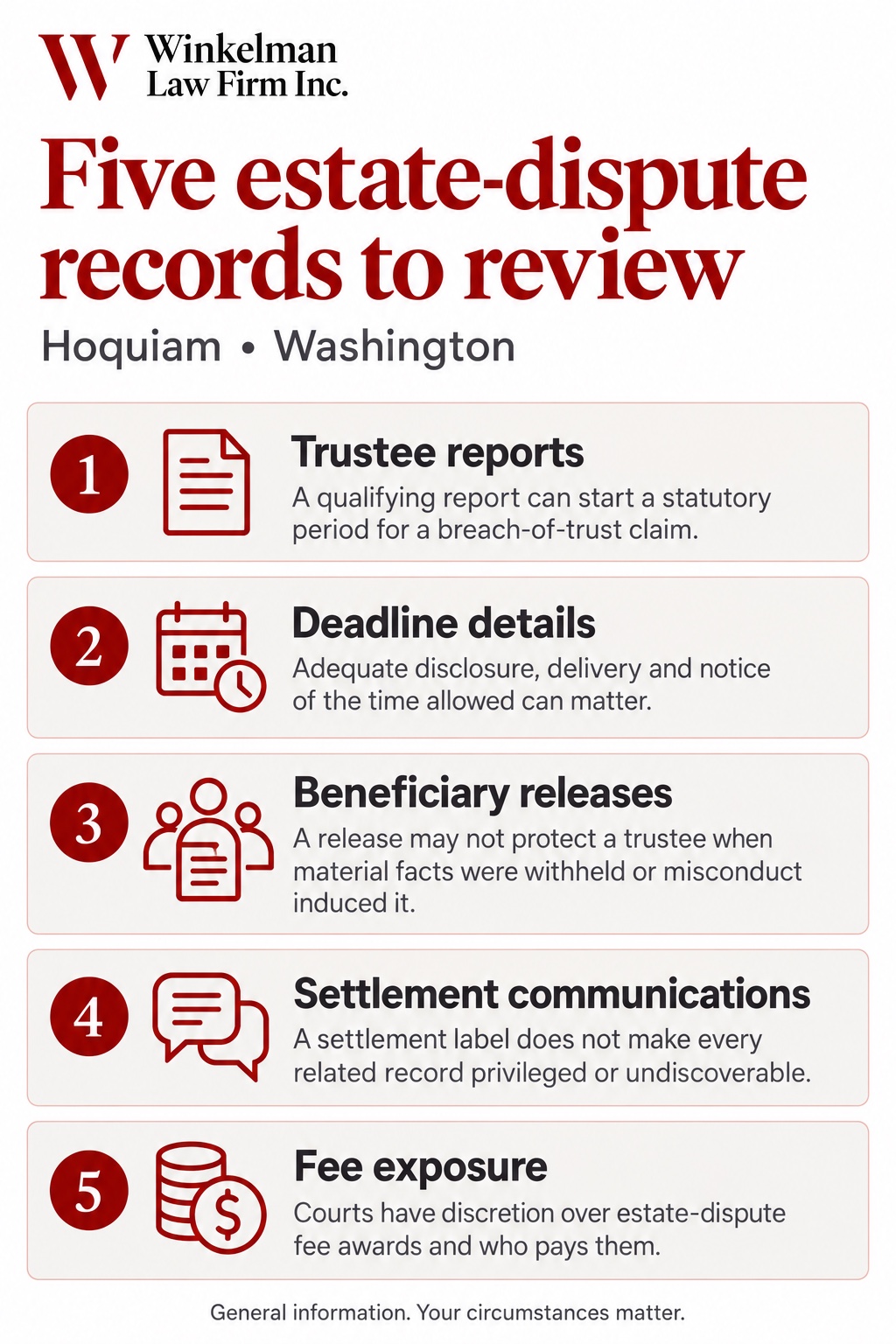
Yes. For an express trust, a properly delivered report that adequately discloses a potential breach and explains the time allowed can start a statutory claim period. Other triggering events may apply when that reporting rule is not satisfied, so preserve the report and obtain a deadline review promptly. See RCW 11.96A.070: Trust claim limitation periods.
Not necessarily. Washington law recognizes exceptions to a trustee's release protection when improper conduct induced the release or the beneficiary lacked knowledge of rights or material facts relating to the breach. Review what was disclosed and understood before treating a signed release as conclusive. See RCW 11.98.108: Beneficiary consent, release or ratification.
No. Washington Evidence Rule 408 limits specified uses of compromise negotiations, but it does not make all related evidence undiscoverable or exclude it for every purpose. Review the substance and context instead of relying on a settlement label to create blanket confidentiality. See Washington Evidence Rule 408.
No. Washington's estate-dispute statute gives the court discretion to award reasonable fees and costs in an equitable amount and manner. Payment may come from a party, estate or trust assets, or certain disputed nonprobate assets. Discuss potential fee exposure before assuming another person or the estate will pay. See RCW 11.96A.150: costs and attorneys' fees.
We assist clients with Hoquiam estate litigation from our office in Hoquiam, Washington. You can contact us and mention your main concerns, any existing documents and upcoming dates. We can then discuss your circumstances and the next steps for a consultation.