Estate tax planning can help individuals and families preserve more of what they have built and create a more efficient plan for transferring wealth to the next generation. For Washington residents, this planning deserves particular attention because the state maintains its own estate tax system with rules and thresholds that are separate from federal estate tax law.
At Winkelman Law Firm, our Hoquiam estate tax planning attorneys help clients evaluate the value and structure of their estates, identify potential tax exposure, and consider strategies that align with broader family and estate planning goals.
We work with individuals, families, property owners, and business owners in Hoquiam, throughout Grays Harbor County, and across surrounding Western Washington communities. Effective estate tax planning is not simply about reducing taxes. It involves coordinating property ownership, trusts, family wealth transfers, business interests, and other planning decisions to create a strategy appropriate for each client's circumstances.
Washington imposes an estate tax on the transfer of property at death. It is an estate tax rather than an inheritance tax, meaning the tax is imposed on the estate instead of directly on beneficiaries merely because they receive an inheritance.
For deaths occurring on or after July 1, 2026, Washington's estate tax filing threshold and applicable exclusion amount are $3 million. The threshold is based on the gross estate rather than the amount remaining after deductions. An estate exceeding the applicable filing threshold may therefore have a Washington filing requirement even when deductions ultimately result in little or no estate tax being owed.
Washington estate tax rates are graduated. For deaths occurring on or after July 1, 2026, the rates applied to the Washington taxable estate range from 10% to 20%.
These rules make accurate valuation important. A family's estate may be larger for estate tax purposes than expected when real estate, retirement accounts, investments, life insurance, business interests, and other property are considered together.
Estate tax planning can be especially relevant for Hoquiam residents whose property is approaching the state threshold. Real estate appreciation, investment growth, business value, and additional assets acquired over time can move an estate into a different position even when estate tax was not a concern when the original plan was prepared.
Our Hoquiam estate tax lawyers help clients evaluate potential exposure before estate tax becomes an administration issue. Because tax laws and estate values can change, planning should be based on current circumstances rather than assumptions made years earlier.
Determining whether Washington estate tax may be relevant begins with understanding the gross estate. This calculation can include considerably more than money in bank accounts or property passing through probate.
Washington's Department of Revenue identifies numerous categories of property that may be included when determining the gross estate. Depending on the circumstances, those assets can include:
Assets held in a revocable living trust can still be included in the gross estate. Similarly, using a beneficiary designation or transfer-on-death arrangement does not necessarily remove an asset from estate tax calculations simply because that property can transfer outside probate.
This distinction is important. Probate planning and estate tax planning address different legal issues. An asset can avoid probate while still being relevant when determining the value of an estate for tax purposes.
Business ownership can create additional valuation questions. A closely held company may represent a significant portion of a family's wealth even when the owner does not think of the business as a readily available financial asset. Real estate can present similar issues when property has appreciated substantially over many years.
Our Hoquiam estate tax planning attorneys help clients look beyond the most obvious assets and develop a more complete picture of their estates. Understanding what the estate actually includes is an important first step toward determining whether additional planning should be considered.
Washington estate tax and federal estate tax are separate systems. As a result, determining that an estate is not expected to owe federal estate tax does not necessarily resolve the Washington estate tax question.
This distinction is particularly important because state and federal exemption amounts can differ significantly.
A Hoquiam family may therefore have an estate that does not create an immediate federal estate tax concern but is large enough to warrant careful analysis under Washington law. Relying solely on federal thresholds can cause families to overlook state-level exposure.
The two systems can also involve different planning considerations. Property ownership, marital planning, trusts, lifetime transfers, charitable planning, business interests, and other decisions may have consequences under both state and federal law.
Tax laws are also subject to change. A plan created around thresholds or rules that applied several years ago may no longer reflect the current legal environment or the present value of the client's estate.
Our Hoquiam estate tax attorneys consider Washington and federal issues as parts of a coordinated estate planning process. For clients whose estates may approach applicable thresholds, reviewing both systems can help identify potential concerns early enough to preserve meaningful planning options.

Estate tax planning should be tailored to the size and composition of the estate, the client's family circumstances, and the way the client wants property to be managed and transferred. The goal is not simply to reduce the value of an estate. A successful strategy should also preserve appropriate control, provide for intended beneficiaries, and support the client's broader financial and estate planning objectives.
Depending on the circumstances, estate tax planning strategies may involve:
The timing and structure of these strategies matter. Transferring an asset during life can have tax, control, and financial consequences that differ substantially from transferring the same property at death. Trusts can provide additional planning options, but the terms of the trust and the rights retained by the person creating it can affect the results.
Tax planning should also account for more than estate tax alone. Income tax, capital gains considerations, gift tax rules, property ownership, and other consequences may influence whether a particular strategy makes sense.
For that reason, our Hoquiam estate tax planning attorneys evaluate potential strategies in the context of the client's complete estate. When appropriate, estate planning lawyers can also coordinate with accountants, financial professionals, and other advisors so that legal documents and financial planning work toward consistent objectives.
The appropriate plan may be relatively straightforward or involve several coordinated strategies. What matters is that the approach reflects the client's actual estate, family priorities, and long-term goals rather than relying on a technique simply because it is commonly associated with estate tax planning.
Married couples have additional estate tax planning considerations because the ownership and transfer of property between spouses can affect how an estate is ultimately taxed.
A plan should consider how property is titled, what happens when the first spouse dies, how assets will be managed for the surviving spouse, and what property may eventually pass to children or other beneficiaries.
Trust planning may be appropriate for some married couples. Depending on the family's circumstances, trusts can be structured to provide benefits for a surviving spouse while also addressing the eventual transfer of property to future beneficiaries. Other families may have simpler planning needs.
Washington law also contains specific provisions affecting estate tax calculations for married couples. These rules can change, making periodic review particularly important for families whose combined wealth may approach applicable thresholds.
Estate tax considerations should not overshadow the family's broader objectives. A married couple may also need to consider:
For Hoquiam families, the appropriate strategy should balance tax considerations with practical questions about control, access to property, and long-term family needs.
Our Hoquiam estate tax lawyers help married couples evaluate how their wills, trusts, ownership arrangements, and beneficiary plans work together. The objective is a coordinated plan that addresses potential tax exposure without losing sight of the people and property the estate plan is intended to protect.
A closely held business can significantly affect estate tax planning. Even when much of an owner's wealth is tied up in the company rather than held in cash or investments, the value of the business interest may still be relevant when determining the size of the estate.
That creates two related concerns: valuation and liquidity.
A successful company may appreciate considerably during the owner's lifetime. As the business grows, an estate plan created years earlier may no longer reflect the value of the owner's interest. Periodic valuation and planning can help identify whether that growth creates additional estate tax exposure.
Liquidity presents a different challenge. An estate can contain valuable business interests without having substantial cash available to address taxes, administration expenses, or other obligations. Poor planning may place pressure on the family or successor owners at a difficult time.
Business owners may therefore need to coordinate estate tax planning with:
Washington law also provides specific estate tax treatment for certain qualifying family-owned business interests. Whether those provisions apply depends on statutory requirements and the particular circumstances of the estate.
For Hoquiam and Grays Harbor County business owners, estate planning should therefore address both the value of the business and what should happen to it in the future. Our Hoquiam estate tax planning attorneys help clients coordinate ownership, succession, and estate planning so that tax considerations are evaluated alongside the long-term future of the business.
Estate tax planning generally provides more options when it begins before tax exposure becomes an immediate concern.
An estate that falls below an applicable threshold today may not remain there. Real estate can appreciate, investments can grow, businesses can increase substantially in value, and life insurance or other assets may increase the total value considered for estate tax purposes.
Starting early gives Hoquiam residents an opportunity to monitor those changes and evaluate planning strategies before decisions become time-sensitive.
Early planning can be particularly important when a strategy involves lifetime transfers, trusts, business succession, or changes in ownership. These decisions can affect control of property, taxes, beneficiaries, and long-term financial security. They deserve careful consideration rather than being implemented hastily after a serious illness or other major event.
Planning early does not necessarily mean transferring assets immediately or creating complex trusts. In some cases, the appropriate first step is simply determining the current value of the estate, understanding potential exposure, and establishing points at which the plan should be reviewed.
Estate tax laws can change as well. A strategy based entirely on today's exemption amounts may become outdated as state or federal rules evolve.
Our Hoquiam estate tax attorneys help clients take a forward-looking approach. By reviewing estate values, family circumstances, business interests, and existing planning documents before an urgent need develops, clients can make deliberate decisions and preserve more flexibility for the future.
Estate tax planning should not be treated as a one-time decision. Changes in finances, family circumstances, property values, and tax laws can all affect whether an existing plan continues to accomplish its intended purpose.
A review may be appropriate after:
Review can be especially important for Hoquiam residents whose estates are approaching Washington's applicable estate tax threshold. Growth that occurs gradually may eventually create tax considerations that were not relevant when the original plan was prepared.
An estate tax review does not necessarily mean major changes are required. It may confirm that the existing plan remains appropriate or identify relatively limited adjustments that better reflect current circumstances.
Our Hoquiam estate tax planning lawyers help clients reassess estate values, existing documents, ownership arrangements, and long-term transfer goals. Regular review can help keep planning aligned with both current law and the client's evolving financial circumstances.
Estate tax planning can involve trusts, property ownership, family wealth transfers, business interests, and succession planning. Winkelman Law Firm'sattorneys bring decades of combined legal experience to individuals, families, and business owners in Hoquiam, throughout Grays Harbor County, and beyond.
Founding shareholder Ben Winkelman has more than 20 years of legal experience, including wills, trusts, estate planning, probate, business law, and real estate matters. Associate attorney Ryan M. Pesicka also brings experience involving estate planning, business law, contracts, entity formation, and real property.
That breadth allows our Hoquiam estate tax attorneys to consider potential tax exposure within the client's larger legal and financial picture. Our team focuses on practical planning tailored to the client's assets, family priorities, business interests, and long-term objectives rather than unnecessarily complicated strategies.
Estate tax planning can provide more flexibility when potential exposure is identified before it becomes an immediate concern.
Winkelman Law Firm helps individuals, families, and business owners in Hoquiam and throughout Grays Harbor County evaluate estate values, existing plans, and strategies for transferring wealth efficiently while addressing broader family and succession goals.
To discuss how Washington estate tax considerations may affect your estate,contact our Hoquiam estate tax planning attorneys to schedule an appointment. Our lawyers can help you evaluate your current plan and determine whether additional estate tax planning should be considered.
Reviewed for legal accuracy by Benjamin R Winkelman on October 18, 2026
For Hoquiam estate tax planning, we ask for ownership percentages, governing agreements and current financial statements for closely held companies. Note any transfer restrictions or existing valuation work. We can identify questions for appropriate valuation and tax advice before relying on an informal estimate of the interest.
We ask about prior gifts during Hoquiam estate tax planning and recommend keeping related returns and valuation records. A family member's recollection may not establish what was transferred or how it was reported. We can identify issues to coordinate with your tax preparer before recommending further transfers.
Our Hoquiam estate tax planning review considers the type of asset and the date associated with each value. An old insurance figure or informal estimate may serve a different purpose from a tax valuation. We can help identify where a qualified valuation or updated information may be needed.
For Hoquiam estate tax planning, we ask for a complete inventory that identifies where property is located. Ownership outside Washington can introduce additional administration and tax questions. We can coordinate the legal review with appropriate tax or local advice instead of assuming one state's treatment answers every issue.
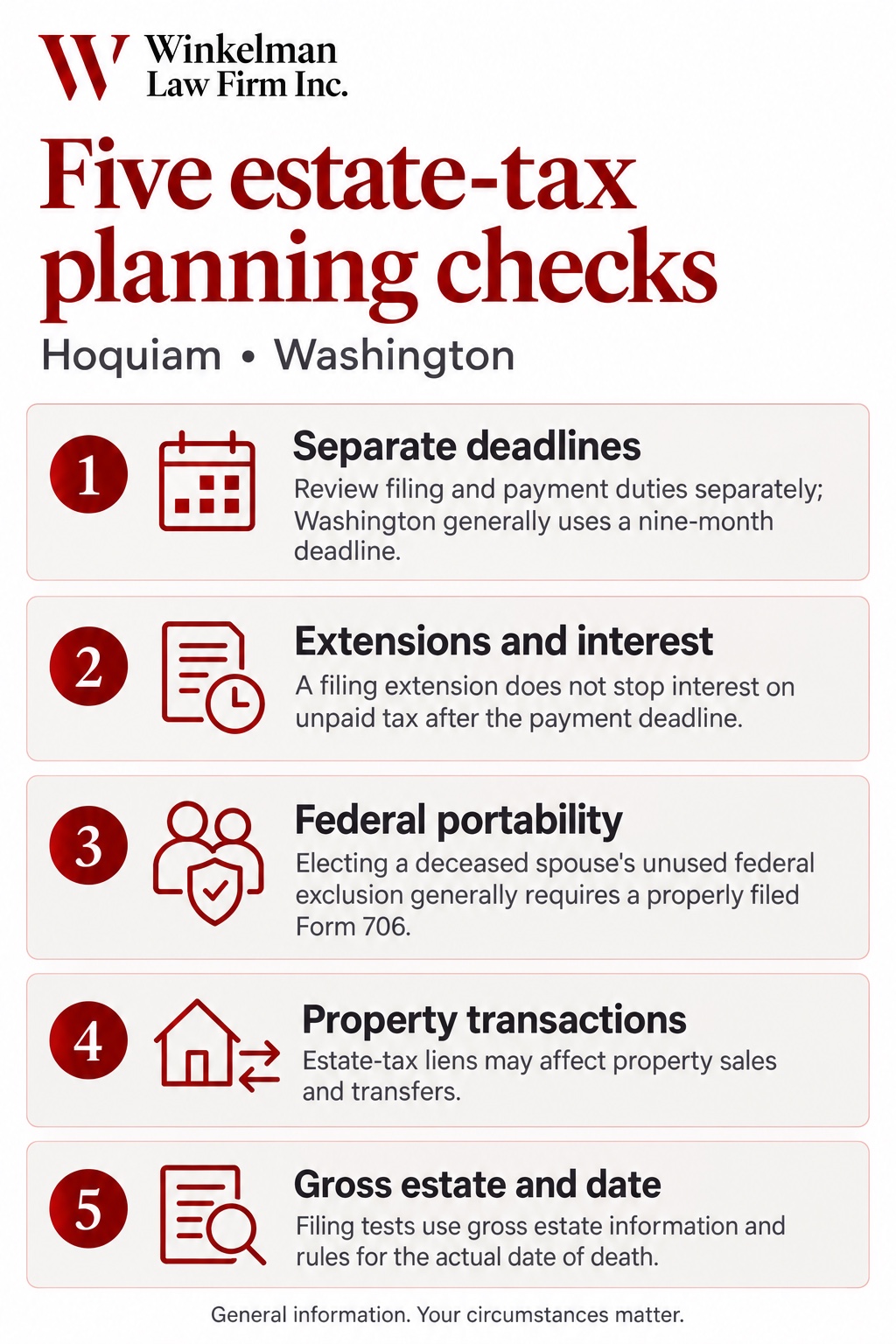
A Washington extension to file the estate-tax return does not, by itself, stop interest on unpaid tax after the payment deadline. The Department of Revenue generally requires payment within nine months after death, so review filing and payment arrangements separately. See Washington estate tax deadlines.
Yes. Electing federal portability of a deceased spouse's unused exclusion generally requires a timely, properly prepared Form 706 even if the estate would not otherwise owe federal estate tax. Review the election, filing deadline and any available relief rather than assuming portability is automatic. See IRS estate tax portability.
Washington estate tax can create a lien on property subject to the tax, with statutory rules for sales, proceeds and payment extensions. A transaction therefore calls for review of the estate's tax position and any required clearance, rather than assuming the property's transfer resolves every tax obligation. See RCW 83.100.110: Estate tax lien.
The filing threshold and exclusion are $3,076,000 for deaths from January 1 through June 30, 2026, and $3,000,000 for deaths from July 1 through December 31, 2026. The filing threshold is based on the gross estate, so deductions do not alone decide whether a return is required. See Washington DOR: estate tax tables.
We assist clients with Hoquiam estate tax planning from our office in Hoquiam, Washington. You can contact us and mention your main concerns, any existing documents and upcoming dates. We can then discuss your circumstances and the next steps for a consultation.