A revocable living trust can give individuals and families a flexible way to manage property during life while establishing clear instructions for how trust assets should be handled in the future. For some people, it can also provide important continuity if they become unable to manage their financial affairs or after their death.
At Winkelman Law Firm, our Hoquiam revocable living trust attorneys help clients determine whether this type of trust fits their property, family circumstances, and broader estate planning goals. We serve individuals and families in Hoquiam, throughout Grays Harbor County, and across surrounding Western Washington communities.
A living trust is not automatically the right solution for every estate. Our lawyers help clients understand what a revocable trust can accomplish, what it cannot accomplish, and what steps are necessary to make the plan work as intended.
A revocable living trust is a trust created during a person's lifetime that generally allows the person creating it to retain substantial control over the trust and its property. As the name suggests, the trust can generally be changed or revoked while the person who created it retains the legal authority to do so.
The person establishing the trust is commonly called the settlor, grantor, or trustor. That person transfers or coordinates property with the trust and establishes the terms governing how trust assets will be managed and distributed.
Many revocable living trusts are structured so that the person creating the trust initially serves as the trustee as well. This arrangement can allow the settlor to continue controlling and managing trust property much as they did before the trust was created.
The trust document can then name one or more successor trustees who can assume responsibility under circumstances described in the document. A successor trustee may become responsible for trust administration if the original trustee dies, becomes unable to serve, resigns, or another specified event occurs.
A revocable living trust can also identify beneficiaries and establish instructions governing what happens to trust property after the settlor's death. Depending on the client's goals, the trust might direct assets to be distributed outright or provide for property to remain in trust and be managed for beneficiaries over time.
This combination of present control and future instructions is one reason living trusts can be useful estate planning tools.
However, creating the trust document is only one part of the process. Property intended to be governed by the trust generally needs to be properly transferred or otherwise coordinated with it. A trust that was never appropriately funded may not control assets in the way the settlor expected.
Our Hoquiam revocable living trust lawyers help clients consider the entire arrangement, including the trust terms, successor trustee provisions, beneficiaries, and the property the trust is intended to govern.
One of the defining characteristics of a revocable living trust is the degree of control the settlor can generally retain during life.
When a Hoquiam resident establishes a revocable living trust and serves as the initial trustee, that person can typically continue managing the property held in the trust. Depending on the assets involved, this may include managing financial accounts, buying or selling property, addressing real estate, or otherwise making decisions concerning trust assets.
The settlor may also generally retain the ability to amend the trust. This can be important because estate planning circumstances rarely remain completely static.
For example, a client may want to make changes after:
Depending on the terms of the trust and applicable law, the settlor may also be able to revoke the trust entirely.
That flexibility distinguishes revocable living trusts from irrevocable arrangements, which can involve considerably greater restrictions on modification and control.
A living trust also does not require the settlor to give up the benefit of the property simply because legal ownership has been coordinated with the trust. In a commonly used revocable structure, the settlor may remain the person managing and benefiting from trust assets during life while establishing instructions for what should occur later.
The trust can also provide a framework for a transition in management. If the original trustee can no longer serve, the designated successor trustee may be able to assume responsibility for property already held in the trust according to its terms.
For Hoquiam families, this continuity can be as important as planning for what happens after death. Estate planning involves both the future transfer of property and the possibility that someone may need assistance managing assets during life.
Our attorneys help clients structure revocable living trusts around those objectives while coordinating the trust with other estate planning documents.
A revocable living trust can offer several planning advantages, but those advantages depend on how the trust is drafted, funded, and coordinated with the rest of the estate plan. A living trust should therefore be selected because its features address a client's particular needs—not simply because trusts are sometimes portrayed as preferable to wills.
For an appropriate estate plan, potential benefits may include:
These potential advantages need to be considered alongside the work required to establish and maintain the plan. A trust must be properly drafted, relevant property must be coordinated with it, and significant changes in assets or family circumstances may require additional attention.
A revocable living trust also does not provide every benefit associated with every type of trust. In particular, retaining broad control over trust property has legal consequences. Clients should not assume that transferring property to a standard revocable trust automatically shields those assets from creditors or produces estate tax savings.
For some Hoquiam residents, a revocable living trust can become the central asset-management component of an estate plan. For others, a will-based plan may accomplish their objectives more efficiently.
Our Hoquiam living trust attorneys help individuals and families evaluate those differences based on their actual circumstances rather than treating a revocable trust as a universal estate planning solution.

Estate planning is not limited to determining what happens after death. It can also address how property will be managed if an individual becomes unable to handle financial affairs during life.
A revocable living trust can provide a framework for continuity in the management of assets held in the trust. When creating the trust, the settlor can name a successor trustee and establish the circumstances under which that person will assume responsibility.
If the original trustee can no longer serve, the successor trustee may be able to step into that role and manage trust property according to the document's terms. Depending on the assets held in the trust, this can provide continuity for financial accounts, real estate, business interests, or other property without requiring the settlor to establish an entirely new arrangement at the time assistance becomes necessary.
Careful selection of a successor trustee is therefore important. The person chosen may eventually have substantial responsibility for managing property and carrying out the trust's instructions. Hoquiam residents creating living trusts should consider the proposed trustee's reliability, financial judgment, availability, and ability to act responsibly for the benefit of the people identified in the trust.
A revocable living trust, however, is only one component of incapacity planning.
The successor trustee's authority generally concerns property governed by the trust. Other financial or legal matters may require a power of attorney, while health care decisions require separate planning. A living trust does not give a successor trustee unlimited authority over every aspect of the settlor's life.
This is why our Hoquiam revocable living trust attorneys consider the trust alongside the client's other estate planning documents. Powers of attorney, health care planning documents, asset ownership, and the living trust should be coordinated so that important responsibilities are addressed rather than leaving unintended gaps.
For clients throughout Hoquiam and Grays Harbor County, planning for incapacity can provide an important additional reason to consider a revocable living trust rather than viewing the trust solely as a tool for transferring property after death.
Probate is one of the most common reasons people ask our attorneys about revocable living trusts. A properly established and funded trust can reduce the assets that must be administered through probate, but the result depends heavily on how property is owned when the settlor dies.
Assets legally held in a revocable living trust are generally administered according to the trust's terms rather than through the settlor's probate estate. After death, the successor trustee can take responsibility for trust property and carry out the instructions established in the trust.
That does not mean merely signing a living trust guarantees that probate will be unnecessary.
Consider a Hoquiam resident who creates a revocable trust but never transfers a piece of real estate or another significant asset into it. If that property remains individually owned at death and does not pass through another nonprobate arrangement, the existence of the trust alone does not automatically place the asset under the successor trustee's control.
This distinction between creating a trust and funding a trust is critical.
Other assets may already transfer outside probate for reasons unrelated to a living trust. Property with certain beneficiary designations, survivorship arrangements, or other nonprobate transfer mechanisms may be governed by those arrangements instead.
The objective should therefore be broader than simply trying to “avoid probate.” A sound estate plan considers:
Probate is not inherently evidence that an estate plan failed. Depending on a client's assets and circumstances, a will-based estate plan may remain entirely appropriate. For other Hoquiam families, reducing the amount of property requiring probate administration may be a meaningful objective.
Our revocable living trust lawyers help clients evaluate that distinction before deciding how heavily a trust should factor into their estate plan.
Funding is the process of transferring or coordinating property so that the revocable living trust actually governs the assets it was intended to control. It is one of the most important practical steps in establishing a living trust.
The appropriate method depends on the type of property.
For example, real estate may require changes to title or other documentation. Financial accounts may require different ownership arrangements. Business interests can involve governing documents, transfer restrictions, or other considerations that need to be evaluated before an ownership interest is transferred.
Assets commonly considered during the funding process may include:
Not every asset should automatically be retitled in the name of a living trust.
Retirement accounts, life insurance policies, and other assets with beneficiary designations require separate consideration. The appropriate strategy may involve coordinating beneficiary designations with the overall estate plan rather than simply attempting to change ownership of every asset.
This is another reason individualized planning matters.
Funding also should not necessarily be treated as a one-time event. A client may establish a revocable living trust and properly coordinate existing property with it, then purchase a new home, open additional accounts, acquire an investment property, or obtain an ownership interest in a business several years later.
If newly acquired property is never considered in connection with the trust, the estate plan can gradually become less coordinated over time.
Hoquiam residents with living trusts should therefore periodically review significant assets and ownership arrangements, particularly after major financial or property changes.
Our Hoquiam living trust attorneys help clients consider which assets should be associated with a revocable trust and how the trust fits alongside beneficiary designations and other transfer arrangements. The goal is not simply to create a trust document. It is to develop a plan in which ownership and estate planning documents work together as intended.
A revocable living trust changes in an important way when the settlor dies. Although the settlor generally retains the ability to amend or revoke the trust during life, that authority ends at death. The trust then becomes irrevocable, and the successor trustee must administer the trust according to its terms and applicable law.
The successor trustee's responsibilities will depend on the trust, the property involved, and the circumstances of the estate. Those responsibilities may include identifying and securing trust assets, obtaining information about property values, maintaining records, addressing appropriate expenses and tax matters, communicating with beneficiaries, and ultimately distributing or continuing to manage trust property according to the trust document.
Not every trust requires immediate distribution of all remaining property.
A settlor may direct that certain assets be distributed outright to beneficiaries. In other circumstances, the trust may provide for assets to remain under management for a period of time or until specified conditions are satisfied.
For example, a parent may establish terms under which property remains in trust for younger beneficiaries rather than passing to them immediately. Other family circumstances may also support continued trust administration.
The successor trustee does not simply inherit unrestricted control of the property. The trustee is responsible for administering trust assets in accordance with the trust and the fiduciary obligations associated with the role.
This is why the selection of a successor trustee and the clarity of the trust document matter. The person taking over should be able to understand the settlor's instructions and carry out the administrative responsibilities that follow.
A trust also does not necessarily eliminate every issue associated with settling the settlor's affairs. Property outside the trust may require separate administration, and tax, creditor, ownership, or beneficiary issues can still arise.
Our Hoquiam revocable living trust attorneys help clients plan for this transition in advance. By establishing clear instructions, selecting appropriate successor trustees, and coordinating property with the trust during life, clients can create a more organized framework for administration after death.
Revocable living trusts can be useful estate planning tools, but they are sometimes credited with benefits they do not automatically provide. Understanding those limitations is an important part of deciding whether a living trust belongs in an estate plan.
One common misconception involves asset protection. Because the settlor of a typical revocable living trust retains substantial control over trust property, transferring assets to the trust does not generally create the same type of creditor protection that may be associated with certain irrevocable planning strategies.
Clients should also be cautious about assuming that a revocable living trust automatically reduces estate taxes. Tax planning depends on the size and composition of the estate, the applicable law, and the planning strategies being used. Creating a standard revocable trust by itself should not be treated as a guaranteed tax-reduction strategy.
A living trust also does not:
These limitations do not diminish the usefulness of revocable living trusts. Instead, they illustrate why a trust should be created for clearly defined reasons and coordinated with other estate planning tools.
For example, a Hoquiam resident may use a revocable living trust to establish continuity in the management of real estate and financial assets while relying on a financial power of attorney for matters outside the trustee's authority. A will may address property remaining outside the trust, while separate health care documents address medical decisions.
Each document has its own purpose.
Our Hoquiam living trust lawyers help clients distinguish between what a revocable trust can accomplish and what requires additional planning. That approach can produce a more complete estate plan than relying on a single document to solve every potential issue.
Not every Hoquiam resident needs a revocable living trust. Whether one is appropriate depends on the client's assets, family circumstances, planning objectives, and preferences for how property should be managed during life and after death.
A revocable living trust may be worth considering when a client is particularly concerned about continuity in asset management, planning for possible incapacity, administration of trust-owned property after death, or establishing detailed instructions for beneficiaries.
Relevant considerations can include:
The administrative side of the decision also matters. A living trust works best when clients are prepared to coordinate appropriate assets with it and revisit the plan as their property changes. Someone who creates a trust but never completes the necessary funding steps may not receive the intended benefits.
For some individuals and families, a well-prepared will and related estate planning documents may provide an appropriate and more straightforward structure. For others, a revocable living trust can offer meaningful flexibility and continuity.
The decision should therefore come after evaluating the client's circumstances rather than starting with the assumption that everyone needs a trust.
At Winkelman Law Firm, our Hoquiam revocable living trust attorneys help clients compare available estate planning approaches and understand the practical differences between them. Our goal is to help clients select tools that fit their actual needs rather than add unnecessary complexity to their plans.
Creating a revocable living trust requires attention to more than the language of the document. The trust should reflect the client's objectives, identify appropriate decision-makers and beneficiaries, and work together with asset ownership and other components of the estate plan.
At Winkelman Law Firm, ourattorneys bring decades of combined legal experience serving individuals, families, and businesses in Hoquiam, throughout Grays Harbor County, and beyond. Founding shareholder Ben Winkelman has more than 20 years of legal experience, including work involving trusts, wills, estate planning, and probate. Associate attorney Ryan M. Pesicka also brings estate planning experience from his background in private practice and other areas of law.
Our Hoquiam living trust lawyers take the time to understand the client's family, property, and long-term objectives before recommending a particular structure. We can also review existing living trusts when clients have experienced significant changes or have questions about whether their assets remain properly coordinated with their plans.
Whether a client needs a revocable living trust or a different estate planning approach, our team focuses on practical planning tailored to the client's circumstances.
A revocable living trust can be a valuable estate planning tool when it is properly structured, funded, and coordinated with the rest of your plan.
At Winkelman Law Firm, our Hoquiam revocable living trust attorneys help clients create, review, update, and fund living trusts based on their property, family circumstances, and long-term objectives. We serve individuals and families in Hoquiam, throughout Grays Harbor County, and across surrounding Western Washington communities.
If you are considering a living trust or want to review an existing one,contact our Hoquiam revocable living trust attorneys to discuss your estate planning needs and schedule an appointment. Our lawyers can help you evaluate whether a revocable living trust is appropriate and how it should fit within your broader estate plan.
Reviewed for legal accuracy by Benjamin R Winkelman on October 18, 2026
We recommend reviewing Hoquiam revocable living trusts when a lender requests a change in title during refinancing. The lender's closing instructions and the estate plan should be considered together. We can check the proposed documents and any follow-up ownership work instead of assuming the trust will be restored automatically.
We treat opening a new account as a useful checkpoint for Hoquiam revocable living trusts. Record how the account is titled and whether it has a beneficiary designation. We can then review that arrangement against the plan before you assume the new asset follows the treatment of an older account.
When reviewing Hoquiam revocable living trusts, we look at where sale proceeds went as well as the property that was sold. Keep the closing statement and the receiving account information together. We can use those records to check whether the funds remain coordinated with your intended plan.
For Hoquiam revocable living trusts, we review the document's actual process for a successor to begin acting. The successor should know where to find the trust and what evidence the document or an institution may require. We can explain the relevant provisions rather than assuming a family member's concern alone authorizes access.
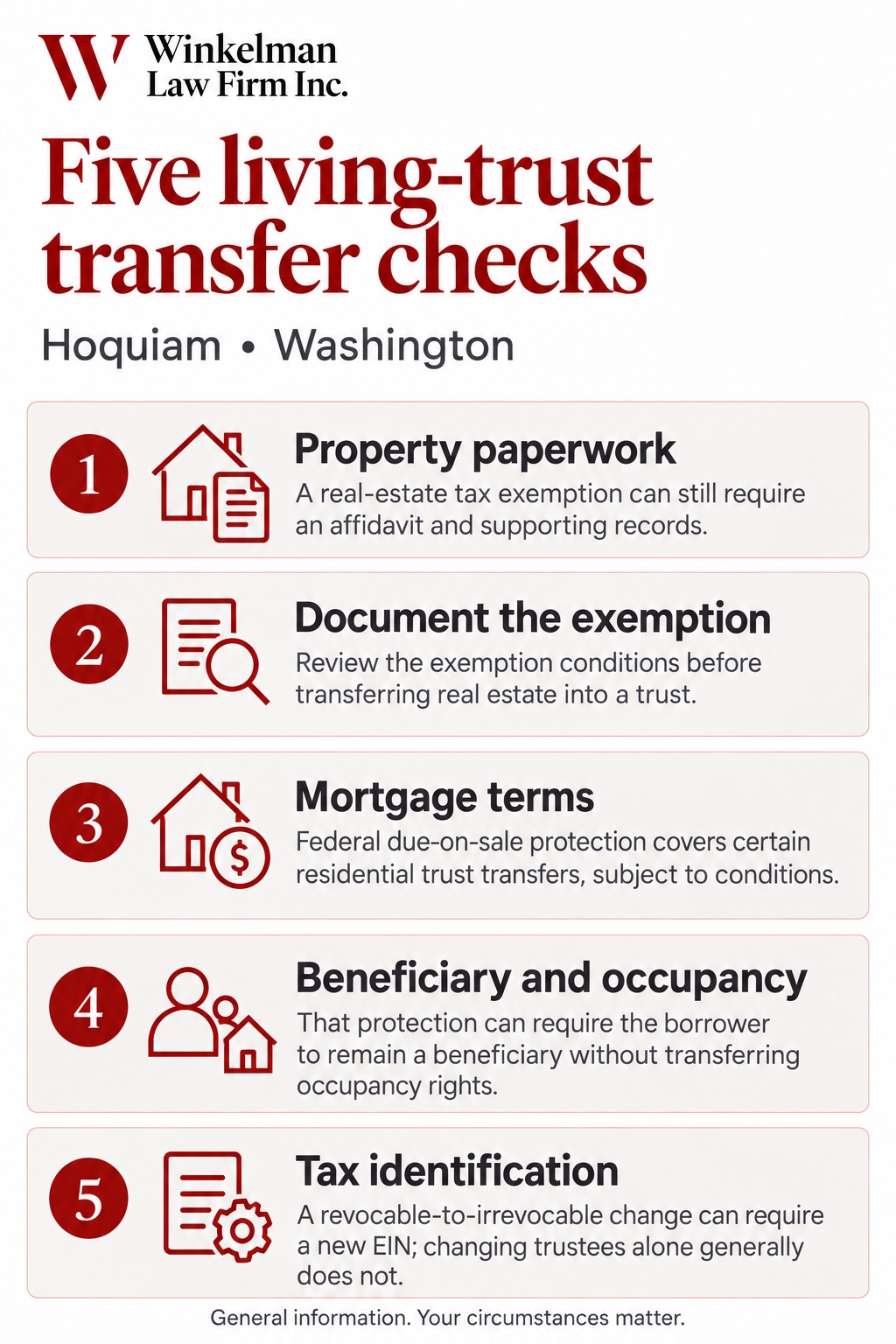
No. A transfer may qualify for a real-estate excise-tax exemption while still requiring an affidavit and supporting documentation. Washington's Department of Revenue identifies exemptions for qualifying revocable-trust transfers and explains how the claimed exemption must be documented. See Washington REET exemptions and affidavits.
Federal law protects certain transfers into an inter vivos trust when the borrower remains a beneficiary and occupancy rights are not transferred. That protection applies to specified residential loans and conditions, so review the loan and proposed transfer rather than treating every trust transfer as exempt. See 12 USC 1701j-3: Due-on-sale exceptions.
Review the issue when a death changes a revocable trust into an irrevocable trust or otherwise changes its tax status. The IRS lists that conversion as a reason for a new EIN, while a change of trustee alone generally does not require one. See IRS: When to get a new EIN.
Use the rules applicable to the decedent's date of death, rather than the date the trust was signed or property was distributed. Washington's estate-tax exclusion and rate tables changed on July 1, 2026, so the exact date matters when reviewing administration. See Washington DOR: summary of 2026 legislation.
We assist clients with Hoquiam revocable living trusts from our office in Hoquiam, Washington. You can contact us and mention your main concerns, any existing documents and upcoming dates. We can then discuss your circumstances and the next steps for a consultation.