After someone dies, family members may be responsible for managing property, addressing debts and expenses, communicating with beneficiaries, and completing legal requirements before the estate can be distributed. Handling those responsibilities while grieving can make an already difficult period more demanding.
At Winkelman Law Firm, our Hoquiam probate and estate administration attorneys help personal representatives, executors, administrators, and families navigate the process of settling an estate. We serve clients in Hoquiam, throughout Grays Harbor County, and across surrounding Western Washington communities.
Every estate is different. Some require formal probate proceedings, while others may involve substantial administration outside probate. Our lawyers help clients determine what process is appropriate, understand their responsibilities, address issues involving estate property and creditors, and move the administration toward an orderly conclusion.
Probate is a legal process used to administer certain estates after a person dies. When probate is required or appropriate, the court can formally recognize the person authorized to administer the estate and provide a framework for addressing property, debts, expenses, and distributions to beneficiaries or heirs.
Washington generally refers to the person appointed to administer a probate estate as the personal representative. A will may nominate someone to serve in that role. The term “executor” is also commonly used, while an administrator may be appointed in circumstances where there is no will or no nominated representative able to serve.
Probate can involve several responsibilities, including:
Probate and estate administration are related, but they are not necessarily identical. Estate administration broadly refers to the work required to settle a person's financial and legal affairs after death. Probate is the court process that may be used as part of that administration.
A Hoquiam estate can therefore require important administrative work even when some or all property transfers outside probate.
Our Hoquiam probate attorneys help families determine what legal steps are necessary based on the assets, ownership arrangements, estate planning documents, and other circumstances involved. Understanding the appropriate process at the beginning can help the personal representative approach the estate with clearer expectations.
Not every Washington estate requires the same probate process. Whether probate is necessary or useful depends largely on what the person owned, how the property was titled, whether beneficiaries were designated, and the circumstances surrounding the estate.
Property owned solely in the deceased person's name may require probate administration before it can be transferred to the appropriate beneficiaries or heirs. Real estate can be particularly important because clear authority may be needed to manage, transfer, or sell the property.
Other assets may have mechanisms allowing them to pass outside probate.
For example, an estate may include:
The existence of a will does not, by itself, determine whether probate is necessary. A will provides instructions regarding the administration and distribution of property subject to it, but it does not automatically transfer every asset outside the probate process.
Likewise, the absence of a will does not mean probate is impossible. When someone dies without a valid will, Washington's intestate succession laws may determine who is entitled to inherit property that does not otherwise pass through a nonprobate arrangement.
Some estates may also qualify for procedures that are simpler than a traditional probate, depending on the property and circumstances involved.
Our Hoquiam probate lawyers review the deceased person's assets, estate planning documents, beneficiary designations, and ownership arrangements to determine what type of administration may be appropriate. For families throughout Grays Harbor County, that initial review can prevent unnecessary assumptions about whether probate is required and what steps should come next.
Although every estate presents different issues, Washington probate generally follows a progression from establishing authority to ultimately distributing property and completing the administration.
The process commonly begins by filing the appropriate documents with the court and seeking appointment of a personal representative. If the deceased person left a will, the original will may be submitted as part of that process. Once appointed and properly authorized, the personal representative can begin carrying out the responsibilities associated with the estate.
The administration may then involve several stages:
Not every step requires extensive court involvement. Depending on how the probate is structured and the authority granted to the personal representative, Washington law can allow significant estate administration to occur without obtaining separate court approval for every routine action.
Even relatively straightforward estates can require careful recordkeeping. Money received or spent on behalf of the estate should be distinguished from the personal representative's own finances, and distributions should generally be made only after the representative understands the estate's obligations.
Complications can also arise during administration. Real estate may need to be maintained or sold, a business may need continued management, creditors may submit claims, or beneficiaries may disagree about property or the interpretation of estate documents.
Our Hoquiam probate and estate administration attorneys guide personal representatives through each stage of the process. Rather than treating probate as a series of disconnected filings, our team helps clients understand how decisions made early in the administration can affect creditors, property management, beneficiaries, and the eventual closing of the estate.
A personal representative is responsible for administering the estate and carrying out the duties associated with that role. Being named in a will does not necessarily mean the person already has authority to act on behalf of the estate. When probate is opened, the court can formally appoint the personal representative and establish that authority.
Once appointed, the personal representative may be responsible for:
The personal representative acts on behalf of the estate rather than for personal benefit. That responsibility can become especially important when family members disagree about property or when the representative is also one of the beneficiaries.
Good recordkeeping is essential. Estate funds should be handled appropriately, transactions should be documented, and significant decisions should be made with the representative's legal responsibilities in mind.
Some estates require considerably more management than others. A Hoquiam personal representative may need to maintain or sell a house, address rental property, manage business interests, locate beneficiaries, or resolve questions about ownership before distributions can occur.
Our Hoquiam probate attorneys help personal representatives understand their responsibilities and navigate the legal requirements associated with estate administration. Having guidance throughout the process can be particularly valuable when the representative has never administered an estate before or encounters an issue that makes the administration more complicated than expected.
A valid will can provide important instructions for administering an estate, but having a will does not necessarily eliminate the need for probate.
When someone dies with a valid will, the estate is generally described as testate. The will may identify beneficiaries, nominate a personal representative, and provide instructions regarding the distribution of property subject to the will.
Probate can provide the legal process for carrying out those instructions.
When someone dies without a valid will, the estate is generally described as intestate. Washington law then determines who inherits probate property according to the state's intestate succession rules. The result depends on the family relationships that exist at the time of death.
An intestate estate may still require a personal representative to identify property, address debts and expenses, and distribute remaining assets to the appropriate heirs.
The distinction between testate and intestate estates also does not determine what happens to every asset. Property governed by a valid beneficiary designation, survivorship arrangement, trust, or other nonprobate mechanism may transfer according to that arrangement rather than the will or intestate succession laws.
For Hoquiam families, this can create confusion when the terms of a will appear to conflict with how a particular account or property is legally structured.
Our Hoquiam probate lawyers help personal representatives and families determine which assets are controlled by the will, which may pass under Washington intestacy law, and which are governed by separate transfer arrangements. Establishing those distinctions early can provide a clearer foundation for the rest of the estate administration.

Not every asset a person owns necessarily becomes part of the probate estate. Some property can transfer directly to another person because of the way the asset is owned or because a valid transfer arrangement was established during the owner's lifetime.
Depending on the circumstances, nonprobate assets may include:
Whether a particular asset passes outside probate depends on the actual ownership documents and beneficiary arrangements. Families should not assume an asset is nonprobate based only on how the deceased person informally described it.
Nonprobate also does not mean the asset is irrelevant to every aspect of estate administration. Depending on the circumstances, property passing outside probate may still need to be considered for tax, creditor, family support, or other legal purposes.
That is why identifying and classifying property is an important early step.
Our Hoquiam estate administration attorneys help families review how assets are titled and determine which property belongs in the probate estate and which may transfer through another mechanism. This can help the personal representative understand the scope of the estate before making decisions about creditors, property, or distributions.
Some estates can be administered relatively smoothly. Others involve property, financial, or family issues that require additional legal attention.
Complications may arise when:
Business and real estate interests can make administration particularly involved. A personal representative may need to preserve the value of a company, deal with other owners, collect income, maintain property, or determine whether an asset should be transferred or sold.
Disagreements among beneficiaries can create additional challenges. Some concerns can be addressed through communication and careful administration, while others may develop into disputes requiring separate legal action.
Personal representatives should be particularly cautious about making distributions before understanding unresolved debts, claims, expenses, and other estate obligations. Distributing property prematurely can create problems if the estate later needs those assets to satisfy legitimate obligations.
Our Hoquiam probate and estate administration lawyers help clients identify complications early and determine how they should be addressed. When an estate involves contested issues, the administration strategy may also need to account for potential litigation while continuing to protect and manage estate property.
There is no single timeline for completing probate in Washington. The length of the process depends on the estate's assets, debts, tax matters, property transfers, creditor issues, and whether disagreements arise among beneficiaries or other interested parties.
A relatively straightforward estate with organized records and uncomplicated assets may move more efficiently than an estate involving a business, multiple properties, disputed claims, difficult-to-value assets, or contested issues.
Factors that can affect the probate timeline include:
Personal representatives should generally focus on completing each required step correctly rather than attempting to distribute property as quickly as possible. Premature distributions can create additional problems when debts, expenses, taxes, or claims remain unresolved.
Our Hoquiam probate attorneys help personal representatives understand what needs to occur before an estate can be completed. By identifying potential complications early and keeping the administration moving, our lawyers can help clients work toward an orderly resolution without creating unrealistic expectations about how long a particular probate will take.
Serving as a personal representative can involve unfamiliar legal responsibilities at a time when the individual may also be dealing with the loss of a family member or close friend. A probate attorney can provide guidance throughout the administration and help the representative understand what actions should be taken at each stage.
Depending on the estate, legal assistance may include:
Legal guidance can also help when an unexpected issue arises. A seemingly straightforward Hoquiam estate may become more complicated when property ownership is unclear, a creditor submits a disputed claim, beneficiaries disagree, or a business must continue operating during administration.
Our Hoquiam probate and estate administration lawyers help personal representatives approach those issues within the larger administration rather than treating each problem in isolation. The goal is to help the representative fulfill legal responsibilities while moving the estate toward proper distribution and completion.
Probate can involve much more than court filings. Estate administration may require decisions involving wills and trusts, real estate, business interests, creditors, beneficiaries, and property transfers.
Winkelman Law Firm'sattorneys bring decades of combined legal experience serving individuals and families in Hoquiam, throughout Grays Harbor County, and beyond.
Founding shareholder Ben Winkelman has more than 20 years of legal experience, including probate, wills, trusts, estate planning, business law, and real estate matters. Associate attorney Ryan M. Pesicka brings additional experience involving estate planning, business law, contracts, real property, and civil litigation.
That broader background can be particularly valuable when an estate contains a home, investment property, business interests, or other assets requiring more than routine administration.
Our Hoquiam probate attorneys provide practical guidance to personal representatives and families throughout the estate administration process. We help clients understand their responsibilities, address complications as they arise, and work toward an orderly resolution of the estate.
Administering an estate can involve significant legal and financial responsibilities, and personal representatives do not have to navigate those responsibilities without guidance.
Winkelman Law Firm helps personal representatives, executors, administrators, and families in Hoquiam and throughout Grays Harbor County manage probate and estate administration.
To discuss an estate and determine what steps may be required,contact our Hoquiam probate and estate administration attorneys to schedule an appointment. Our lawyers can help you understand the process, fulfill your responsibilities, and move the estate toward completion.
Reviewed for legal accuracy by Benjamin R Winkelman on October 18, 2026
When advising on Hoquiam probate, we suggest keeping receipts and a dated record of payments made from your own funds. Identify the expense and who paid it without assuming every payment will be reimbursed. We can evaluate the request within the estate's administration and available records.
Our Hoquiam probate work includes helping personal representatives establish a clear record of estate activity. Combining personal spending with estate transactions can make later explanations more difficult. We can review the proper handling of particular funds before distributions or reimbursements are made.
In Hoquiam probate, we suggest documenting the items and checking the governing documents before property is divided. Photographs and an inventory can preserve useful information about what was present. We can help evaluate the disagreement rather than treating possession of an item as the answer to ownership.
For Hoquiam probate, we recommend retaining records that identify assets, debts, recurring charges and possible tax documents. Keep the envelopes or electronic dates when they may help explain a notice. We can review what the records mean without assuming that every bill should be paid immediately.
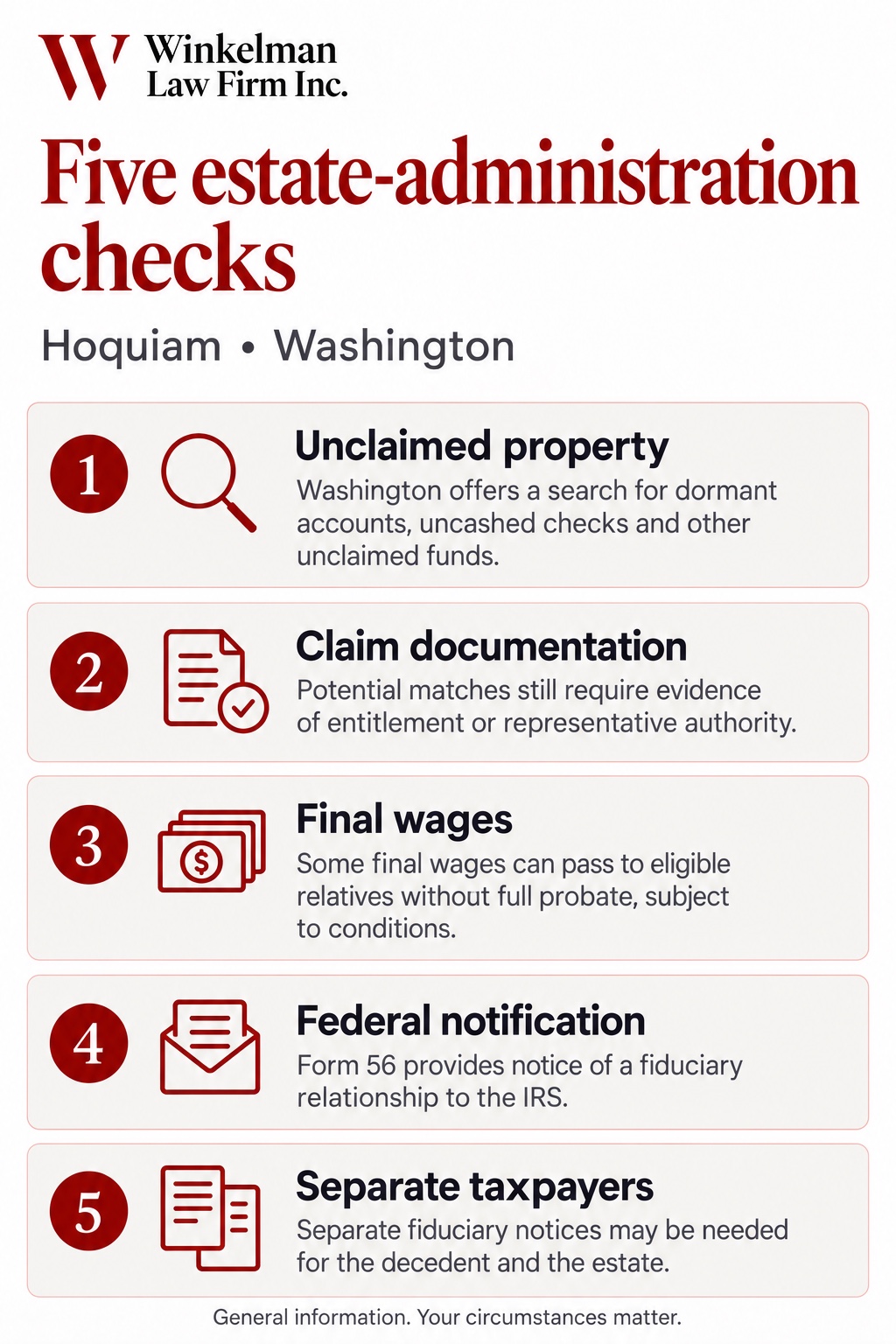
Washington's Department of Revenue provides an unclaimed-property search for funds such as dormant accounts, uncashed checks and insurance proceeds. Search relevant names and preserve potential matches, then follow the state's claim process with evidence of entitlement or representative authority. See Washington unclaimed property search.
Not always. Washington law permits certain final wages to be paid to specified surviving relatives when no executor or administrator has been appointed, subject to statutory limits and conditions. Confirm the amount, employer type and eligible recipient before using that procedure. See RCW 49.48.120: Payment on employee death.
Do not assume the court appointment alone completes federal tax notification. IRS Form 56 provides notice of a fiduciary relationship, and separate notices may be needed for the decedent and the estate. Review the applicable filings and identifying numbers with the estate's tax adviser. See IRS Form 56 fiduciary notification.
Some otherwise qualifying estates can use IRS Revenue Procedure 2022-32 to elect federal portability by the fifth anniversary of death. For a 2021 death, that anniversary falls in 2026. This relief has conditions and does not give every estate five years to meet its ordinary filing obligations. See IRS Revenue Procedure 2022-32.
We assist clients with Hoquiam probate from our office in Hoquiam, Washington. You can contact us and mention your main concerns, any existing documents and upcoming dates. We can then discuss your circumstances and the next steps for a consultation.