A parenting plan can shape a family's routine long after a divorce, separation, or parenting case is completed. It determines when children reside with each parent and can establish expectations for holidays, school breaks, decision-making, transportation, and other responsibilities that parents must manage while raising children in separate households.
Winkelman Law Firm represents parents in Hoquiam, throughout Grays Harbor County, and across surrounding Western Washington communities in parenting plan and visitation matters. Our Hoquiam parenting plan attorneys help clients develop workable arrangements, evaluate proposed terms, resolve disputes, and address problems involving existing parenting orders.
A strong parenting plan should do more than resolve the immediate legal case. It should provide enough clarity and structure to help parents understand their responsibilities and reduce avoidable disputes as they move forward.
Washington uses parenting plans to establish many of the legal arrangements governing parents and children when the parents live separately. Although people commonly search for terms such as “child custody” and “visitation,” Washington parenting plans generally address these issues through residential schedules, decision-making provisions, and other defined parental responsibilities.
A parenting plan may be established as part of a divorce or in a parenting case involving unmarried parents.
The plan can provide a framework for questions such as:
The residential schedule is particularly important because it establishes the children's regular pattern of time with each parent. Clear provisions can help both parents understand when transitions occur and reduce disagreements about what the order requires.
Parenting plans should also reflect the practical circumstances of the family. A schedule that appears balanced on paper may be difficult to follow if it does not account for school, work schedules, transportation, distance between households, or the children's needs.
Our Hoquiam parenting plan lawyers help parents evaluate these considerations before final terms are established. Whether the parents are developing an agreed plan or disagree about significant provisions, our attorneys focus on creating or pursuing arrangements that are clear enough to function outside the courtroom.
A parenting plan can address several aspects of how parents will share responsibilities after they begin living in separate households. The exact terms depend on the circumstances of the family and the issues requiring resolution.
Residential provisions establish when children are scheduled to reside with each parent. A plan may distinguish between the regular school-year schedule and arrangements for holidays, vacations, or summer breaks.
Other provisions may address:
The details matter. A provision stating that parents will “share holidays,” for example, may leave unanswered questions about which parent has a particular holiday in a particular year, when the holiday period begins, and where the exchange occurs.
Similar problems can arise when transportation responsibilities, vacation notice, or school-break schedules are unclear.
At the same time, a parenting plan does not need to anticipate every minor parenting decision that could arise. The objective is to establish sufficient structure for the significant issues governed by the court order while allowing parents to manage ordinary parenting responsibilities within that framework.
Our Hoquiam visitation attorneys help clients identify provisions that deserve particular attention based on the family's circumstances. Clear drafting can be especially valuable when communication between parents is difficult or when prior disagreements suggest that vague terms could create recurring conflict.
A residential schedule determines when children are scheduled to live with each parent. Developing that schedule requires more than choosing a particular number of days or attempting to divide time according to a simple formula.
The arrangement needs to function within the children's actual lives.
Depending on the family, relevant practical considerations may include:
Families can structure residential time in different ways. Some schedules involve frequent transitions between parents, while others use longer blocks of residential time. What is workable depends on the circumstances rather than a single schedule that is appropriate for every family.
Parents should also consider how the schedule will operate during the school year. Early school mornings, homework, activities, transportation, and the location of each household can affect whether a proposed arrangement is practical.
For families in Hoquiam and throughout Grays Harbor County, travel between homes, schools, work, and activities can be an important part of that analysis.
Our Hoquiam parenting plan attorneys help clients evaluate residential proposals from both a legal and practical perspective. When parents agree, we can help translate that agreement into clear terms. When they disagree, our lawyers can advocate for a residential arrangement supported by the circumstances of the children and family.
The regular residential schedule is only part of a parenting plan. Holidays, school breaks, vacations, birthdays, and other special occasions can require separate arrangements so parents know where the children will be and when transitions will occur.
A parenting plan may address:
Parents can structure these periods in different ways. Some holidays may alternate each year, while others may consistently be assigned to a particular parent. Longer school breaks can be divided or incorporated into an extended vacation schedule.
Specificity can help prevent conflict. A plan that simply states that parents will alternate a holiday may leave unanswered questions about when the holiday begins, when it ends, and where the child will be exchanged.
Vacation provisions may also address how much advance notice is required and how vacation time interacts with the normal residential schedule.
Our Hoquiam parenting plan attorneys help clients think through these details before final terms are established. A clear holiday and vacation schedule can reduce the need for parents to renegotiate important dates each year and provide children with greater predictability between households.
Even a well-designed residential schedule can create problems if the parenting plan does not provide enough clarity about how children will move between households.
Transportation arrangements may need to identify which parent is responsible for pickup or drop-off, where exchanges occur, and what time transitions take place. Distance between households, school schedules, and parents' work obligations can influence what arrangement is practical.
Parents may need to consider:
Clear expectations can be particularly useful when parents have difficulty communicating. Repeated disagreements about exchange locations or timing can create unnecessary conflict even when the underlying residential schedule is not disputed.
Communication provisions should also be realistic. Parents raising children in separate households may need to exchange information concerning school, activities, health, or other important matters, but the appropriate structure depends on the circumstances.
Our Hoquiam visitation lawyers help parents evaluate transportation and communication provisions that fit the family's actual routine. The goal is to create terms that are sufficiently specific to provide guidance without making ordinary parenting unnecessarily difficult.
A parenting plan can establish responsibility for significant decisions involving the children in addition to setting the residential schedule.
Depending on the circumstances, decision-making provisions may address areas such as:
Decision-making responsibility is not necessarily determined solely by which parent has more residential time. The parenting plan can separately establish how major decisions will be handled.
Parents may be able to share responsibility for certain decisions. In other circumstances, particular decision-making authority may be allocated differently based on the family situation and applicable Washington law.
Clear provisions can help parents understand when consultation or agreement is expected and reduce uncertainty when important decisions arise.
Disputes over decision-making can become significant when parents have substantially different views concerning a child's education, medical care, or other major issues. These questions should be evaluated within the broader parenting-plan framework rather than treated as routine scheduling disagreements.
Our Hoquiam parenting plan attorneys help clients understand proposed decision-making provisions and how those terms may operate after the case concludes. When decision-making authority is contested, we help clients identify the relevant circumstances and pursue an appropriate resolution.
Parents who agree about how they want to raise their children across separate households may be able to develop a parenting plan without asking the court to decide every provision.
Agreement can give parents greater involvement in designing a schedule that reflects their children's needs, work responsibilities, school calendars, transportation requirements, and other practical circumstances.
However, an agreed parenting plan should still be drafted carefully.
Terms that seem obvious while parents are cooperating can become sources of disagreement later if expectations change. Clear provisions concerning residential time, holidays, transportation, decision-making, and other important responsibilities can make an agreement more durable.
Parents may reach agreement through direct discussion, attorney-assisted negotiation, or mediation. Some cases begin with significant disagreements but ultimately result in a negotiated parenting plan after the disputed issues have been narrowed.
Our Hoquiam parenting plan lawyers help clients evaluate proposed agreements before they become final orders. We focus on whether the terms are understandable, practical, and sufficiently detailed to provide a reliable framework for the family after the legal case ends.
Parents may agree that both should remain actively involved in their children's lives while still having very different ideas about how residential time should be structured.
Disputes can involve weekday schedules, weekends, holidays, transportation, vacation time, or the frequency of transitions between households. One parent may believe an existing routine should continue, while the other proposes a substantially different arrangement.
Common disagreements may involve:
A disagreement does not necessarily mean every issue must be decided at trial. Parents may be able to narrow disputed terms through attorney-assisted negotiation or mediation.
When agreement is not possible, however, the court may need to determine the contested provisions of the parenting plan.
Our Hoquiam visitation attorneys help parents distinguish between practical disagreements that may be negotiated and significant parenting issues requiring court resolution. We focus on the facts relevant to the proposed arrangement and advocate for parenting-plan terms that address the circumstances of the children and family.
A parenting plan is a court order, not simply a suggested schedule. Once entered, parents are expected to follow its terms unless they mutually make permissible adjustments or the order is later modified through the appropriate legal process.
Problems may arise when a parent repeatedly fails to follow the residential schedule, interferes with parenting time, refuses required exchanges, or disregards other provisions of the plan.
Enforcement disputes can involve:
Parents should be cautious about responding to alleged violations by independently disregarding other parts of the order. One parent's failure to comply does not necessarily authorize the other parent to rewrite the parenting plan.
Documentation can become important when violations are disputed. Calendars, communications, exchange records, and other information may help establish what occurred.
Our Hoquiam parenting plan lawyers help clients evaluate alleged violations and determine what legal remedies may be appropriate. We represent parents seeking compliance as well as those responding to enforcement allegations.
Children and families change over time, but an existing parenting plan does not automatically change when the parents begin following a different routine.
Washington law provides procedures for modifying parenting plans under qualifying circumstances. The requirements can vary depending on the nature and extent of the proposed change.
A parent may seek changes because an existing residential arrangement no longer works, circumstances affecting a parent or child have materially changed, relocation has become an issue, or other significant developments have occurred.
Informal schedule adjustments can sometimes work when parents cooperate, but they should not be confused with formally changing a court order.
Our Hoquiam parenting plan attorneys help parents review existing orders and evaluate whether circumstances may support a modification. We also represent parents responding to proposed changes they believe are unnecessary or inappropriate.
Parenting plans require both careful legal analysis and attention to the practical details that determine how an arrangement will function after the case ends.
Winkelman Law Firm'sattorneys bring decades of combined legal experience to parents in Hoquiam and throughout Grays Harbor County.
Founding shareholder Ben Winkelman has more than 20 years of legal experience, including substantial work involving family law, trial practice, and mediation. His family law background includes service on the Washington State Bar Family Law Section Executive Committee from 2007 through 2013, including serving as chair.
Associate attorney Ryan M. Pesicka brings additional family law and litigation experience, including representing clients in family law matters in Grays Harbor County.
Our Hoquiam parenting plan attorneys help clients establish new parenting arrangements, negotiate disputed terms, address enforcement problems, and evaluate changes involving existing plans. We focus on creating clear legal arrangements that account for both the rights of parents and the practical realities of raising children across separate households.
A well-structured parenting plan can provide clarity about residential schedules, holidays, transportation, decision-making, and other responsibilities that affect a family's daily life.
Winkelman Law Firm represents parents in Hoquiam, throughout Grays Harbor County, and across surrounding Western Washington communities.
If you need help establishing, negotiating, enforcing, or addressing changes to a parenting plan,contact our Hoquiam parenting plan and visitation attorneys to schedule an appointment. Our team can evaluate your circumstances and help you pursue a clear, practical parenting arrangement.
Reviewed for legal accuracy by Benjamin R Winkelman on October 18, 2026
For Hoquiam parenting plans, we suggest checking the school's actual calendar against holiday and vacation provisions. Identify teacher workdays, early-release days and any conflicts with the regular schedule. We can review wording that makes the relevant dates understandable instead of relying on assumptions about a typical school year.
In Hoquiam parenting plans, a precise location and an understood handoff arrangement can reduce uncertainty. Consider how a location works after school, during holidays and when an activity ends elsewhere. We review those details alongside the existing order and any safety-related restrictions.
For Hoquiam parenting plans, we suggest documenting the particular dates and what both parents actually agreed to change. Keep the exchange factual and consistent with any governing communication rules. We can explain when a temporary accommodation differs from a formal modification of the order.
Our Hoquiam parenting plans review considers what information parents need and how it should be exchanged. A clear process can address timing, contact details and the difference between notice and consent. We evaluate the proposed wording against the allocation of decision-making authority in the plan.
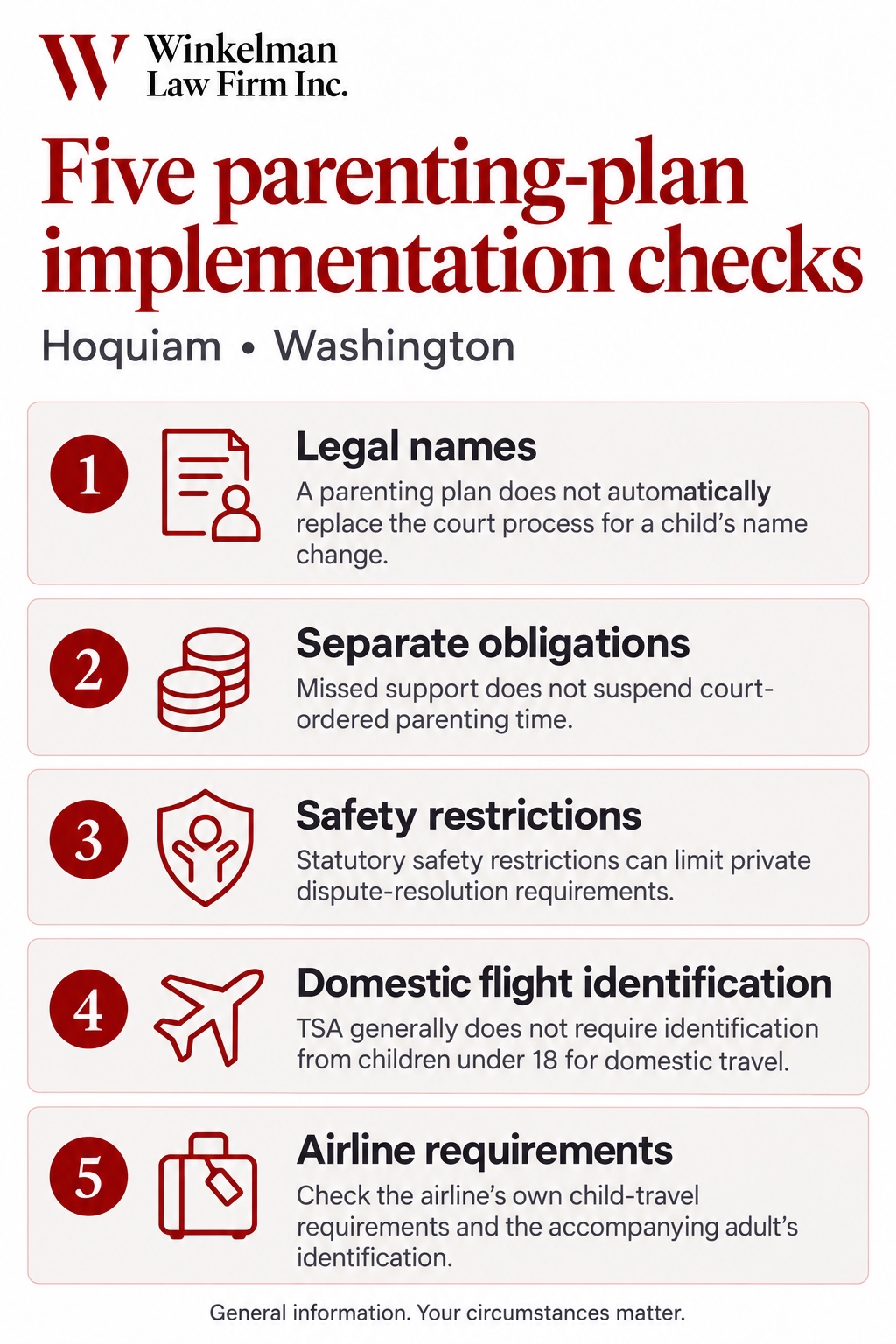
Do not assume a parenting plan alone has changed a child's legal name. Washington provides a court petition process for name changes, so review whether the existing order actually grants that relief and what records must be updated afterward. See RCW 4.24.130: Name change petitions.
Washington treats support and parenting responsibilities as distinct obligations. One parent's failure to pay support does not suspend the other parent's duty to permit court-ordered contact, so address enforcement through the appropriate legal process rather than withholding scheduled time as leverage. See RCW 26.09.160: Separate support and parenting duties.
Statutory safety restrictions must be considered before requiring private dispute resolution. Washington law calls for court-based resolution in specified circumstances involving serious harmful conduct, subject to its stated exceptions and findings, so review the actual safety facts and proposed plan. See RCW 26.09.191: Parenting plan limitations.
TSA generally does not require identification from children under 18 traveling within the United States, although airlines can have their own requirements and special expedited-screening rules can apply. Check the child's airline requirements and the accompanying adult's acceptable identification before arranging travel under a parenting plan. See TSA: acceptable identification and children.
We assist clients with Hoquiam parenting plans from our office in Hoquiam, Washington. You can contact us and mention your main concerns, any existing documents and upcoming dates. We can then discuss your circumstances and the next steps for a consultation.