Creating an estate plan is an important step, but effective planning does not necessarily end when the documents are signed. Families change, assets change, businesses grow, and the people selected to carry out a plan may no longer be the right choices years later.
Winkelman Law Firm helps individuals and families in Hoquiam, throughout Grays Harbor County, and across surrounding Western Washington communities take a long-term approach to estate and wealth planning.
Our Wealth Stewards approach emphasizes keeping legal planning connected to the client's current family, property, business interests, and long-term objectives. Rather than viewing estate planning as a one-time transaction, wealth stewardship recognizes that a plan may need attention as life evolves.
Whether you recently created an estate plan or have documents that have not been reviewed for years, our Hoquiam estate planning attorneys can help you evaluate whether your existing strategy still reflects what you want to accomplish.
A Wealth Steward takes an ongoing approach to protecting and organizing the legal framework surrounding family wealth, property, and legacy.
Traditional estate planning often focuses on creating documents such as wills, trusts, powers of attorney, and health care directives. Those documents are important, but their effectiveness can depend on whether they continue to reflect the client's circumstances and whether assets remain properly coordinated with the plan.
Wealth stewardship looks beyond the initial documents.
It considers questions such as:
The answers can change considerably over a person's lifetime.
Our Hoquiam Wealth Stewards help clients consider estate planning as an evolving process rather than a document that is completed once and forgotten. The objective is to maintain greater alignment between the legal plan and the family, assets, and goals that plan is intended to protect.
An estate plan reflects a particular moment in a person's life. Years later, the assumptions behind that plan may no longer be accurate.
A person who created a will before having children may now have an entirely different family structure. Someone who named a trusted relative as an agent under a power of attorney may later decide another person is better suited for the responsibility. A modest business can grow into one of the family's most valuable assets.
Events that may justify reviewing a plan include:
Not every life event requires rewriting an entire estate plan. Sometimes the existing structure remains appropriate. In other situations, a relatively small update can prevent a document from becoming inconsistent with the client's current intentions.
The important point is knowing when review is appropriate.
Our Hoquiam estate planning lawyers help individuals and families assess existing plans after meaningful life and financial changes. Regular attention can identify outdated provisions before they become problems during incapacity, estate administration, or the transfer of family wealth.

Estate planning documents should reflect the people, property, and decisions that matter to you now—not simply the circumstances that existed when the documents were originally signed.
An ongoing review may involve documents such as:
A review can begin by asking whether the people named in the plan remain appropriate. A personal representative, trustee, agent, or other fiduciary selected years ago may have moved away, experienced health problems, died, or simply no longer be the person the client would choose today.
Distribution provisions also deserve attention. Families may grow, relationships may change, beneficiaries may develop different needs, and property identified in an older plan may no longer be owned.
Trust planning can require additional attention because the effectiveness of a trust may depend on how assets and ownership are structured.
Our Hoquiam Wealth Stewards help clients review existing documents in the context of their current circumstances. When updates are appropriate, Winkelman Law Firm can help revise the legal plan while maintaining consistency across the documents intended to work together.
Estate planning documents are only one part of a complete wealth plan. How property is titled and how beneficiary designations are structured can also affect what happens to assets after death.
Over time, people open new accounts, purchase property, change investments, replace insurance policies, and move assets between financial institutions. Those changes can create gaps between an estate plan and the assets it is intended to address.
A wealth-planning review may consider:
Trust planning deserves particular attention. Creating a trust does not necessarily mean every intended asset has been properly coordinated with that trust. Asset ownership and beneficiary arrangements may need to be reviewed as property changes over time.
Beneficiary designations can also become outdated after marriage, divorce, deaths in the family, or other significant events.
Our Hoquiam Wealth Stewards help clients look beyond the estate-planning documents themselves and consider whether significant assets remain aligned with the overall plan. When inconsistencies are identified, our attorneys can help determine what legal updates may be appropriate.
Certain events create natural opportunities to revisit an estate and wealth plan.
Retirement may change income, investments, property ownership, and long-term priorities. Receiving an inheritance may substantially increase family wealth. Selling a business can convert an operating asset into cash or investments that require an entirely different planning strategy.
Family changes can be equally important.
A new marriage may introduce a spouse and stepchildren into an existing estate plan. The birth of grandchildren may create new legacy objectives. Children who were minors when a trust was created may now be adults with very different circumstances.
Major changes worth reviewing may include:
The appropriate response depends on the change. Some events may require revisions to legal documents, while others call for reviewing asset ownership, beneficiary designations, or succession arrangements.
Our Hoquiam estate planning attorneys help clients assess how major changes affect the broader plan. Periodic review can keep individual documents from becoming disconnected from the family's current financial and personal circumstances.
For a business owner, personal wealth planning and business planning are often closely connected.
A closely held company may provide the owner's income, represent a substantial portion of family wealth, employ relatives, and eventually become an asset that must be transferred, sold, or managed by someone else.
That creates planning questions beyond what happens to personal bank accounts or real estate.
Business owners may need to consider:
These issues can evolve substantially. A succession strategy developed when a business was small may no longer fit after years of growth. A child once expected to take over the company may pursue a different career. New partners or owners may enter the business.
Winkelman Law Firm's experience in estate planning and business law allows our Hoquiam attorneys to consider these issues together. Wealth stewardship for business owners means keeping personal estate objectives, business ownership, and succession planning aligned rather than treating each as an unrelated legal matter.
Successful wealth planning involves more than deciding who receives property. Families may also need to consider who will eventually manage assets, carry out the estate plan, oversee a trust, or assume responsibility for a family business.
The people selected for these roles should understand the responsibilities they may eventually be asked to accept.
Depending on the plan, future responsibilities may fall to:
Families do not necessarily need to disclose every financial detail immediately. However, appropriate communication can reduce confusion when someone is eventually asked to act.
Planning can also change as the next generation develops. A child who was not ready to manage significant property when a trust was created may become financially experienced later. Another beneficiary may develop circumstances that make continued trust management more appropriate.
The same principle applies to family businesses. Succession should reflect whether the intended next generation actually has the interest, experience, and ability to take on ownership or leadership.
Our Hoquiam Wealth Stewards help families consider not only how wealth will transfer, but how the people involved fit into the plan. Thoughtful stewardship can make the transition of responsibility more deliberate and help future decision-makers better understand the roles they may eventually assume.
Families often accumulate assets in ways that cross several areas of law. An estate plan may include a home and investment accounts while also addressing trusts, business ownership interests, inherited property, or real estate held for investment.
Treating each part independently can create inconsistencies.
A business succession arrangement, for example, should make sense alongside the owner's estate plan. Property intended for a trust should be coordinated with the trust structure. Beneficiary designations should reflect the broader distribution strategy rather than unintentionally competing with it.
Coordinated planning may involve reviewing:
The objective is not to make a family's legal planning unnecessarily complicated. It is to make sure the different components support the same overall goals.
This becomes increasingly important as wealth and family circumstances become more complex. A plan created when someone owns a home and retirement account may need a different structure after that person acquires investment property, builds a business, receives an inheritance, or begins planning for multiple generations.
Our Hoquiam Wealth Stewards help clients evaluate these connections and identify areas where planning may no longer be aligned. By considering estate, property, business, and succession issues together, our attorneys can help families maintain a more cohesive long-term strategy.
Ongoing wealth stewardship benefits from legal counsel that can look beyond a single document or transaction.
Winkelman Law Firm'sattorneys bring decades of combined legal experience to individuals, families, and business owners in Hoquiam and throughout Grays Harbor County.
Founding shareholder Ben Winkelman has more than 20 years of legal experience spanning wills, trusts, estate planning, probate, business law, real estate, family law, and mediation. That broad background is particularly useful when a family's wealth plan involves property, closely held businesses, succession concerns, or changing family circumstances.
Associate attorney Ryan M. Pesicka brings additional experience involving estate planning, business law, contracts, entity formation, real property, and civil litigation.
Our Hoquiam Wealth Stewards take a long-term view of legal planning. We help clients review existing plans, identify changes that may require attention, coordinate different components of their planning, and keep their legal strategy connected to the family and assets it is intended to serve.
The goal is not complexity for its own sake. It is maintaining a plan that continues to reflect what matters to the client as circumstances evolve.
An estate or wealth plan should continue to reflect your family, property, business interests, and long-term goals as they change.
Whether you recently completed your planning or have documents that have not been reviewed in years, Winkelman Law Firm can help you determine whether updates or additional coordination may be appropriate.
Contact our Hoquiam Wealth Stewards to schedule an appointment with our team. We assist individuals, families, and business owners in Hoquiam, throughout Grays Harbor County, and across surrounding Western Washington communities with maintaining thoughtful, coordinated plans for the future.
Reviewed for legal accuracy by Benjamin R Winkelman on October 18, 2026
Our Hoquiam wealth stewards approach can include a dated action list identifying the task and the person responsible. Record whether an institution confirmed a change rather than simply marking a form as sent. We can use that information during a review to distinguish completed work from matters that still need attention.
For Hoquiam wealth stewards, keeping a copy of the submitted form is a useful starting point. A current confirmation or account record can help show what the institution actually has on file. We compare those records with your intentions instead of assuming a request was processed as expected.
In our Hoquiam wealth stewards work, we discuss where documents are kept and which professional contacts a future decision-maker may need. Secure access arrangements should be considered separately from general family information. We help review legal authority without treating knowledge of a password as a substitute for it.
For Hoquiam wealth stewards, we suggest bringing the purchase or ownership records and any account or beneficiary information. Note how the acquisition was funded and whether other owners are involved. We can then review how the asset fits the existing legal plan and identify follow-up questions.
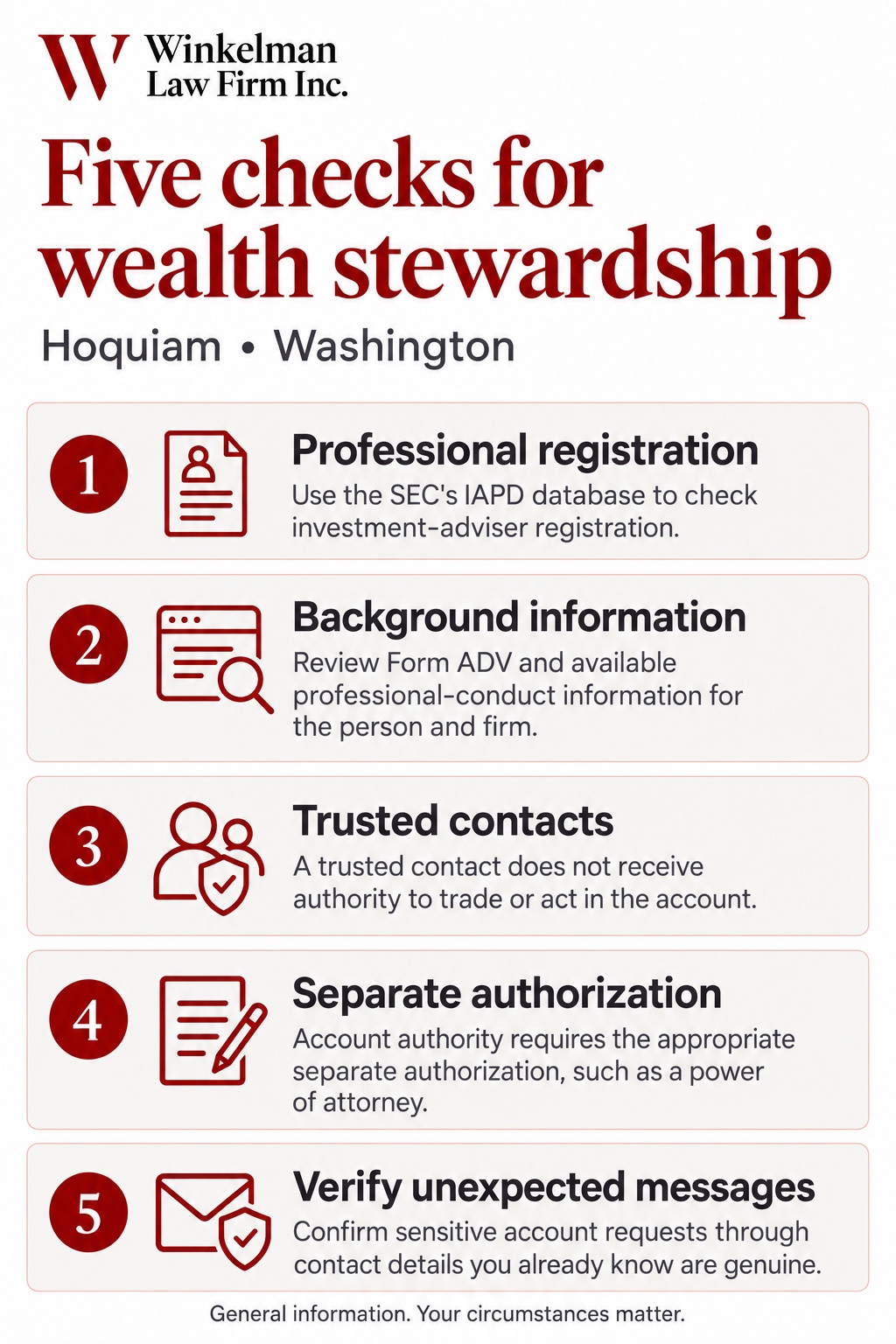
The SEC's Investment Adviser Public Disclosure database shows registration information, Form ADV filings and professional background or conduct information. It also links to FINRA BrokerCheck for brokers, so check the person and firm before deciding what role they will have in your planning. See SEC: Using IAPD to check professionals.
No. A brokerage trusted contact can be contacted in limited circumstances, such as difficulty reaching you or suspected exploitation, but does not receive authority to trade or act in the account. Review any separate power of attorney or other authorization independently. See SEC: Trusted contacts.
Verify the message through a telephone number or other contact method you already know is genuine. The SEC warns that apparent financial-firm emails and texts can be phishing, so avoid using an unexpected message's links or contact details to confirm a sensitive account change. See SEC: Protecting financial accounts from phishing.
The IRS lists a $24,500 employee deferral limit for most 401(k) plans and a $7,500 IRA contribution limit for 2026, before applicable catch-up rules. Contribution eligibility, deductions and beneficiary planning are separate issues. Bring current account records and coordinate tax or contribution decisions with the appropriate adviser. See IRS: 2026 retirement contribution limits.
We assist clients in Hoquiam, Washington with ongoing estate plan reviews through our Wealth Stewards approach. You can contact us and mention the documents you have and the changes you want to discuss. We can then review your circumstances and the next steps for a consultation.