Dividing property during divorce can affect where you live, what assets you retain, which debts you remain responsible for, and your financial position for years after the marriage ends. Homes, retirement accounts, businesses, investments, and property acquired before marriage can make the process particularly complex.
Winkelman Law Firm represents clients in Hoquiam, throughout Grays Harbor County, and across surrounding Western Washington communities in divorce property disputes. Our Hoquiam property division attorneys help clients identify assets and liabilities, distinguish between community and separate property issues, evaluate proposed settlements, and address disagreements over ownership or value.
Property division should not be reduced to simply dividing a list of assets. Our lawyers consider how the proposed distribution may affect the client's finances after divorce and work toward a resolution that addresses both the legal and practical consequences of the division.
Washington is a community property state, but that does not mean every divorce requires each asset and debt to be divided exactly in half.
When dividing property and liabilities in a divorce, Washington courts are directed to reach a just and equitable result after considering the relevant circumstances. The analysis includes the nature and extent of both community and separate property, the duration of the marriage, and the spouses' economic circumstances when the property division takes effect.
This distinction is important because an equitable distribution depends on the overall financial picture rather than a mechanical 50/50 calculation.
Property division can require several steps:
Some property can be divided directly. Other assets require different solutions. A house cannot practically be divided in half, for example, so spouses may need to consider whether it should be sold or retained by one spouse. A business may require valuation and a potential buyout rather than disrupting an operating company.
The same broader analysis applies to liabilities. Dividing assets without considering mortgages, loans, taxes, or other associated obligations can provide an incomplete picture of what each spouse will actually receive.
Our Hoquiam property division lawyers help clients evaluate the marital estate as a whole. Whether the spouses can negotiate an agreement or require the court to resolve disputed property issues, we focus on developing a clear understanding of the assets, debts, and financial consequences involved.
Determining whether an asset is community or separate property can be a central issue in a Washington divorce.
Generally, property acquired during the marriage is community property unless it falls within a legally recognized category of separate property. Property a spouse owned before marriage can be separate property, as can certain property received during marriage through a gift or inheritance.
The distinction can appear straightforward until the history of an asset becomes more complicated.
Property questions may involve:
In these situations, identifying when and how the property was acquired can become important.
Characterization is also not necessarily the final question in the divorce. Washington's property-division statute directs courts to consider the nature and extent of both community and separate property when reaching a just and equitable distribution.
That makes careful documentation valuable. Deeds, account statements, purchase records, inheritance documents, business records, and other financial materials may help establish the history of disputed property.
Our Hoquiam divorce property attorneys help clients identify potential community and separate property issues and evaluate the records relevant to disputed assets. When ownership or characterization is contested, we work to develop a clear factual history rather than relying only on whose name currently appears on an account or asset.
A complete property division begins with understanding the assets and liabilities involved. Significant property can sometimes be overlooked when spouses focus primarily on the family home or their current bank accounts.
Depending on the marriage, property requiring consideration may include:
Identifying an asset does not necessarily establish how it should ultimately be characterized or distributed. Some assets may contain both separate and community components, while others may require professional valuation before meaningful negotiations can occur.
It is also important to look beyond an asset's headline value. A piece of real estate with substantial equity and an investment account with the same stated value may carry different expenses, liquidity, risks, or financial consequences.
Full financial information therefore plays an important role in property negotiations. A proposed settlement is difficult to evaluate if significant assets, debts, or ownership interests remain unclear.
Our Hoquiam property division attorneys help clients develop a comprehensive picture of the property involved before evaluating potential distributions. When questions arise concerning real estate, business interests, or other substantial assets, our broader legal experience can help identify issues that may require additional analysis before the divorce is finalized.

For many divorcing couples, the family home is one of their largest assets and one of the most difficult to divide. Real estate can carry financial and personal significance, and deciding what happens to the property requires more than determining its estimated market value.
Common options may include selling the home and addressing the proceeds through the property division or allowing one spouse to retain the property as part of the overall settlement. Either approach can raise additional financial questions.
Issues involving real estate may include:
When one spouse wants to keep the home, the parties may need to consider whether that spouse can realistically afford the property after divorce. Mortgage payments, taxes, insurance, maintenance, and other expenses can make retaining a home substantially different from simply receiving an asset with a particular amount of equity.
Real estate acquired before marriage can create additional questions when marital funds were later used for mortgage payments, improvements, or other expenses. Vacation property, rental properties, land, and other real estate may present similar valuation and characterization issues.
Our Hoquiam property division attorneys help clients evaluate real estate as part of the complete financial settlement. Winkelman Law Firm's experience with both family law and real property matters gives our team a broader perspective when divorce involves significant real estate interests.
Retirement assets can represent a substantial portion of the wealth accumulated during a marriage, even though those funds may not be immediately available to either spouse.
Divorce may require consideration of assets such as:
An account being held in one spouse's name does not necessarily determine how the interest will be treated during divorce. The history of contributions and the period during which retirement benefits were earned can become important, particularly when an account existed before the marriage and continued growing afterward.
Valuation also deserves careful attention. Retirement assets may have different characteristics from cash, real estate, or other property, and certain retirement benefits can require specific procedures to divide properly.
Spouses may negotiate different approaches to distributing retirement and investment assets as part of the overall property settlement. The appropriate structure depends on the assets involved and the rest of the marital estate.
Our Hoquiam divorce property lawyers help clients identify retirement and investment interests that need to be considered during property division. When specialized valuation, tax, or retirement-plan issues arise, those matters can be coordinated with appropriate financial professionals before final terms are established.
A closely held business can create some of the most complicated property issues in a divorce. The business may provide income to one or both spouses while also representing a significant asset with value independent of the income it produces.
The first questions often involve ownership, characterization, and value.
A business may have been created during the marriage, acquired before marriage, inherited from family, or built using a combination of separate and community resources. One spouse may operate the company while the other has little direct involvement, or both spouses may participate in its management.
Business property disputes can involve:
Preserving the viability of an operating business can also be an important practical concern. Forcing an unnecessary disruption may affect employees, customers, income, and the value available to both spouses.
A negotiated resolution might allow one spouse to retain the business while the other receives different assets or compensation. Other cases may require more detailed valuation and litigation when the parties cannot agree about the business's value or ownership interests.
Our Hoquiam property division attorneys bring family law and business law experience to these disputes. We help clients evaluate business interests within the complete marital estate while considering both the legal property issues and the practical consequences of proposed solutions.
Property division involves liabilities as well as assets. Mortgages, credit cards, personal loans, vehicle financing, business obligations, and other debts can substantially affect what each spouse actually receives when the marriage ends.
Debt issues may include:
As with property, determining whose name appears on an account does not always answer how a debt should be addressed between the spouses in the divorce.
There is also an important practical distinction between allocating a debt in a divorce and changing the rights of an outside creditor. A divorce order assigning responsibility for a particular obligation between spouses does not necessarily remove the other spouse from a loan or contractual obligation owed to a lender.
That issue can be particularly important with mortgages, jointly held credit accounts, and other debts for which both spouses remain contractually responsible.
Our Hoquiam property division lawyers help clients identify liabilities and evaluate proposed debt allocations alongside the assets being divided. Considering both sides of the financial picture can help avoid a settlement that appears favorable based on assets alone but leaves a client responsible for substantial accompanying obligations.
Property characterization can become more complicated when separate and community funds or interests have been combined over the course of a marriage.
An asset may have begun as separate property but later received community contributions. Funds from different sources may have been deposited into the same account. A home purchased before marriage may have been refinanced, improved, or paid for during the marriage. A business that existed before the wedding may have grown substantially while one or both spouses contributed time and resources to its operation.
Potentially complicated situations can involve:
These situations can require tracing the history of the asset and the funds associated with it. Bank statements, deeds, purchase documents, tax records, business records, and historical account statements may become important when the parties disagree about characterization.
The passage of time can make tracing more difficult, particularly when records are incomplete or funds have moved through multiple accounts.
Our Hoquiam property division attorneys help clients examine the history of disputed assets and identify the documentation relevant to community and separate property claims. Rather than assuming an asset's current title resolves the issue, we look at how the property was acquired, maintained, funded, and handled during the marriage.
Spouses do not necessarily need a judge to decide every property issue. Many divorces are resolved through negotiation or mediation after the parties have developed a sufficiently clear understanding of their assets, liabilities, and disputed claims.
Meaningful settlement discussions generally require reliable financial information. Negotiating before significant assets have been identified or valued can make it difficult to evaluate whether a proposed distribution is appropriate.
Property disputes may require:
Settlement can provide flexibility. Spouses may agree that one person retains a particular asset while the other receives different property, allowing the overall distribution to reflect their priorities and circumstances.
An agreement should still be evaluated for its long-term consequences. Retaining a valuable asset may also mean assuming associated debt, expenses, or financial risk.
When an appropriate settlement cannot be reached, contested property issues may need to be presented to the court.
Our Hoquiam property division lawyers help clients evaluate settlement proposals, prepare for mediation, and advocate in contested proceedings when necessary. The objective is to resolve the property division with a clear understanding of what the client will own and owe after the divorce.
Property division can involve more than family law. Real estate, business ownership, contracts, retirement assets, debt, and long-term financial consequences may all become part of the same divorce.
Winkelman Law Firm'sattorneys bring decades of combined legal experience to clients in Hoquiam and throughout Grays Harbor County. Our team's experience spans family law as well as business and real estate matters, providing valuable perspective when a marital estate includes substantial or complicated assets.
Founding shareholder Ben Winkelman has more than 20 years of legal experience, including family law, trial practice, business law, real estate, and mediation. His background also includes service on the Washington State Bar Family Law Section Executive Committee from 2007 through 2013, including serving as chair.
Associate attorney Ryan M. Pesicka brings additional experience involving family law, business matters, contracts, real property, and civil litigation.
Our Hoquiam property division attorneys focus on understanding the complete financial picture before pursuing a resolution. Whether the marital estate involves a family home and retirement accounts or more complicated business and real estate interests, our team works to protect the client's financial interests through negotiation, mediation, or contested proceedings.
The way property and debts are divided during divorce can shape your financial circumstances long after the case ends. Identifying the assets involved and understanding their ownership, value, and associated obligations are important steps before accepting a settlement or presenting disputed issues to the court.
Winkelman Law Firm represents clients in Hoquiam, throughout Grays Harbor County, and across surrounding Western Washington communities.
If your divorce involves disputes over a home, retirement assets, business interests, separate property, debts, or other significant assets,contact our Hoquiam property division attorneys to schedule an appointment. Our team can evaluate the property issues involved and help you pursue a clear and practical resolution.
Reviewed for legal accuracy by Benjamin R Winkelman on October 18, 2026
For Hoquiam property division, we suggest preserving statements near the marriage date and records of later transfers. Ownership, contributions and changes over time may all need review. We can assess the evidence without assuming the account's current title answers every classification question.
In Hoquiam property division, we consider available equity alongside debt, upkeep and the ability to meet future payments. A mortgage statement and realistic housing budget can help explain the practical effect of a proposal. We review the full arrangement rather than comparing assets solely by their stated balances.
For Hoquiam property division, we suggest using photographs and a clear list to identify particular household items. Note existing possession and any available purchase or value records without marking the list as a final allocation. We can review disputed items in context rather than assuming current possession establishes who should receive them.
Our Hoquiam property division review identifies the plan type, current records and any required implementation order. Certain employer plans use a qualified domestic relations order rather than an ordinary withdrawal request. We can review the proposed division before funds are moved or tax consequences are assumed.
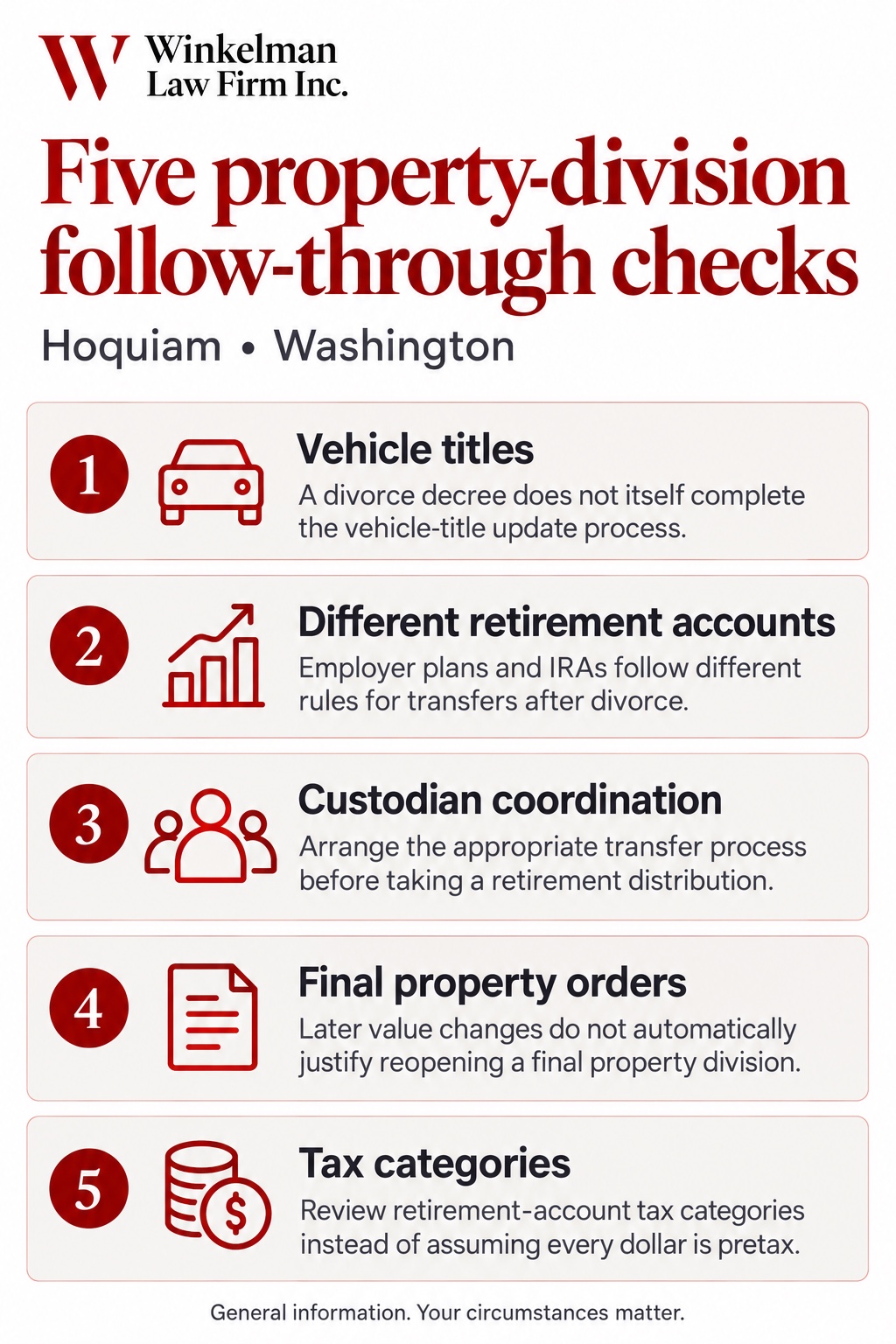
Do not assume the court order updates the licensing record by itself. Washington DOL provides an inheritance and litigation title form for vehicles awarded through court proceedings, and the required title application and supporting documents should be checked for the particular transfer. See Washington DOL inheritance and litigation title forms.
No. An employer retirement plan may require a qualified domestic relations order, while an IRA transfer incident to divorce follows different federal requirements. Arrange the transfer with the account custodian before taking a distribution or assuming one form works for both accounts. See IRS: Retirement plans and IRAs after divorce.
A final property disposition is not freely adjustable whenever later circumstances change. Washington law requires conditions justifying reopening a judgment, so a later increase or decrease in value should not be treated as an automatic basis for a new division. See RCW 26.09.170: Modification of support, maintenance and property orders.
The IRS says covered catch-up contributions must be Roth in 2026 when prior-year wages from the plan sponsor exceeded $150,000. Current statements may therefore contain different tax categories. Have the plan's records and applicable tax treatment reviewed instead of assuming every retirement dollar is pretax. See IRS: retirement catch-up contributions.
We assist clients with Hoquiam property division from our office in Hoquiam, Washington. You can contact us and mention your main concerns, any existing documents and upcoming dates. We can then discuss your circumstances and the next steps for a consultation.